Key takeaways
- Put the desk against a window for daylight, but keep fabric and paper out of direct sun.
- Use wall space for pegboards and rails so tools stay visible and the surface stays clear.
- Keep a stool or chair that can tuck under the desk so the room remains walkable.
- Route cords along the back edge with clips to avoid snagging them on materials.
- Reserve one drawer for items you use daily, such as scissors, tape and a ruler.
The best craft desk is one sized for your tools, not just your room. For Cricut and paper crafting, the Sauder Craft Pro Series or a Bush Furniture L-shaped desk gives the surface and storage; for a smaller footprint, a Sauder sewing craft cart or a Sew Ready adjustable table is better; and for tight apartments, a compact folding station fits. Pick the desk shape first (straight, L-shaped or cart), then check height, drawers and weight limits.
Our top picks


As an Amazon Associate we earn from qualifying purchases at no extra cost to you.
Desk or Table: Which Is a Craft Desk?
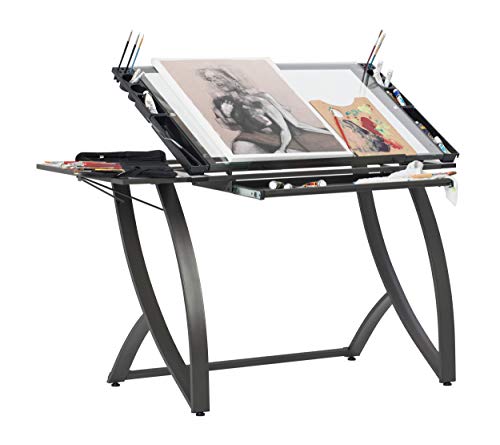
A craft desk is a work surface with built-in support for tools: drawers, shelves, a hutch or pegboard, and sometimes cable management. It differs from a standard desk by prioritizing durable surfaces and open storage, and from a craft table by being more compact and often fixed against a wall. If you stand to cut and move around the project, choose a table. If you sit for long sessions, choose a desk.
Quick Comparison
| Pick | Best for | Shape and size | Storage | Price range |
|---|---|---|---|---|
| Sauder Craft Pro Series Work Table | Serious crafters with a dedicated room | About 60 x 30 inch straight top | 6 drawers | Premium |
| Bush Furniture Key West L-shaped desk | Large layouts and a seated workspace | L-shaped corner | Open shelving and drawers on selected configurations | Mid-range |
| Bush Furniture Salinas L-shaped desk with hutch | Vertical storage for tools | L-shaped with hutch | Hutch shelves and drawers | Mid-range to upper mid |
| Sauder Sewing Craft Cart | Small rooms | Drop-leaf, rolling | Shelves and cabinet | Mid-range |
| Sew Ready adjustable height craft table | Sit-or-stand cutting | Foldable top with adjustable legs | Mesh drawers and shelf | Mid-range |
| Armocity folding desk | Apartments | Compact folding | Light shelves | Budget |
Specifications come from manufacturers’ pages and published buyer guides; confirm dimensions and included parts on the listing.
Best Overall: Sauder Craft Pro Series
The Craft Pro Series is the best known of the dedicated craft pieces, with a 60 by 30 inch surface, double-sided drawers and a stated weight capacity near 270 pounds. It suits Cricut users, scrapbookers and general crafters with the room to dedicate. It is heavy, and the melamine top benefits from a mat.
Best L-Shaped Option: Bush Furniture Key West
Bush’s L-shaped desks give you two surfaces: one for machine work and another for hand crafting or a computer. This layout suits makers who design on screen and cut on the same desk. They are large, so measure the corner carefully.
Best With a Hutch: Bush Furniture Salinas
The hutch adds shelves above the desk, which is useful for storing paint, paper and tools without taking desk space. It is a good choice if you have a tall wall but limited floor area. A hutch adds weight and assembly time.
Best for Small Rooms: Sauder Sewing Craft Cart
The cart’s drop leaf expands the top and folds down for storage. Lockable wheels let you roll it to another room. It is ideal when the craft area shares a living space.
Best Adjustable: Sew Ready Adjustable Height Craft Table
Switching between sitting and standing can reduce fatigue during long sessions. Sew Ready’s table adjusts and folds flat, which makes it flexible for quilters. Its surface is lighter-duty than a cabinet desk.
Best Budget Compact: Armocity Folding Desk
Armocity’s compact desk is meant for tight spaces and light crafting. It folds up easily. It is not designed for heavy machines or large cutting mats.
Ergonomics Worked Example
Seated work is comfortable when the desk surface is at about elbow height. For a person with a 10 to 11 inch elbow-to-seat distance and a seat height of 17 inches, a desk around 28 to 30 inches tall suits them. For standing cutting, a surface roughly 36 inches high suits most average-height crafters. If you do both, an adjustable desk or a stool can bridge the gap.
| Task | Ideal surface height | Why |
|---|---|---|
| Seated drawing or sewing | 28 to 30 inches | Elbows stay near 90 degrees |
| Standing cutting | 34 to 38 inches | Reduces back bending |
| Mixed use | Adjustable 30 to 39 inches | Switch between tasks |
How to Choose
Measure Your Largest Project
Choose a surface that holds your largest mat or layout with space around it.
Check Storage Type
Drawers keep dust out, open shelves keep tools visible, and pegboards use wall space. Pick the style that matches how you work.
Consider Power Access
Cricut and sewing machines need outlets. Desks with a power strip or cable holes help keep the area tidy.
Plan for Weight
Heavy machines and stacked supplies need sturdy construction. Particleboard desks are fine for most uses but can sag under concentrated loads.
Pick by Situation
| Your situation | Best choice | Reason |
|---|---|---|
| Designing on a computer and cutting | Bush L-shaped desk | Two work zones in one corner |
| Lots of small tools and paints | Bush Salinas with hutch | Vertical shelves free desk space |
| Sharing a room | Sauder Sewing Craft Cart | Rolls away and folds down |
| Long standing sessions | Sew Ready adjustable table | Raises to standing height |
| Studio apartment | Armocity folding desk | Folds flat when finished |
Layout Tips That Help Small Spaces
- Put the desk against a window for daylight, but keep fabric and paper out of direct sun.
- Use wall space for pegboards and rails so tools stay visible and the surface stays clear.
- Keep a stool or chair that can tuck under the desk so the room remains walkable.
- Route cords along the back edge with clips to avoid snagging them on materials.
- Reserve one drawer for items you use daily, such as scissors, tape and a ruler.
Ownership Realities
Craft desks wear in predictable places. Edges chip where they meet a chair, drawer fronts scuff, and laminate tops show knife marks without a mat. Tightening cam-lock fasteners after the first month keeps the frame from racking. Keep adhesives and paints on a protective sheet, since solvents can dull a laminate finish. If the desk has a hutch, anchor it to the wall for stability.
Frequently Asked Questions
What is the difference between a craft desk and a craft table?
A craft desk is typically smaller, seated and wall-oriented, while a craft table is larger, often freestanding and suited to standing work.
What size craft desk do I need for a Cricut?
A surface at least 36 inches wide handles a Cricut machine plus a mat. Larger projects need 48 to 60 inches.
Can I use a regular desk for crafting?
Yes, with a protective mat. Craft desks add storage and sturdier surfaces but are not required.
Are L-shaped desks good for crafting?
They are, because the second arm offers extra space for a machine or computer while keeping everything within reach.
How do I protect my desk surface?
Use a self-healing cutting mat and keep adhesives and paints on a separate protective sheet.