Our Top Picks
An ultrasonic jewelry cleaner does the one job a polishing cloth cannot: it scrubs the recessed settings, chain links and prong undersides where lotion, soap film and skin oil actually collect. It does this with sound, not brushes. A transducer vibrates the water tens of thousands of times per second, and the collapsing micro-bubbles that form in the liquid knock grime loose from surfaces a cloth never touches. The five machines below are all countertop ultrasonic cleaners for home use, compared on published specifications only: tank capacity, operating frequency, timer range, heating, and the accessories in the box. They split into two families. Four are personal-size tanks around 600 to 750 ml for rings, eyeglasses and retainers, and one is a heated 2.5-liter commercial unit for people who clean in batches.
As an Amazon Associate, we earn from qualifying purchases.
Quick Answer
For most homes, the Magnasonic MGUC500 is the right ultrasonic jewelry cleaner: a 600 ml stainless tank, 42 kHz cavitation and five timed cycles cover rings, glasses and retainers. The CD2800 is the simpler budget pick, LifeBasis adds degas at 45 kHz, KECOOLKE fits bigger loads, and the iSonic P4821-BSB is the heated commercial step-up.
How Cavitation Does the Scrubbing
Every pick here works by cavitation. The transducer drives the tank liquid at ultrasonic frequency, forming microscopic bubbles that grow and collapse against the surface of the item. Each collapse is a tiny, localized scrubbing action, repeated across every submerged surface at once. That is why ultrasonic cleaning reaches inside filigree, under stones and between watch-band links, and why it needs no abrasive contact.
Frequency shapes the result. Lower frequencies around 35 kHz, like the iSonic below, produce larger, more energetic bubbles that suit heavier soil and larger items. The 42 to 45 kHz range used by the home-size machines produces finer bubbles that distribute more evenly around small, detailed pieces, which is what jewelry work mostly is. Frequency is not a score to maximize; it is a match between bubble size and the load.
Cavitation also sets the safety limits. Hard, non-porous items such as gold, platinum, silver, diamonds and most hard gemstones tolerate it well. Soft or porous stones, including opal, pearl, emerald, turquoise, coral and amber, can crack or dull, and stones held by glue rather than prongs can loosen. The How to Choose section returns to this, because the right machine cannot fix the wrong load.
The Five Cleaners Compared
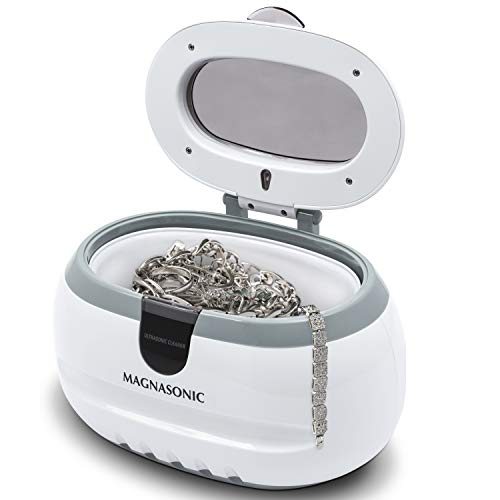
Magnasonic MGUC500: The Balanced Home Pick
The MGUC500 is the reference point for home ultrasonic cleaning: a 600 ml stainless steel tank, a digital timer and five preset cleaning cycles, so a lightly soiled ring and a grimy pair of eyeglasses do not get the same treatment by default. It sits in the mid-range tier and covers the widest spread of household loads without asking the owner to think about settings beyond picking a cycle length.
Specs:
- Tank capacity: 20 oz (600 ml), stainless steel
- Ultrasonic frequency: 42 kHz
- Timer: digital display with 5 preset cleaning cycles
- Controls: push-button with cycle selection
- Accessories: cleaning basket included
- Model: MGUC500
Magnasonic CD2800: The One-Button Budget Pick
The CD2800 strips the format down to its essentials. There is one button and one fixed cycle: three minutes at 42,000 Hz, then automatic shut-off. The tank is the same 600 ml size as the MGUC500, and the 35-watt draw is the lowest here. It is the budget tier pick for a household that cleans a few pieces occasionally and would never use a timer menu. The trade is flexibility: delicate loads and heavily soiled loads both get the same three minutes.
Specs:
- Tank capacity: 600 ml, stainless steel
- Ultrasonic frequency: 42,000 Hz
- Power: 35 watts
- Timer: single fixed 3-minute cycle with automatic shut-off
- Controls: one-button operation
- Model: CD2800
LifeBasis 600 ml: Degas and a Cooling Fan at 45 kHz
LifeBasis runs at 45 kHz, the finest bubble field in this group, and adds two features the other home tanks skip. A degas function clears dissolved gas from fresh tap water before the cycle, which makes cavitation more consistent from the first run. A built-in cooling fan supports repeated back-to-back cycles without a long rest between them. Five digital timer settings and a watch holder round out a mid-range package aimed at households that clean often.
Specs:
- Tank capacity: 600 ml (20 oz), stainless steel
- Ultrasonic frequency: 45 kHz
- Timer: digital, 5 settings
- Extra functions: degas mode, built-in cooling fan
- Accessories: watch holder included
- Finish: silver housing
KECOOLKE SU-750: The Largest Home Tank
The SU-750 stretches the home format to 750 ml, the biggest tank here outside the commercial iSonic. That extra volume is what lets it take sunglasses, larger bracelets and several pieces at once without crowding, and crowding matters because items resting against each other shield the contact points from the bubbles. It runs at 42 kHz with a digital timer and preset cycles, in the budget-to-mid-range tier.
Specs:
- Tank capacity: 750 ml
- Ultrasonic frequency: 42 kHz
- Timer: digital with preset cycles
- Dimensions: approximately 8.86 x 6.73 x 3.5 inches
- Weight: approximately 1.54 lb
- Model: SU-750
iSonic P4821-BSB: The Heated Commercial Step-Up
The P4821-BSB is a different class of machine. Its polished stainless tank holds 2.6 quarts (2.5 liters), the timer runs a full 1 to 30 minute range instead of fixed presets, and a built-in heater preset to 140 degrees Fahrenheit (60 degrees Celsius) runs independently of the cleaning cycle, which helps dissolve greasy soil that cold water leaves behind. It works at 35,000 Hz with 160 watts of total power, adds a degas function, and ships with a stainless steel wire mesh basket. This is the premium tier pick for batch cleaning, workshop parts and anyone whose loads outgrew a jewelry-size tank.
Specs:
- Tank capacity: 2.6 quarts (2.5 liters), polished stainless steel
- Ultrasonic frequency: 35,000 Hz
- Power: 160 watts
- Heater: built-in, preset to 140 degrees Fahrenheit (60 degrees Celsius)
- Timer: full-range 1 to 30 minutes, touch-sensing controls
- Accessories: stainless steel wire mesh basket, degas function
- Model: P4821-BSB
How to Choose
Start with tank size, because it cannot be upgraded later. A 600 ml tank handles rings, earrings, eyeglasses and retainers comfortably. Move to 750 ml if sunglasses, chunky bracelets or several pieces go in together, and to the 2.5-liter class only if cleaning is a batch chore rather than a weekly touch-up.
Match frequency to the load. For fine jewelry and detailed settings, 42 to 45 kHz spreads finer bubbles more evenly. For heavier soil on larger, sturdier items, the 35 kHz commercial pattern hits harder per bubble. Either cleans jewelry; the difference shows at the extremes.
Timer design decides daily convenience. A fixed three-minute cycle is foolproof but inflexible. Preset digital cycles cover most households. A full-range timer up to 30 minutes matters only for the heated commercial work where long, warm cycles do the heavy lifting.
Heat and degas are refinements, not requirements. Warm water loosens oily film faster, and degassing fresh water makes the first cycle of the day as effective as later ones. If loads are light and occasional, plain water in a simple tank is enough, and a drop of dish soap in the water handles most household film.
Check the load before the machine. Keep opals, pearls, emeralds, turquoise, coral, amber and glued-in stones out of any ultrasonic tank. Submerge watch heads only when their water resistance is rated for it; otherwise clean the strap alone on a watch holder.
Who Should Skip an Ultrasonic Cleaner
Skip the category entirely if the collection is mostly soft-stone or glued jewelry, since those pieces need a soft brush and mild soap instead. Skip it if the only item is a single ring worn daily; a cloth and warm soapy water solve that in less time than filling a tank. Owners of one pair of eyeglasses are in the same position. And if the real problem is tarnish on silver rather than grime in settings, ultrasonic cleaning is the wrong tool, because cavitation removes soil, not oxidation.
Frequently Asked Questions
Which items should never go in an ultrasonic jewelry cleaner?
Keep out soft and porous stones such as opal, pearl, emerald, turquoise, coral and amber, plus any stone set with glue instead of prongs or a bezel. Coated eyeglass lenses and watch heads without a suitable water-resistance rating should also stay out, since the vibration and immersion work against their seals and coatings.
Does an ultrasonic cleaner remove tarnish from silver?
No. Cavitation lifts dirt, oil and soap film from surfaces and recesses, but tarnish is a chemical layer bonded to the metal. A silver piece comes out clean yet still darkened, and it needs a polishing cloth or a dedicated tarnish treatment afterward to restore the shine.
How often should the water in the tank be changed?
Change it whenever it looks cloudy, and as a rule after every few loads in a session. Dirty water absorbs the cavitation energy that should be reaching the items, so a long session on one fill of water cleans progressively worse. Fresh water, degassed if the machine offers it, restores full effect.
Can an ultrasonic cleaner damage a watch?
It can if the watch head goes in without adequate water resistance, because vibration can work against aging gaskets. The safer pattern is to clean metal straps and bracelets on their own or on a watch holder that keeps the head above the waterline, and to leave vintage and dress watches to a cloth.
Final Verdict
Most households should buy the Magnasonic MGUC500: the 600 ml tank, five timed cycles and 42 kHz output cover the full range of routine jewelry, eyeglass and retainer cleaning with nothing to configure. Choose the CD2800 for the simplest budget route, the LifeBasis for frequent use with degas at 45 kHz, the KECOOLKE SU-750 when loads regularly crowd a smaller tank, and the iSonic P4821-BSB when heated, half-hour batch cleaning is the actual job.



FAQ
Which items should never go in an ultrasonic jewelry cleaner?
Does an ultrasonic cleaner remove tarnish from silver?
How often should the water in the tank be changed?
Can an ultrasonic cleaner damage a watch?
More from Amazon
Programs that pair well with the guide above. Offers and eligibility are set by Amazon and may change.
Free shipping on eligible items, Prime Video and more. Eligible new members can start with a free trial.
Start a Prime free trialAudiobooks and podcasts to listen to on the go. Eligible new members can start with a free trial.
Try Audible freeAd-free music streaming. Eligible new subscribers can start with a free trial.
Try Music Unlimited freeA free business account with business pricing and bulk-buying tools for work, shop or home office.
Create a business accountAs an Amazon Associate we earn from qualifying purchases.