Key takeaways
- Compare the best digital voice recorders for lectures, meetings and interviews, with storage, battery life, formats and microphones explained.
- Top Pick: Sony ICD-UX570
- Runner-up: OM System WS-883
- Also consider: Sony ICD-PX470
A phone can record a voice memo, but it is a fragile tool for a two-hour lecture or a meeting that matters. Calls and notifications interrupt recordings, the microphone sits wherever the phone happens to be, and the file ends up buried in an app. A dedicated digital voice recorder solves those problems with physical buttons, a microphone built for speech, swappable or rechargeable power and storage measured in hundreds of hours. The five recorders below cover the main buying patterns: a rechargeable stereo flagship, a marathon runner on AAA batteries, a simpler stereo model, a true starter recorder and a high-capacity budget pick.
As an Amazon Associate, we earn from qualifying purchases.
Quick Answer
For most people, the Sony ICD-UX570 is the digital voice recorder to buy: it records in stereo up to Linear PCM quality, recharges over its built-in USB connector and still fits in a shirt pocket. The OM System WS-883 runs far longer on AAA batteries, the VN-541PC is the simplest starter model, and the EVISTR L357 stores the most audio in this group.
Before the Picks: Why Format and Microphone Layout Decide Everything
Recording time figures on voice recorder packaging are best-case numbers calculated at the lowest bit rate a device offers. The same 4 GB of memory that holds well over a thousand hours of heavily compressed audio holds only a few hours of uncompressed Linear PCM. Bit rate is therefore the first spec to read properly: MP3 at speech-friendly settings is the practical default for lectures and meetings, while Linear PCM is worth its storage cost only when the recording will be edited, archived or used as evidence of exactly what was said.
Microphone layout is the second decision. A mono recorder like the VN-541PC or ICD-PX370 class of device is built for one voice at close range, which is exactly right for dictation and personal notes. Stereo microphones spread across the top of a recorder capture where voices sit around a table, so a meeting recording stays intelligible when two people talk from opposite sides. Scene modes and automatic level control matter for the same reason: they set microphone sensitivity for a quiet interview or a loud lecture hall without the user touching a gain dial.
The 5 Best Digital Voice Recorders
1. Sony ICD-UX570

The ICD-UX570 is the most complete recorder in this group. Its stereo S-Microphone records in Linear PCM for maximum fidelity or MP3 for long sessions, and the built-in battery recharges through the slide-out USB connector, so there is no cable to carry and no battery door to open before a lecture. A quick-charge function tops the battery up fast between classes, and the 4 GB of internal memory expands with a microSD card when a full day of recording is planned. It is the pick for students and professionals who record several times a week and want one device that handles all of it.
Specs
- Storage: 4 GB internal, microSD card slot
- Recording formats: Linear PCM (WAV) and MP3
- Microphone: built-in stereo S-Microphone
- Battery: built-in rechargeable, charges over USB
- Connection: built-in slide-out USB-A connector
- Weight: 1.76 ounces
- Model: ICDUX570BLK
2. OM System WS-883
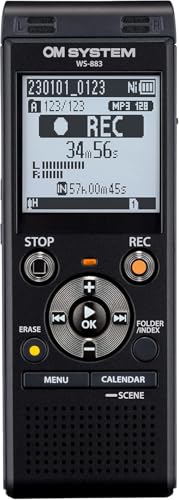
The WS-883 is built around endurance and transfer speed. It runs on two AAA batteries, charges rechargeable cells in the device over USB, and OM System rates it for up to 110 hours of recording on alkaline cells in its most frugal mode. The slide-out USB connector plugs straight into a computer like a thumb drive, and the true stereo microphones sit at a 90-degree angle to separate voices across a table. Intelligent Auto Mode adjusts recording level on its own, Noise Cancel cleans up playback, and a Simple Mode strips the display down to essentials for first-time users.
Specs
- Storage: 8 GB internal, microSD slot up to 32 GB
- Recording formats: Linear PCM and MP3
- Microphones: true stereo, 90-degree layout
- Battery: 2 AAA, up to 110 hours in LP mode (manufacturer figure)
- Connection: built-in slide-out USB-A connector
- Dimensions: 39 x 111.5 x 18 mm
- Weight: 77 g
- Model: V420340BU000
3. Sony ICD-PX470

The ICD-PX470 covers the core Sony recipe at a lower tier: a stereo S-Microphone, Linear PCM and MP3 recording, 4 GB of memory with a microSD slot, and a slide-out USB connector for cable-free transfers. It runs on two AAA batteries rated for up to 55 hours, which suits users who prefer swapping cells to recharging. Auto Voice Recording reduces background noise automatically, and the adjustable microphone settings handle both a single speaker and a wider room. On its internal memory it stores up to 59 hours and 35 minutes at MP3 128 kbps, enough for weeks of lectures between offloads.
Specs
- Storage: 4 GB internal, microSD slot up to 32 GB
- Recording formats: Linear PCM and MP3
- Microphone: built-in stereo S-Microphone
- Battery: 2 AAA, up to 55 hours (manufacturer figure)
- Connection: built-in slide-out USB-A connector
- Weight: 74 g
- Model: ICD-PX470
4. OM System VN-541PC

The VN-541PC strips the voice recorder down to its simplest form. One-touch recording starts capture with a single press, four scene settings configure the microphone for common situations, and a noise cancellation function keeps playback clear. It records in WMA format to 4 GB of internal memory, which is a real limitation to note: WMA files are less universal than MP3, so buyers who move audio between many apps should weigh that. For dictated notes, reminders and short interviews, though, the 67-gram body and uncluttered controls make it the easiest recorder here to hand to a first-time user.
Specs
- Storage: 4 GB internal
- Recording format: WMA
- Microphone: built-in mono, noise cancellation function
- Recording scenes: four preset scenes
- Battery: 2 AAA
- Connection: micro-USB, cable included
- Weight: 67 g
- Model: V420040BU000
5. EVISTR L357

The L357 is the capacity play. Its 64 GB of internal memory holds thousands of hours of MP3 audio, and it records in WAV or MP3 at up to 1536 kbps through a dynamic noise-reduction microphone with PCM noise reduction. The 500 mAh rechargeable battery is rated for up to 32 hours of continuous recording and refills over USB-C, and voice-activated recording offers seven sensitivity levels so long pauses do not consume storage. Password protection and A-B repeat playback round out a feature list aimed at students who record every lecture in a semester and offload rarely.
Specs
- Storage: 64 GB internal
- Recording formats: WAV and MP3, up to 1536 kbps
- Microphone: dynamic noise-reduction microphone
- Battery: 500 mAh rechargeable, up to 32 hours of recording
- Connection: USB-C
- Voice activation: seven adjustable sensitivity levels
- Dimensions: 3.86 x 1.2 x 0.47 inches
How to Choose
Start with battery style, because it shapes daily use more than any other spec. A built-in rechargeable battery, as on the ICD-UX570 and the L357, means one less consumable to buy but a device that is out of service while it charges. AAA-powered recorders like the WS-883, ICD-PX470 and VN-541PC run for days or weeks and return to service instantly with fresh cells, at the cost of carrying spares.
Next, match format to purpose. Choose MP3 recording for lectures, meetings and interviews that will be played back, shared or transcribed, and reserve Linear PCM for recordings that must preserve every detail. Then check storage against your offload habit: 4 GB is plenty if files move to a computer weekly, while the 64 GB L357 suits a semester of unattended accumulation. A microSD slot, offered by the Sony models and the WS-883, is cheap insurance either way.
Finally, look at transfer and controls. A slide-out USB connector removes the cable from the equation entirely. Voice activation, scene presets and automatic level control reduce the chance of a ruined recording, and a standard 3.5 mm microphone input, where fitted, lets an external microphone handle large rooms that defeat any built-in microphone.
Who Should Skip a Dedicated Voice Recorder
Skip this category if voice memos are an occasional, five-minute task; a phone already does that job well enough, and a separate device will sit in a drawer. Podcasters, musicians and field recordists should also look elsewhere, because handheld field recorders with larger capsules, XLR inputs and multi-track recording are a different product class built for produced audio rather than speech capture. And anyone whose real goal is searchable text should shop for transcription software or an AI note-taking service instead, since a classic voice recorder like the five above produces audio files, not transcripts.
Frequently Asked Questions
How many hours of audio can a digital voice recorder hold?
It depends almost entirely on the recording format and bit rate, not just the memory size. At speech-friendly MP3 settings, 4 GB holds roughly 59 hours, while the lowest-quality modes stretch the same memory past a thousand hours at noticeably reduced clarity. The 64 GB EVISTR L357 multiplies those figures many times over, which is why its capacity suits a full semester of lectures.
Is a stereo or mono recorder better for lectures?
Stereo is the safer choice for lectures and meetings, because two microphones preserve a sense of where each voice sits and keep overlapping speakers easier to follow. Mono recorders such as the VN-541PC are designed for one voice at close range, which makes them excellent for dictation and personal notes but less forgiving when the speaker is across a room.
Do these voice recorders turn speech into text automatically?
No. The five recorders in this guide capture audio files in formats such as MP3, WAV and WMA, and transcription happens later in separate software or services. What the recorders do provide is clean, well-organised source audio with folders, bookmarks and index marks on some models, which makes any later transcription faster and more accurate.
Can a small voice recorder capture a whole meeting room?
Within reason, yes. Stereo models with scene modes and automatic level control, such as the WS-883 and ICD-UX570, are designed to pick up voices across a conference table when placed in the centre of it. Very large or noisy rooms still benefit from an external microphone plugged into the recorder’s microphone input, which several models here support.
Final Verdict
Buy the Sony ICD-UX570 if recording is a weekly habit and one polished, rechargeable stereo recorder has to cover lectures, meetings and interviews. Choose the OM System WS-883 when battery endurance and instant USB transfers matter most, the ICD-PX470 for the same Sony formula on swappable AAA power, the VN-541PC for the simplest possible controls, and the EVISTR L357 when storage capacity per charge is the deciding factor.
FAQ
How many hours of audio can a digital voice recorder hold?
Is a stereo or mono recorder better for lectures?
Do these voice recorders turn speech into text automatically?
Can a small voice recorder capture a whole meeting room?
More from Amazon
Programs that pair well with the guide above. Offers and eligibility are set by Amazon and may change.
Free shipping on eligible items, Prime Video and more. Eligible new members can start with a free trial.
Start a Prime free trialAudiobooks and podcasts to listen to on the go. Eligible new members can start with a free trial.
Try Audible freeAd-free music streaming. Eligible new subscribers can start with a free trial.
Try Music Unlimited freeA free business account with business pricing and bulk-buying tools for work, shop or home office.
Create a business accountAs an Amazon Associate we earn from qualifying purchases.