Our Short List of 3

- Best for: Front doors on factory or mild amplifier power where tweeter aim matters.
- Brand: JBL
- Model: GTO629
- Format: premium 6.5-inch co-axial speaker, set of 2
- Power handling from listing data: 60 watts RMS, 180 watts peak per speaker

- Best for: A standard 4-ohm door replacement that must fit behind factory grilles.
- Brand: KICKER
- Model number: 46CSC654
- Format: 6.5-inch (160mm) coaxial speakers, pair
- Impedance: 4-ohm, per the product name

- Best for: A single location that needs 3-way coverage with grilles included in the box.
- Brand: Rockford Fosgate
- Model number: R165X3
- Format: 6.5-inch 3-way full range coaxial speakers, pair
- Included components: pair of speakers with grilles and mounting hardware
All 4 Picks at a Glance
| Product | Specs | Action |
|---|---|---|
| JBL GTO629 |
| Check price on Amazon |
| KICKER 46CSC654 CS-Series |
| Check price on Amazon |
| Rockford Fosgate R165X3 Prime |
| Check price on Amazon |
 Pioneer TS-A6960F |
| Check price on Amazon |
Key takeaways
- Compare the best speakers for a car audio system by size, impedance, power handling and tweeter design, with verified Amazon listings for each pair.
Replacing car speakers fails most often on fit, not on sound: a pair that is the wrong size, too deep for the door, or mismatched to the power your head unit actually delivers will disappoint no matter how good its specification sheet looks. The real decision is which format already lives in your doors and rear deck, and whether the new pair is built to run happily on factory power or expects an amplifier behind it.
This guide is for drivers replacing worn factory speakers, owners building a first amplified system, and anyone filling both front and rear locations in one order. Each product below was selected from the name and specifications on its Amazon listing, and each section flags the fit or impedance detail that needs confirming against your vehicle before you buy.
Quick Picks
As an Amazon Associate we earn from qualifying purchases.
| Product | Best for | Key spec from title |
|---|---|---|
| JBL GTO629 | Factory-power clarity in 6.5-inch doors | Premium 6.5-inch co-axial speaker, set of 2 |
| KICKER 46CSC654 CS-Series | A straightforward 4-ohm factory swap | 6.5-inch (160mm) coaxial speakers, 4-ohm, pair |
| Rockford Fosgate R165X3 Prime | Three-way sound from one door location | 6.5-inch 3-way full range coaxial speakers, pair |
| Pioneer TS-A6960F | Rear deck 6×9 locations needing output | 6×9-inch 4-way coaxial design |
How to Choose
Start With the Size Already in Your Car
Car speaker shopping begins with a tape measure and your vehicle’s existing locations, not with a brand. Most doors take a 6.5-inch round speaker, many rear decks take a 6×9-inch oval, and mixing the two in one system is normal. A 6×9 has more cone area and usually gives fuller low notes from the back, while the front 6.5-inch pair does most of the work you actually hear. Check mounting depth as well as diameter, because a deeper magnet can foul the window mechanism inside a door. Every listing here states its size in the product name, so match that number to your location first and only then compare the rest.
Coaxial Simplicity Versus Component Separation
A coaxial speaker mounts the tweeter in front of the woofer, so one unit drops into the factory hole and plays the full range. That is why every pick in this guide is coaxial: for a system built around a head unit and door locations, it is the format that installs without cutting new tweeter mounts. Component sets separate the tweeter for better placement high in the door or on the dash, but they add crossovers and fitting time. If your plan is a same-day swap using existing wiring, coaxial is the honest choice. If you are already fitting an amplifier and sound deadening, that is the point where components enter the conversation.
Match Impedance and Power to Your Source
Two numbers decide whether a speaker suits your system: impedance and power handling. Most factory and aftermarket head units expect a 4-ohm load, and the Kicker pair here is a 4-ohm design, which makes it the safe default for a standard swap. The JBL pair is a 3-ohm design, a detail stated in its listing information, intended to draw a little more from factory amplification, but it deserves a check against your head unit’s specification. For power, compare the continuous or RMS figure rather than the peak headline, and keep it in a range your source can supply without straining, whether that source is the radio alone or a separate amplifier.
Tweeters Decide How the Top End Feels
The tweeter material and design shape cymbals, voices and the sense of detail more than any other single part. A silk dome, as used in the Rockford Fosgate pair, tends toward a smoother presentation, while harder dome materials can sound brighter and more forward at the same volume. Aimable designs, such as the pivoting tweeter described for the JBL pair, help when the speaker sits low in a door and fires at your ankles rather than your ears. Think about where the speaker will sit and what you listen to most, then let the tweeter design follow from that rather than chasing the longest specification list.
The 4 Best Options
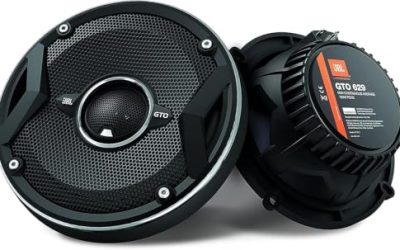
JBL GTO629
- Best for: Front doors on factory or mild amplifier power where tweeter aim matters.
- Brand: JBL
- Model: GTO629
- Format: premium 6.5-inch co-axial speaker, set of 2
- Power handling from listing data: 60 watts RMS, 180 watts peak per speaker
Front doors on factory or mild amplifier power where tweeter aim matters.
Confirm your head unit is comfortable with a 3-ohm load and check door depth before ordering.
The GTO629 is a 6.5-inch coaxial pair for drivers who want a clear step up in clarity while staying on head unit or factory amplifier power. Its listing describes a set of two premium co-axial speakers, and the model’s published figures give it a higher continuous power rating than basic factory replacements, which suits a system that may gain a small amplifier later. The aimable tweeter design is the practical highlight for door mounting, because it lets the high frequencies be angled toward the seats instead of the footwells. Check the 3-ohm impedance against your head unit before treating it as a universal swap.
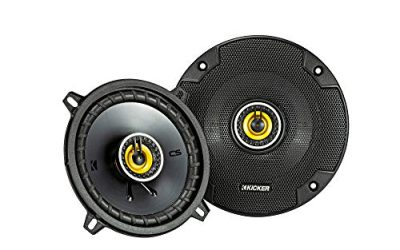
KICKER 46CSC654 CS-Series
- Best for: A standard 4-ohm door replacement that must fit behind factory grilles.
- Brand: KICKER
- Model number: 46CSC654
- Format: 6.5-inch (160mm) coaxial speakers, pair
- Impedance: 4-ohm, per the product name
A standard 4-ohm door replacement that must fit behind factory grilles.
Power figures are quoted differently across bundle listings, so verify the rating on this exact product page.
This Kicker pair is the plain, low-risk factory replacement in the group: a 6.5-inch coaxial pair in a standard 4-ohm impedance, sized at 160mm and sold for in-car audio systems, as its product name states. The CS-Series design uses a polypropylene cone and a zero-protrusion tweeter according to related listing descriptions, which helps the speaker sit behind factory grilles without clearance trouble. Its published power figures give it comfortable headroom for an amplified system as well as a standard radio. For a driver who wants one pair that fits the commonest door size and the commonest impedance, this is the simplest decision in the guide.
Rockford Fosgate R165X3 Prime
- Best for: A single location that needs 3-way coverage with grilles included in the box.
- Brand: Rockford Fosgate
- Model number: R165X3
- Format: 6.5-inch 3-way full range coaxial speakers, pair
- Included components: pair of speakers with grilles and mounting hardware
A single location that needs 3-way coverage with grilles included in the box.
Its continuous power rating is the lowest here, so it is not the pair to pair with a strong amplifier.
The R165X3 takes a different route to full-range sound by using a 3-way design in a single 6.5-inch unit, adding a midrange element alongside the woofer and tweeter. The pair ships with grilles and mounting hardware included, per its listing, which suits a visible rear deck or door installation where the factory grille will not be reused. Its published ratings are modest, which is honest positioning for a speaker meant to run on ordinary head unit power and still sound complete. Choose it when one location has to cover the whole range and a tidy, grille-included install matters to you.
Pioneer TS-A6960F
- Best for: Rear 6×9 locations that need to add weight and output behind front door pairs.
- Brand: Pioneer
- Model: TS-A6960F
- Format: 6×9-inch 4-way coaxial speaker
- Frequency range from listing information: 35Hz to 24kHz
Rear 6×9 locations that need to add weight and output behind front door pairs.
Confirm the rear opening is truly 6×9 and check the continuous rating on the listing, not only the maximum figure.
The TS-A6960F fills the other common factory location: the 6×9-inch rear deck or rear door opening. Its 4-way coaxial layout and larger oval cone give the back of the car more output and low-end presence than a small round speaker can manage, which balances a system whose front doors carry 6.5-inch pairs. Listing information for this model cites a wide frequency range and high maximum power handling, positioning it for systems with amplifier support. Measure the rear opening before assuming it is a 6×9 car, because some decks use smaller oval sizes that look similar at a glance.
Which One Fits Your Situation
You Are Swapping Front Doors on Factory Power
Choose the KICKER 46CSC654 for the lowest-risk fit, or the JBL GTO629 if your head unit accepts its impedance and you want the aimable tweeter. Both are 6.5-inch coaxial pairs made for the standard door job. The Kicker’s 4-ohm rating matches most radios without a second thought, while the JBL rewards a quick specification check with a design aimed at low door positions.
Your Rear Deck Uses 6×9 Openings
Choose the Pioneer TS-A6960F. Rear passengers and overall cabin fullness benefit most from the larger cone area, and pairing it with either 6.5-inch front pair in this guide gives a balanced front-and-rear system. Verify the opening size and depth first, because a 6×9 bought for a smaller oval location helps nobody and turns a simple job into a cutting job.
One Location Has to Do Everything
Choose the Rockford Fosgate R165X3. In a two-speaker car, or a vehicle where only the doors will be touched, its 3-way layout covers more of the range from one hole, and the included grilles finish the job neatly. Its modest power rating matches the head-unit-only systems such cars usually run, so the pairing is coherent rather than a compromise you will feel later.
An Amplifier Is Already Part of the Plan
Choose between the Kicker pair and the Pioneer 6×9 pair according to location, since both carry the higher power figures in this group. Give the doors the Kicker pair and the deck the Pioneer pair for a full amplified layout, and confirm each listing’s continuous rating against your amplifier’s output per channel before ordering, rather than matching on peak numbers that describe brief moments only.
Common Mistakes
- Ordering by diameter alone and ignoring mounting depth, then finding the magnet fouls the window.
- Matching an amplifier to peak power figures instead of the continuous rating.
- Fitting a low-impedance pair without checking what the head unit is specified to drive.
- Replacing only the rear speakers, when the front pair does most of what the driver hears.
- Throwing away the included grilles and hardware before confirming the factory parts will be reused.
Frequently Asked Questions
Should I replace the front or rear speakers first?
Replace the front pair first. The driver and front passenger hear the front doors most directly, and in most cars the front locations carry the main vocal and instrument detail. The Kicker and JBL pairs in this guide are sized for that job. Add a rear pair such as the Pioneer 6×9 afterwards if the cabin still feels thin from the back seats or you want more overall fullness at higher volume.
Do I need an amplifier with these speakers?
Not necessarily. Every pair here can run from a head unit, and the Rockford Fosgate pair is rated modestly enough that factory power suits it well. An amplifier helps the higher-rated pairs, such as the Kicker and Pioneer models, play cleaner at high volume, but it is an upgrade path rather than a requirement. Start with the speakers on your current source, then decide whether the remaining limitation is volume or clarity.
What does impedance mean for a simple speaker swap?
Impedance is the electrical load the speaker presents, measured in ohms, and the source expects a certain range. A standard 4-ohm pair like the Kicker set matches most car radios directly. A 3-ohm pair like the JBL set draws a little more current, which some factory systems handle and some do not. The safe routine is to read the impedance in the listing and compare it with your head unit or amplifier specification before buying.
How do I know which size my car takes?
Check the vehicle’s existing speakers or its factory specification for each location, and measure the opening and depth if a panel is already off. Front doors are commonly 6.5-inch and rear decks commonly 6×9-inch, but there are many exceptions, including smaller oval sizes. The product names in this guide state each pair’s size plainly, so once your locations are measured, matching them is a quick comparison rather than guesswork.
FAQ
Should I replace the front or rear speakers first?
Do I need an amplifier with these speakers?
What does impedance mean for a simple speaker swap?
How do I know which size my car takes?
More from Amazon
Programs that pair well with the guide above. Offers and eligibility are set by Amazon and may change.
Free shipping on eligible items, Prime Video and more. Eligible new members can start with a free trial.
Start a Prime free trialAudiobooks and podcasts to listen to on the go. Eligible new members can start with a free trial.
Try Audible freeAd-free music streaming. Eligible new subscribers can start with a free trial.
Try Music Unlimited freeA free business account with business pricing and bulk-buying tools for work, shop or home office.
Create a business accountAs an Amazon Associate we earn from qualifying purchases.