Our Short List of 3
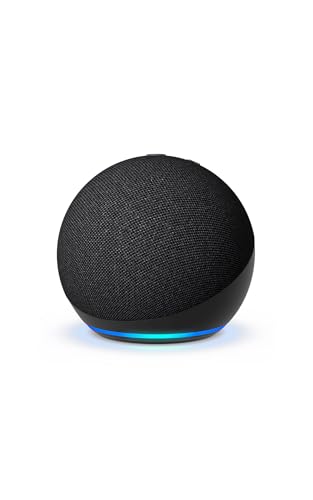
- Best for: A bedroom or small room that needs a capable Alexa speaker on a shelf or nightstand.
- 1.73-inch (44 mm) front-firing speaker with Lossless High Definition audio
- 3.9 x 3.9 x 3.5 inches, 10.7 oz
- Dual-band Wi-Fi 802.11a/b/g/n/ac on 2.4 and 5 GHz networks
- Wi-Fi, Bluetooth Low Energy Mesh, and Matter smart home compatibility

- Best for: A first smart speaker for a small room, a dorm, or a second room that needs Alexa on a tight shelf.
- 1.95-inch (49.5 mm) front-firing speaker with Lossless High Definition audio
- 3.9 x 3.3 x 3.6 inches, 6.9 oz
- Dual-band Wi-Fi 802.11a/b/g/n/ac on 2.4 and 5 GHz networks
- Bluetooth audio streaming with A2DP and AVRCP profiles

- Best for: A Google or Android household that wants the newest Gemini assistant and a Thread hub in one speaker.
- 58 mm full-range driver with omnidirectional 360-degree sound
- Gemini for Home voice assistant with Voice Match
- Wi-Fi 6 802.11ax on 2.4 and 5 GHz networks, Bluetooth 5.4
- Thread 1.3 border router and Matter smart home hub
All 4 Picks at a Glance
| Product | Specs | Action |
|---|---|---|
| Amazon Echo Dot (5th Gen) |
| Check price on Amazon |
| Amazon Echo Pop |
| Check price on Amazon |
| Google Home Speaker (2026) |
| Check price on Amazon |
 Sonos Era 100 |
| Check price on Amazon |
Key takeaways
- Compare the best smart speakers for Alexa, Google Gemini and Siri homes, with sound quality, voice control and smart home features explained.
A smart speaker is the part of the house you talk to, so the real decision is not which one sounds best in isolation. It is which voice assistant already runs your home, and how much sound you need from the room where the speaker will live. Pick the wrong assistant and you end up re-learning commands or running two systems side by side. Pick a speaker that is too small for an open living room and music sounds thin at normal volume.
This guide is for households choosing a first smart speaker, for people adding a speaker to a room that already has smart lights or a thermostat, and for listeners who want music plus voice control from one box. Each speaker below was picked from the name and specifications on its Amazon product page, looking at the assistant, sound hardware, connectivity, and how it fits into a multi-room setup.
Quick Picks
As an Amazon Associate we earn from qualifying purchases.
| Product | Best for | Key spec from title |
|---|---|---|
| Amazon Echo Dot (5th Gen) | A bedroom or office that needs Alexa on a small shelf | 1.73-inch front-firing speaker with motion detection |
| Amazon Echo Pop | The smallest, simplest first step into Alexa | 1.95-inch front-firing speaker in a half-dome body |
| Google Home Speaker (2026) | A Google household that wants the newest Gemini assistant | 58 mm driver with 360-degree sound and Thread |
| Apple HomePod mini | An iPhone household that wants Siri and multi-room audio | 360-degree audio with an Apple S5 chip |
| Sonos Era 100 | A living room where music quality comes first | Alexa built in with stereo pairing and multi-room audio |
How to Choose
Match the Assistant to the Home You Already Have
The assistant matters more than the speaker hardware, because it decides which services answer when you speak. Alexa fits households that already use Amazon devices, routines, and compatible smart home gear. Gemini for Home fits Android phones and Google services, with conversational commands that handle multi-step requests. Siri fits iPhone households and Apple Home, where the speaker doubles as a home hub and intercom. Mixing assistants across rooms works, but routines and voice commands do not carry over, so one household usually settles on a single assistant for daily use.
Size the Sound to the Room
A compact speaker fills a bedroom or a kitchen corner, but it strains in an open-plan living room where the listening position sits several metres from the shelf. Larger drivers and wider dispersion move more air and keep vocals clear at conversation volume, while a small driver has to work harder and loses bass first. Check the driver size and whether the speaker radiates sound in all directions or fires forward from one face. If the room is large, plan for a bigger speaker or a stereo pair rather than turning a small one up until it distorts.
Check the Smart-Home Radio Inside
Every smart speaker uses Wi-Fi, but the extra radios decide whether it can control devices directly. Matter support lets a speaker talk to lights, plugs, and locks from many brands without a separate hub. Thread acts as a low-power mesh for sensors and bulbs, and a built-in Zigbee hub covers older smart home gear. Bluetooth handles phone audio and nearby accessories. Before buying, list the devices already in the house and confirm the speaker speaks their protocol, because a missing radio means buying another hub later.
Look at the Microphones and Privacy Controls
A smart speaker only helps when it hears the wake word from across a noisy room, so far-field microphones and their placement matter. Three or four microphones arranged around the body pick up commands better than a single mic, especially while music plays. Equally important is how the speaker stops listening: a physical mute button or switch that cuts the microphones, plus a visible light that shows the muted state. If the household includes children or a home office, a clear hardware mute is worth more than an extra microphone.
The 5 Best Options
Amazon Echo Dot (5th Gen)
- Best for: A bedroom or small room that needs a capable Alexa speaker on a shelf or nightstand.
- 1.73-inch (44 mm) front-firing speaker with Lossless High Definition audio
- 3.9 x 3.9 x 3.5 inches, 10.7 oz
- Dual-band Wi-Fi 802.11a/b/g/n/ac on 2.4 and 5 GHz networks
- Wi-Fi, Bluetooth Low Energy Mesh, and Matter smart home compatibility
A bedroom or small room that needs a capable Alexa speaker on a shelf or nightstand.
It has no battery, so it must stay plugged into a power outlet, and it works best as part of an Alexa household rather than alongside a different assistant.
The Echo Dot (5th Gen) is the default Alexa speaker for a bedroom, office, or kitchen shelf, because it packs the full Alexa experience into a sphere that fits almost anywhere. Its front-firing driver delivers clearer vocals and deeper bass than earlier Dots, and built-in motion and temperature sensors let it trigger routines when someone enters a room or the temperature shifts. Dual-band Wi-Fi, Bluetooth Low Energy Mesh, and Matter support connect it to a wide range of smart home devices without an extra hub.
Watch out for: It has no battery, so it must stay plugged into a power outlet, and it works best as part of an Alexa household rather than alongside a different assistant.
Amazon Echo Pop
- Best for: A first smart speaker for a small room, a dorm, or a second room that needs Alexa on a tight shelf.
- 1.95-inch (49.5 mm) front-firing speaker with Lossless High Definition audio
- 3.9 x 3.3 x 3.6 inches, 6.9 oz
- Dual-band Wi-Fi 802.11a/b/g/n/ac on 2.4 and 5 GHz networks
- Bluetooth audio streaming with A2DP and AVRCP profiles
A first smart speaker for a small room, a dorm, or a second room that needs Alexa on a tight shelf.
It has no Action button, so there is no physical way to wake Alexa silently, and its small driver cannot fill a large open room.
The Echo Pop is the smallest Alexa speaker Amazon makes, a half-dome that slips onto a crowded shelf, a bathroom counter, or a bedside table where a full-size speaker would not fit. It still carries the full Alexa voice assistant, so it plays music, sets timers, reads the news, and controls compatible smart home devices by voice. Its front-firing speaker sounds fuller than its size suggests, and dual-band Wi-Fi plus Matter support keep it connected to the same smart home gear as larger Echo models.
Watch out for: It has no Action button, so there is no physical way to wake Alexa silently, and its small driver cannot fill a large open room.
Google Home Speaker (2026)
- Best for: A Google or Android household that wants the newest Gemini assistant and a Thread hub in one speaker.
- 58 mm full-range driver with omnidirectional 360-degree sound
- Gemini for Home voice assistant with Voice Match
- Wi-Fi 6 802.11ax on 2.4 and 5 GHz networks, Bluetooth 5.4
- Thread 1.3 border router and Matter smart home hub
A Google or Android household that wants the newest Gemini assistant and a Thread hub in one speaker.
The most advanced Gemini Live conversations need a Google Home Premium subscription after the included trial, and the single driver cannot match larger speakers for bass depth.
The Google Home Speaker is Google’s first new smart speaker in six years, built around Gemini for Home for conversational, multi-step voice commands. Its single 58 mm driver radiates sound in all directions, and Wi-Fi 6, Bluetooth 5.4, a Thread border router, and Matter support make it a capable hub for a Google smart home. Three far-field microphones listen from across the room, and a two-stage hardware mute switch cuts them off completely when privacy matters.
Watch out for: The most advanced Gemini Live conversations need a Google Home Premium subscription after the included trial, and the single driver cannot match larger speakers for bass depth.
Apple HomePod mini
The HomePod mini is the speaker for an iPhone household, because Siri, Apple Home, and multi-room audio work together without extra setup. Its compact sphere produces 360-degree sound that stays clear at normal listening volume, and two minis pair for true stereo in a larger room. A built-in Thread border router and Ultra Wideband chip help it control HomeKit devices and hand music off from a nearby iPhone, while the top touch surface handles playback when speaking feels unnecessary.
Specs
- Full-range driver with dual passive radiators for 360-degree audio
- Apple S5 chip with Siri built in
- Wi-Fi 802.11n, Bluetooth 5.0, and Thread border router
- Ultra Wideband U1 chip for handoff from a nearby iPhone
- Stereo pairing with a second HomePod mini and multi-room audio
- 3.3 inches high x 3.9 inches diameter, 0.76 lb, with USB-C cable and 20 W power adapter
Best for: An Apple household that wants Siri, HomeKit control, and multi-room audio from a compact speaker.
Watch out for: It works best inside the Apple ecosystem, and Android users lose the seamless setup and handoff features that make it convenient.
Sonos Era 100
- Best for: A living room or music-first household that wants strong sound, Alexa, and a path to multi-room audio.
- Two angled tweeters with a mid-woofer for wide stereo sound
- Alexa built in, plus Sonos Voice Control
- Wi-Fi and Bluetooth connectivity
- Stereo pairing with a second Sonos Era 100
A living room or music-first household that wants strong sound, Alexa, and a path to multi-room audio.
It has no battery and no built-in smart-home hub radio, so it controls smart home devices through Alexa skills and the cloud rather than directly.
The Sonos Era 100 is the pick when music quality matters more than having the cheapest speaker in the room. Its compact cylindrical body houses angled tweeters that spread sound widely, and Alexa built in means voice control works without adding another device. It connects over Wi-Fi and Bluetooth, pairs with a second Era 100 for stereo, and joins a wider Sonos multi-room system, so one speaker can grow into whole-home audio over time.
Watch out for: It has no battery and no built-in smart-home hub radio, so it controls smart home devices through Alexa skills and the cloud rather than directly.
Which One Fits Your Situation
A First Smart Speaker for a Small Flat
Start with the Echo Pop or the Echo Dot (5th Gen), depending on shelf space. The Pop fits the tightest corners and covers the basics, while the Dot adds motion and temperature sensors that trigger routines automatically. Both run Alexa, connect over Matter, and cost less than larger speakers, so either one teaches the household how voice control fits daily life before a bigger purchase.
A House Already Full of Apple Devices
Choose the HomePod mini, because Siri, HomeKit, and multi-room audio work together from the first setup. Two minis in a living room pair for stereo, and the speaker doubles as a Thread border router for HomeKit accessories. The iPhone handoff alone saves the small daily friction of moving music between phone and speaker.
A Google Household That Wants the Newest Assistant
Choose the Google Home Speaker (2026), because it is built for Gemini for Home and carries the newest radios in this guide. Its Thread border router and Matter support cover current smart home gear, and conversational commands handle multi-step requests that older assistants split into separate phrases. Keep the Nest Audio only if the household already owns several and wants matching units.
A Living Room Where Music Comes First
Choose the Sonos Era 100, because its angled tweeters and wider soundstage suit music better than the compact assistant-first speakers here. It still answers to Alexa, so voice control and timers work, but its strength is sound that fills a room without strain. Add a second Era 100 later for stereo, or let it anchor a multi-room Sonos setup.
Common Mistakes
- Buying a speaker for the wrong assistant, then discovering routines and smart home devices do not carry over to the other system.
- Placing a compact speaker in a large open-plan room and expecting it to fill the space at normal volume.
- Forgetting that none of these speakers has a battery, so each one needs a power outlet where it will live.
- Assuming every smart speaker works as a hub, when some models control devices only through the cloud and lack Thread or Zigbee radios.
- Skipping the microphone mute check, then realising the household has no quick physical way to stop the speaker listening.
Frequently Asked Questions
Do smart speakers need Wi-Fi to work?
Yes, Wi-Fi carries music streaming, voice processing, and smart home commands, so a smart speaker without a network connection loses almost all of its useful functions. Bluetooth alone only plays audio from a nearby phone and cannot reach the assistant or cloud services. Keep the speaker on the same network as the phone app used for setup, and place it within reliable Wi-Fi range.
Can Alexa, Google, and Siri speakers work in the same house?
They can sit in the same house, but they do not share routines, groups, or voice history. Each speaker answers to its own assistant and controls the devices linked to that account, so a household with mixed speakers manages two or three separate setups. Most households pick one assistant for daily use and keep the others in rooms where their specific strengths matter.
Can I pair two smart speakers for stereo sound?
Most models in this guide support stereo pairing with a second unit of the same model, including the Echo Dot, Echo Pop, HomePod mini, Google Home Speaker, and Sonos Era 100. Pairing works through each brand’s own app, and the two speakers must be the same model and on the same network. Mixed brands cannot pair together, so buy the second unit to match the first.
Do smart speakers listen to everything in the room?
Smart speakers listen locally for their wake word and send audio to the cloud only after hearing it, but the only certain way to stop listening is the hardware mute. Every speaker in this guide has a physical microphone off button or switch, and a visible light shows when the microphones are muted. Use the mute switch during private conversations, and check the app for stored voice history controls.
FAQ
Do smart speakers need Wi-Fi to work?
Can Alexa, Google, and Siri speakers work in the same house?
Can I pair two smart speakers for stereo sound?
Do smart speakers listen to everything in the room?
More from Amazon
Programs that pair well with the guide above. Offers and eligibility are set by Amazon and may change.
Free shipping on eligible items, Prime Video and more. Eligible new members can start with a free trial.
Start a Prime free trialAudiobooks and podcasts to listen to on the go. Eligible new members can start with a free trial.
Try Audible freeAd-free music streaming. Eligible new subscribers can start with a free trial.
Try Music Unlimited freeA free business account with business pricing and bulk-buying tools for work, shop or home office.
Create a business accountAs an Amazon Associate we earn from qualifying purchases.