
Best office chair for tall people is a search that usually ends in frustration, because most task chairs are engineered around a body between 5’4″ and 5’10”. This guide works from three numbers instead of adjectives: maximum seat height, backrest height, and rated weight capacity.
As an Amazon Associate we earn from qualifying purchases.
By Daniel Foster
What a Taller Frame Actually Needs From a Task Chair
Anyone hunting for the best office chair for tall people runs into the same wall: height changes the geometry of sitting. Longer femurs need a deeper seat, longer torsos need a taller backrest, and a heavier frame loads the gas cylinder and base harder than the average user. Before looking at any brand, it helps to know which figures on a spec sheet decide whether a chair fits at all.
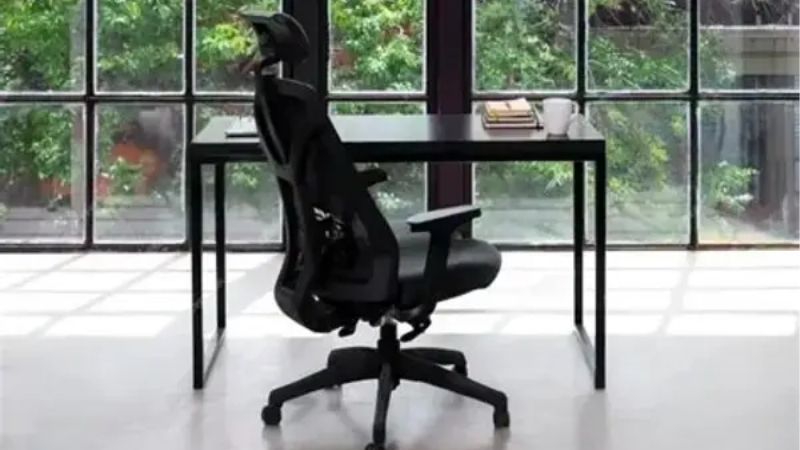
The Decisive Numbers: Seat Height, Back Height and Weight Rating
Three figures do most of the work. Maximum seat height should let your feet rest flat with knees near 90 degrees, which usually means 20-22 in (51-56 cm) for someone over 6’2″. Standard chairs often top out near 20 in (51 cm), which is the single most common reason a chair fails a tall user.
Backrest height matters just as much. A 6’3″ user generally wants a back panel of at least 24-26 in (61-66 cm) above the seat pan, or a headrest that adjusts high enough to meet the base of the skull rather than pushing the neck forward. Seat depth of 18-20 in (46-51 cm) keeps long thighs supported without pressing the back of the knee.
Weight capacity is the durability number. Ratings run from about 250 lb (113 kg) on light home chairs to 400-500 lb (181-227 kg) on big-and-tall models, and that rating usually reflects a stronger cylinder, a steel or reinforced nylon base, and thicker foam. It is a proxy for build quality even if you are nowhere near the limit, and every credible best office chair for tall people shortlist starts there.
Space and Fit: Measure the Desk Before You Order
A chair that raises you correctly can put your knees into the underside of a desk. Measure the clearance from the floor to the bottom of your desk apron, then subtract your target seat height and add roughly 7-9 in (18-23 cm) for thigh and knee clearance. Anything less and you will end up sitting low again.
Footprint is the second constraint. Big-and-tall bases commonly run 27-30 in (69-76 cm) across, wider than the 26 in (66 cm) typical of a standard chair, which matters in a small home office or a corner setup. Armrest width also decides whether the chair tucks under the desk when you stand up, so check the widest measured point.
Durability and the Parts That Fail First
Chairs rarely fail as a whole. The pneumatic cylinder sinks, the armrest pads develop side-to-side play, the seat foam compresses into a permanent dip, and mesh loses tension at the frame edge. Higher weight ratings and Class 4 cylinders push those failures further out, especially for a heavier user.
Warranty terms usually separate the frame from the moving parts and the upholstery, and those windows can differ sharply within the same product. Just as useful is whether the maker sells replacement cylinders, casters and arm pads on their own, since a cheap chair with no spare parts becomes disposable the moment one component wears out.
7 Chairs That Fit Taller Bodies
The best office chair for tall people is rarely the most advertised one. These picks span budget to premium and are selected on published seat height, back height and weight rating rather than marketing language. Prices move constantly on Amazon, so treat the tiers below as ranges and check the listing at the time of purchase.
| Chair | Seat height (listed) | Weight rating | Price tier |
|---|---|---|---|
| Steelcase Gesture | ~16-21 in / 41-53 cm | 400 lb / 181 kg | Premium |
| Herman Miller Aeron Size C | ~16-20.5 in / 41-52 cm | 350 lb / 159 kg | Premium |
| HON Ignition 2.0 Big & Tall | ~19-23 in / 48-58 cm | 450 lb / 204 kg | Mid |
| SIHOO Doro C300 | ~18-21 in / 46-53 cm | ~330 lb / 150 kg | Mid |
| Branch Ergonomic Chair | ~17.5-21 in / 44-53 cm | 275 lb / 125 kg | Mid |
| Autonomous ErgoChair Pro | ~18-20 in / 46-51 cm | 300 lb / 136 kg | Budget-mid |
| Duramont Ergonomic Chair | ~18-21 in / 46-53 cm | ~330 lb / 150 kg | Budget |
Steelcase Gesture: The Armrest Answer
Gesture is the default premium answer to the best office chair for tall people question, rated to 400 lb (181 kg) and its seat lifts to roughly 21 in (53 cm), which clears most standing-height-adjacent desks. The reason it keeps appearing in tall-user discussions is the arm mechanism, which travels far enough outward and upward to support wide shoulders instead of forcing them down.
The honest drawback is the back panel. Without the optional headrest the top edge sits low for anyone past 6’3″, and the headrest is a separate purchase that pushes an already expensive chair higher. Assembly is minimal, but the chair ships heavy and needs two people to position.
Herman Miller Aeron Size C: Mesh Without a Cushion Dip
Size C is the large frame, rated to 350 lb (159 kg), with a wider seat pan than the more common Size B. The suspension mesh removes the foam-compression failure mode entirely, which is the main long-term argument for spending this much on a chair you will sit in daily for years.
Its limitation is adjustability philosophy. Lumbar support is set by pads on a fixed curve rather than a freely moving mechanism, and Herman Miller does not offer a factory headrest, so tall users who want neck support have to rely on third-party attachments that can void warranty coverage.
HON Ignition 2.0 Big and Tall: The Capacity Pick
This is the straightforward answer when weight rating is the priority: 450 lb (204 kg), a wide seat, and a seat height range that reaches around 23 in (58 cm). It is the chair to look at when standard models have already failed you through sinking cylinders.
Compromises are visual and spatial. The base is broad, the styling is plainly commercial, and the mesh back is functional rather than refined. If your desk sits in a shared living space, measure the footprint first because it takes noticeably more floor than a slim home-office chair.
SIHOO Doro C300: Tall Back With a Real Headrest
The Doro C300 pairs a high mesh back with a headrest that adjusts in height and angle, which is the combination most missing from the mid-price segment. Listed capacity sits near 330 lb (150 kg) and the dynamic lumbar mechanism moves with the spine rather than sitting as a fixed bump.
The trade-off is service. Parts availability and long-term support are weaker than with contract-furniture brands, so a failed cylinder three years in is more likely to mean replacing the chair than replacing the component. Assembly is also longer than the marketing suggests.
Branch Ergonomic Chair: Clean Design, Modest Rating
Branch reaches roughly 21 in (53 cm) at the top of its seat range and looks far less industrial than most tall-friendly options, which suits a chair that lives in a bedroom or open-plan room. Adjustments cover seat depth, arm height and tilt tension without an intimidating control cluster.
Its 275 lb (125 kg) rating is the lowest here, and that is the number to check honestly against your own weight rather than rounding down. For a heavier tall user this is the wrong chair; for a lean 6’4″ frame it is one of the better-looking ways to get the height.
Autonomous ErgoChair Pro: Adjustment Range on a Budget
The ErgoChair Pro offers a tall back, adjustable headrest and lumbar, and a 300 lb (136 kg) rating at a price well under the contract brands. For someone assembling a first proper home setup, the range of adjustment per dollar is the strongest part of the package.
Long-term owner reports point consistently at the armrests, which develop lateral play after extended use, and at foam that firms up unevenly. It is a good three-year chair rather than a ten-year one, which may be exactly the right calculation depending on your budget.
Duramont Ergonomic Chair: The Entry Point
Duramont covers the basics that tall users need: a headrest, adjustable lumbar, a seat that lifts to about 21 in (53 cm), and a listed capacity near 330 lb (150 kg). As a first upgrade from a generic desk chair, it solves the height problem without a large outlay.
Seat foam is the weak point. Lower-density foam compresses faster under a heavier user, and the resulting dip pulls the hips backward and undoes the height advantage. Budget for a replacement seat cushion or plan on a shorter service life than the mid-tier options above.
Living With a Big-Frame Chair
Choosing the best office chair for tall people is only half the decision. Running costs, timing and a few avoidable mistakes determine whether the chair is still comfortable two years from now, and these factors are easy to overlook while comparing spec sheets.
Total Cost of Ownership and Warranty Fine Print
The purchase price is rarely the final number. Headrests, hard-floor casters and seat cushions are frequently separate line items, and a premium chair with a required headrest can land 15-20 percent above its sticker. Factor those before comparing tiers across brands.
Read the warranty as three separate warranties. Frames often carry the longest term, moving mechanisms less, and foam and fabric the least, and shipping costs for a warranty replacement on an item this heavy are sometimes on the owner. Confirm whether individual parts can be ordered without a claim.
When to Buy: The Sale Calendar Ahead
Office seating follows the general electronics and home-goods calendar rather than the mattress calendar. Prime Big Deal Days in early October and the Black Friday and Cyber Monday window at the end of November are the two events where large, heavy items are most often discounted in a given year.
Seasonal demand also shifts what is in stock. Late summer through early autumn is back-to-college and home-office refresh season, so tall-friendly models sell through faster and restocks can lag. If a specific size or colourway matters, buying slightly ahead of the rush is usually easier than chasing an event price.
Mistakes That Waste Money
The most expensive error is buying on back height alone. A tall back on a chair that cannot lift the seat high enough still leaves you with knees above hips, which is the posture problem you were trying to solve. Seat height range comes first, back height second.
The second is ignoring the desk. A fixed-height desk at 29 in (74 cm) caps how high you can usefully sit no matter what the chair does, and a keyboard tray or a height-adjustable desk may be the real fix. Nothing here is medical guidance; persistent back or neck pain is a conversation for a doctor or a physical therapist, not a product page.
Frequently Asked Questions
A few questions come up repeatedly when shopping for the best office chair for tall people, and the answers tend to be more practical than the spec sheets suggest.
What seat height do I need if I am 6’4″?
As a starting point, roughly a quarter of your height gives a usable seat height, which puts a 6’4″ user near 21 in (53 cm). Feet flat on the floor with knees at or slightly below hip level is the check that matters more than any formula, so measure your own lower leg from floor to knee crease.
Is a headrest necessary on a tall chair?
Only if it adjusts high enough to meet the base of your skull. A headrest fixed too low pushes the neck forward and is worse than none at all, so the adjustment range is the specification to verify rather than the presence of the feature itself.
Does a higher weight rating help even if I am not heavy?
Generally yes, because the rating reflects a stronger gas cylinder, a sturdier base and denser foam. A tall user applies more leverage through the backrest than a shorter one at the same weight, so the extra margin translates into a chair that stays tight for longer.
See More:
- Best damn air fryer pork chops
- Best way to reheat pizza in air fryer
- Cordless vacuum which best buy
- Best auto dash cam
Final Thoughts on Choosing a Tall-Friendly Chair
The best office chair for tall people is the one whose seat height range, back height and weight rating all clear your measurements at once, and that combination narrows the field faster than any feature list. Measure your floor-to-knee height and your desk clearance before ordering, because a chair that fits the body but not the desk solves nothing. Get those numbers right and the rest of the decision is simply budget and taste.
Our top picks


As an Amazon Associate we earn from qualifying purchases at no extra cost to you.



Write Your Review
No reviews yet. Be the first to share your experience!