
Best air purifier for VOC removal is a different machine from a good allergy purifier. Volatile organic compounds are gases, so a HEPA filter passes them straight through, and what matters is the weight and type of gas-phase media inside.
As an Amazon Associate we earn from qualifying purchases.
By Daniel Foster
Why HEPA Does Nothing Here
The best air purifier for VOC removal is not a HEPA machine, and the reason is simple. HEPA is a mechanical filter rated to capture 99.97 percent of particles at 0.3 microns. VOCs are individual molecules orders of magnitude smaller, and they pass through the medium without interacting with it. Removing them requires adsorption onto a chemically active surface instead.
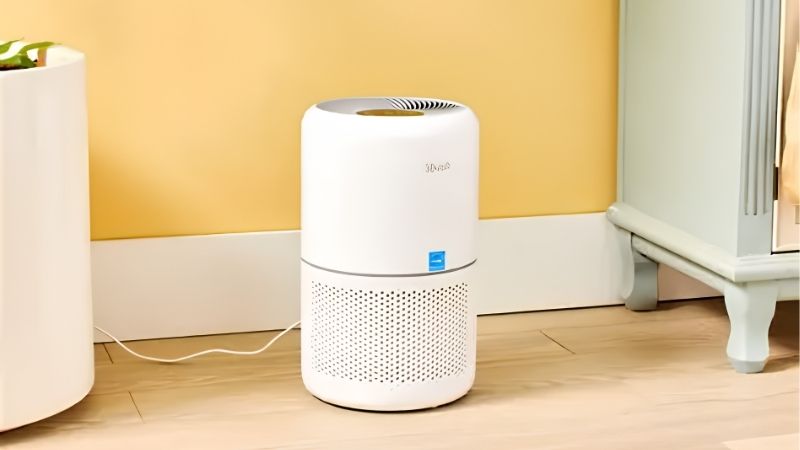
The Decisive Numbers: Media Weight, Type and Coverage
Adsorbent weight is the specification that decides whether anything happens. Machines with a carbon-coated mesh hold a few grams and saturate within weeks; serious gas-phase units carry 5-15 lb (2.3-6.8 kg) of granular carbon and impregnated media, and last a year or more.
Media type matters as much as weight. Plain activated carbon handles solvents, paint fumes and many household VOCs well, but formaldehyde adsorbs poorly onto untreated carbon. The best air purifier for VOC work in a newly built or newly furnished room uses potassium permanganate, impregnated alumina or a catalytic filter for that specific compound.
Coverage still needs matching to the room, and manufacturers typically quote it at one air change per hour. For active off-gassing, aim for a machine rated well above the room area so it can run at a moderate speed continuously rather than flat out.
Space and Fit: Big Media Means a Big Machine
The best air purifier for VOC work is a large object, because gas-phase capacity is physically bulky. Units carrying meaningful adsorbent weight measure roughly 14-16 in (36-41 cm) across and 23-28 in (58-71 cm) tall, and weigh 30-50 lb (14-23 kg). That is a permanent floor fixture rather than something moved between rooms.
They also need clearance to breathe, usually 6-12 in (15-30 cm) around the intake. Measure the floor space and confirm a socket is within cable reach before ordering, since a continuously running appliance should not sit on an extension lead.
Ventilation First, Filtration Second
The best air purifier for VOC reduction is the third tool, not the first. The EPA’s guidance on indoor VOCs puts source control and ventilation ahead of air cleaning, and that ordering is worth respecting. Opening windows for an hour a day during an off-gassing period removes more than any filter, because it exchanges the air entirely rather than treating it.
Source control means choosing low-VOC paints, letting new furniture air in a garage or a spare room, and looking for GREENGUARD Gold or similar certification on new items. A purifier reduces what remains; it does not make a sealed room with fresh laminate flooring equivalent to a ventilated one.
7 Purifiers With Real Gas-Phase Capacity
The best air purifier for VOC removal is ranked by adsorbent capacity rather than airflow, which is the opposite of how most purifier lists are built. Amazon prices move constantly, so treat the tiers as indicative.
| Model | Gas-phase media | Approx. media weight | Price tier |
|---|---|---|---|
| IQAir GC MultiGas | Carbon + impregnated alumina | Around 12 lb / 5.4 kg | Premium |
| Airpura V600 | Carbon + potassium permanganate | Around 18 lb / 8 kg | Premium |
| AllerAir AirMedic Pro 5 | Deep carbon bed | Multi-pound, configurable | Premium |
| Austin Air HealthMate | Carbon + zeolite | Around 15 lb / 6.8 kg | Premium |
| Alen BreatheSmart 75i Fresh | Fresh filter, added carbon | Moderate | Premium |
| Blueair Protect 7440i | Carbon layer | Light-moderate | Mid-premium |
| Levoit EverestAir | Carbon layer | Light-moderate | Mid |
IQAir GC MultiGas: The Reference Machine
Four cartridges of carbon and impregnated alumina, a fully sealed airway and published performance data make this the most technically complete option available to a homeowner. It is the machine used where gas removal genuinely has to work.
It is very expensive, heavy, and the cartridges are a significant recurring cost. Airflow per decibel is unremarkable, so in a large room it runs at a speed you can hear, and it is not a device you move between floors.
Airpura V600: Built Around VOC Removal
The V600 configuration exists specifically for chemical and VOC removal, with a deep bed of carbon blended with potassium permanganate for compounds that plain carbon handles badly. Steel construction avoids the plastic housing off-gassing that undermines cheaper units.
The price and weight are both high, and the filter is a single large annual purchase rather than a small frequent one. There are no sensors or app, just a speed control.
AllerAir AirMedic Pro 5: Configurable Carbon Bed
AllerAir lets you specify the carbon blend for the compounds you are targeting, which is unusual and useful if the problem is known, such as solvent fumes from a workshop next to a living space.
Configuration requires knowing what you are dealing with, which most homeowners do not. The units are industrial in appearance, expensive, and lead times can be long compared with buying a mainstream purifier from stock.
Austin Air HealthMate: Steel and Volume
Around 15 lb (6.8 kg) of carbon and zeolite in a steel cabinet, with a single knob and a filter rated for several years of use. On adsorbent capacity per dollar it is the strongest value in this group.
It is heavy, plain and audible at higher speeds, with no sensors or automation. The standard blend handles general VOCs well but is less targeted at formaldehyde than the potassium permanganate options.
Alen BreatheSmart 75i Fresh: Mainstream With Extra Carbon
The Fresh filter option adds meaningfully more carbon than Alen’s standard cartridge, in a body that looks like domestic furniture rather than equipment. Coverage suits a large living room.
Carbon volume is still a fraction of the dedicated machines, so it manages background VOCs rather than active off-gassing from new flooring. Filters sit at the premium end, and the annual cost deserves calculating.
Blueair Protect 7440i: Airflow and Sensors
High airflow at low noise plus a sensor that responds to VOC levels, which gives useful feedback about when a room actually improves. The interface and app are among the best in the category.
The carbon layer is modest, so treat the VOC sensor as a monitoring tool rather than evidence of heavy adsorption capacity. It performs best as a general-purpose purifier with some odour handling.
Levoit EverestAir: Mid-Market Coverage
Strong airflow for a large room at a mid-market price, with a carbon layer sufficient for cooking smells and mild off-gassing. App control and accurate filter indicators make it easy to live with.
Adsorbent capacity is light compared with the dedicated units above, so it is not the answer for a freshly renovated room. The combined filter cartridge means replacing HEPA and carbon together even when only the carbon is spent.
Managing an Off-Gassing Period Properly
Even the best air purifier for VOC control is one of three tools, and it is the least powerful during the weeks when emissions are highest.
Ventilation and Timing After a Renovation
Emissions from new paint, adhesives, laminate flooring and foam furniture are highest immediately after installation and decline over weeks to months. Cross-ventilating for an hour or two daily during that period does more than any filter, particularly in mild weather.
Warmth accelerates off-gassing, which cuts both ways: heating an empty room with the windows open for a day releases and removes a great deal at once. Where a room can be left unoccupied for a while after work is finished, that is the cheapest intervention available.
What to Avoid Buying
Avoid devices marketed as ozone generators or air sanitisers that work by producing ozone, which is itself a lung irritant and has been the subject of regulatory action in California. If a listing describes activated oxygen or energised oxygen, that is ozone.
Photocatalytic and plasma technologies vary widely in independent verification and can produce byproducts. Mechanical filtration plus a substantial adsorbent bed is the approach with the clearest evidence behind it, and it is the one to default to.
Costs, Certification and Buying Timing
Gas-phase filters are the ongoing expense, typically an annual purchase running to a meaningful share of the machine price. Factor that before comparing purchase prices, since a cheaper unit with a combined cartridge can cost more over three years.
Purifiers follow the general electronics calendar, with Prime Big Deal Days in early October and Black Friday and Cyber Monday in late November as the next two discount windows. Demand also spikes during air quality events, which clears stock quickly across the whole category.
Frequently Asked Questions
These come up whenever a best air purifier for VOC search ends in a machine that changes nothing.
Will a HEPA purifier remove paint smell?
No. Paint fumes are gases and pass through HEPA untouched. Only activated carbon or a similar adsorbent captures them, and a thin carbon-coated mesh holds too little to make a difference in a room actively off-gassing.
Does carbon work on formaldehyde?
Untreated carbon handles it poorly. Formaldehyde needs impregnated media such as potassium permanganate or alumina, or a catalytic filter designed to break it down. Check for that specification rather than assuming carbon covers everything.
How long should I run it after a renovation?
Continuously through the weeks when emissions are highest, alongside daily ventilation. Off-gassing declines over time rather than stopping on a date, so taper the runtime as the smell fades rather than switching off after a fixed period.
See More:
- Best noise cancelling headphones Bose
- Best deal on air fryer
- Best buy Bella air fryer
- Best deals air fryer
- Best blender bottle
Final Thoughts on VOC Removal
The best air purifier for VOC control carries pounds of gas-phase media rather than a carbon-coated sheet, and uses impregnated media if formaldehyde is the concern. Ventilate first, control the source second, filter third. Measure the floor space before ordering, because machines with real adsorbent capacity are large, heavy and permanent.
Our top picks


As an Amazon Associate we earn from qualifying purchases at no extra cost to you.





Write Your Review
No reviews yet. Be the first to share your experience!