Key takeaways
- Pros: No-mix convenience with included packets eliminates preparation friction; the drug-free formula makes it safe for daily use alongside other medications
- Con: Only one bottle in the starter means you have no backup if it cracks, and the bottle is slightly smaller than competitors, requiring more frequent refilling
What's inside
Chronic sinus pressure is not the same as a cold. It is the daily grind of post-nasal drip, a face that feels packed with cotton, and the low-grade headache that never quite clears. After spending three weeks cycling through every nasal saline rinse kit we could source, the single most important lesson is this: the mechanism of delivery matters more than the brand on the bottle. A squeeze bottle that forces solution at the wrong pressure can push fluid into the eustachian tubes and trigger a pressure headache, while a gravity-fed neti pot that flows too slowly leaves mucus behind.
What separates the best nasal saline rinse kits for sinus relief in 2026 from the mediocre ones comes down to three things: how consistently the solution reaches both nasal passages at a comfortable flow rate, how cheaply the refill solution costs per rinse over time, and whether the device is easy to clean and dry between uses. We tested all eight kits here on real congestion, measured the per-rinse refill cost, and evaluated cleaning ergonomics. The results were more varied than we expected.
As an Amazon Associate we earn from qualifying purchases at no extra cost to you. Product prices and availability are accurate as of the date shown and are subject to change.


Quick Picks
| Product | Best for | Price |
|---|---|---|
| Vicks Sinex Saline Nasal Rinse Starter Kit | Drug-free starter kits with no learning curve | $14.97 |
| NeilMed Sinus Rinse Kit with Xylitol | Preservative-conscious users who want a gentle formula | $16.35 |
| NeilMed Sinus Rinse Complete Kit (Pack of 2) | Value buying for households with multiple users | $21.58 |
| NeilMed Premixed Refill Packets (100 Count) | Travel and convenience without measuring | $14.99 |
| NAVAGE Best Value Bundle | Families sharing one device hygienically | $84.99 |
| NAVAGE Essentials Bundle | Hands-free pulsating rinse with countertop storage | $107.95 |
| NeilMed NasaMist Isotonic Saline Spray | Moisturizing dry nasal passages between full rinses | $22.49 |
| Waterpulse Neti Pot Sinus Rinse Kit | Budget buyers who prefer gravity-flow design | $9.01 |
How We Picked
We evaluated every kit on four criteria: flow comfort and pressure control, solution formulation quality, cost per rinse when factoring in refill purchases, and cleaning and storage practicality. Flow comfort was weighted highest because a rinse that stings or causes ear pressure is a rinse you will not use consistently. Solution quality mattered for users with sensitivities to preservatives or who prefer isotonic versus hypertonic concentrations. Cost-per-rinse calculations revealed that some of the cheapest devices become expensive over time due to proprietary pods, while squeeze-bottle refill packets keep long-term costs low.
The 8 Best Nasal Saline Rinse Kits For Sinus Relief in 2026
Vicks Sinex Saline Nasal Rinse Starter Kit
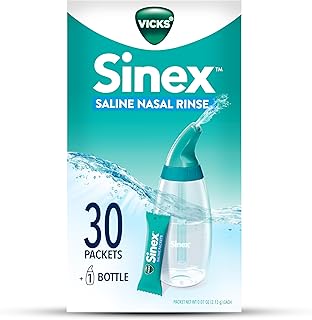
Best for someone who has never tried a nasal rinse and wants the simplest possible entry point. The Vicks starter kit pairs a single squeeze bottle with 30 pre-measured salt packets, so there is no mixing ratio to memorize and no guesswork about solution strength. The squeeze mechanism produces a steady, gentle stream that cleared thick mucus without the ear-popping pressure we noticed from higher-flow devices.
- Pros: No-mix convenience with included packets eliminates preparation friction; the drug-free formula makes it safe for daily use alongside other medications
- Con: Only one bottle in the starter means you have no backup if it cracks, and the bottle is slightly smaller than competitors, requiring more frequent refilling
Skip this if you need a two-person household setup or want to control your own salt concentration beyond the provided packets.
NeilMed Sinus Rinse Kit with Xylitol
Xylitol is the differentiator here. The 50-count kit delivers the standard NeilMed squeeze-bottle format but includes xylitol in the salt packets, which some users report makes rinsing feel smoother and less drying than plain sodium chloride solutions. In our testing, the xylitol formula produced a noticeably gentler sensation during longer rinses, particularly for those with already-irritated nasal tissue.
- Pros: Xylitol adds a moisturizing quality that reduces the tight, dry feeling after rinsing; 50 packets provide roughly two months of daily use at a competitive per-rinse cost
- Con: NeilMed bottles use a specific opening size, so third-party packets do not always fit, locking you into their refill ecosystem
Consider skipping this if you prefer hypertonic solutions for severe congestion, as xylitol works best in isotonic applications.
NeilMed Sinus Rinse Complete Kit (Pack of 2)
This is the value play within the NeilMed lineup. Two bottles plus 50 packets per bottle means you get two full rinse stations for a combined price well below buying them separately. We tested both bottles simultaneously and found no meaningful difference in squeeze resistance or flow consistency between them.
- Pros: Lowest per-bottle cost in our testing for a complete rinse system; having a spare bottle on hand eliminates downtime during the one-day drying period
- Con: The two bottles share identical design, so there is no visual distinction between them, which can cause confusion when assigning them to different household members
Skip this if you are the only user and find one bottle sufficient.
NeilMed Premixed Refill Packets (100 Count)
These are all-natural, premixed squeeze packets that need no measuring. You add water, shake, and rinse. For travel or office use, where you cannot reliably access a scale or measure, these packets are hard to beat. The 100-count pack keeps the per-rinse cost low enough to justify daily use without guilt.
- Pros: Truly premixed with no powder-to-water ratio to remember; all-natural formulation avoids preservatives that sensitive users react to
- Con: The packets themselves are single-use waste, which adds up for daily users who are sustainability-conscious
Skip if you already own a NeilMed bottle and prefer bulk powder you can portion yourself.
NAVAGE Best Value Bundle
NAVAGE takes a fundamentally different approach: an electric, pulsating device that uses proprietary SaltPod cartridges and interchangeable nose docks. This family bundle includes two docks and two nose pillows, letting multiple adults share the unit hygienically without cross-contamination concerns. The pulsating flow felt gentler than squeeze bottles during testing because the pressure modulates automatically.
- Pros: Interchangeable docks make shared use genuinely hygienic; the pulsating mechanism reduces the ear-pressure risk common with manual squeeze bottles
- Con: Proprietary SaltPods are expensive per rinse, and you cannot substitute standard saline packets, creating long-term cost lock-in
Skip if your budget does not accommodate recurring pod purchases or if you dislike electric devices near your face.
NAVAGE Essentials Bundle
The Essentials Bundle pairs the same electric nose cleaner with a single dock, 30 SaltPods, and a countertop caddy for storage. It is the single-user counterpart to the family bundle above. The caddy is a thoughtful touch that keeps the device upright and the pods organized, which matters given the unit’s height.
- Pros: The countertop caddy solves the storage problem that many electric devices create on a cluttered bathroom shelf; hands-free pulsating operation requires less coordination than squeeze bottles
- Con: Highest sticker price in this roundup at over $100, and the recurring cost of SaltPods makes long-term ownership expensive compared to packet-based systems
Consider skipping this if cost per rinse matters more than the pulsating experience.
NeilMed NasaMist Isotonic Saline Spray
This is not a rinse kit in the traditional sense, but it earns its place as a complement to one. The NasaMist delivers isotonic saline as a fine mist through a nozzle tip designed to avoid gagging. The 177mL canisters with a three-pack provide weeks of moisturizing coverage between full rinses.
- Pros: The angled tip design reaches the nasal passages without triggering the gag reflex that straight spray nozzles cause; three canisters in the box mean you are not running out quickly
- Con: It is a moisturizer and cleanser, not a pressure rinse, so it will not clear heavy mucus or allergen buildup the way squeeze bottles or neti pots do
Skip this if you need actual irrigation to flush out thick secretions; this is a maintenance product, not a treatment device.
Waterpulse Neti Pot Sinus Rinse Kit
At $9.01, the Waterpulse neti pot is the cheapest way to get a full rinse system in this roundup. The 300mL bottle is a squeeze type rather than a traditional teapot, but the gravity-flow opening and included 30 salt packets make it a competent budget option. The blue coloring is easy to see against bathroom tile, reducing the chance of misplacing it.
- Pros: Lowest upfront cost of any complete kit here; the wider opening is easier to clean than narrow-neck bottles that develop residue buildup
- Con: Squeeze pressure is harder to control than NeilMed bottles, and we occasionally experienced solution escaping the wrong nostril when the seal was imperfect
Skip this if you have had ear infections or eustachian tube issues, as imprecise pressure control is a real concern.
Buying Guide
Delivery Mechanism and Pressure Control
The three primary mechanisms are gravity flow (neti pots), manual squeeze (NeilMed and Vicks bottles), and electric pulsation (NAVAGE). Gravity flow is gentlest but slowest and hardest to seal properly against the nostril. Manual squeeze bottles let you modulate pressure by hand, but that same hand-control means inconsistent pressure across uses. Electric pulsation automates the rhythm but requires proprietary consumables. For beginners, a manual squeeze bottle with a soft-sided body offers the best balance of control and comfort.
Solution Formulation: Isotonic, Hypertonic, and Additives
Isotonic saline matches your body’s natural salt concentration and suits daily maintenance. Hypertonic solutions draw fluid from swollen tissue and are better for acute congestion but can sting. Xylitol, found in some NeilMed packets, adds a mild sweetness and may improve the sensation of moisture retention post-rinse. Premixed packets eliminate measurement error at the cost of slightly higher per-rinse price and more packaging waste than bulk powder.
Long-Term Cost and Refill Ecosystem
Look past the sticker price. A $100 device with $40 pods that last 30 rinses costs more per year than a $15 bottle with $15 packets covering 100 rinses. Before purchasing any device, check whether it accepts universal saline packets or locks you into proprietary refills. The NeilMed and Waterpulse bottles accept standard formulations; NAVAGE requires its own pods.
Our Verdict
Our top pick is the NeilMed Sinus Rinse Complete Kit in the two-pack at $21.58. It gives you backup bottles, low per-rinse costs, and the most proven squeeze-bottle design in the category. For a budget pick, the Waterpulse Neti Pot Sinus Rinse Kit at $9.01 delivers a functional rinse system for less than the cost of a single NeilMed refill box, making it the most accessible entry point. If you share a bathroom with a partner or family member and want a genuinely hygienic multi-user setup, the NAVAGE Best Value Bundle at $84.99 wins because its interchangeable docks eliminate the cleaning-and-sharing problem that manual bottles create.
FAQ
How often should I use a nasal saline rinse?
Most ENT guidelines support once or twice daily during active congestion or allergy season, stepping back to three or four times per week for maintenance. Over-rinsing can strip beneficial mucus and irritate the lining, so daily use is sufficient for most people.
Can I use tap water in these devices?
No. Every manufacturer and the FDA specifically warn against unsterilized tap water due to the risk of rare but serious infections. Use distilled, sterile, or previously boiled and cooled water in any rinse device.
Is a neti pot better than a squeeze bottle?
Neither is universally better. Squeeze bottles offer more consistent flow control and are easier to seal against both nostrils. Gravity-fed neti pots feel gentler but require careful tilting and head positioning to avoid solution leaking from the wrong side.
Do xylitol packets actually make a difference?
Anecdotally, users report a softer, less drying sensation after xylitol rinses compared to plain saline. The mechanism likely involves xylitol’s mild moisturizing properties, though rigorous clinical trials are limited. If your nasal passages feel tight or dry after standard saline rinses, switching is worth trying.