Key takeaways
What's inside
When you start airbrushing indoors, managing overspray, toxic fumes, and micro-particles is no longer optional—it is a critical safety requirement. Whether you paint scale models, miniatures, custom apparel, or canvas art, an effective airbrush spray booth protects your lungs and keeps your workspace clean. By 2026, the market offers everything from compact, foldable hobby units to heavy-duty professional extraction systems, making the buying process more complex than ever.
With so many designs featuring varying fan speeds, lighting configurations, and filtration layers, it is easy to get overwhelmed by marketing buzzwords. Choosing the right spray booth isn’t just about picking the biggest or most expensive model; it is about matching the equipment to your specific medium, available space, and ventilation constraints. This guide breaks down the core specifications that actually impact performance so you can invest in a setup that serves your craft safely and reliably.
As an Amazon Associate we earn from qualifying purchases at no extra cost to you. Product prices and availability are accurate as of the date shown and are subject to change.
Evaluating Airflow and Extraction Power
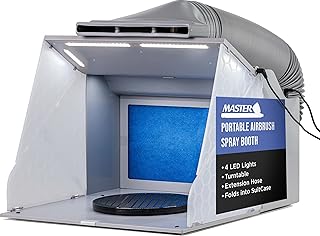
The primary job of any spray booth is to pull atomized paint particles and chemical vapors away from your face and exhaust them safely. When evaluating extraction power, look closely at the cubic feet per minute (CFM) rating rather than just the wattage of the motor. A higher CFM indicates a stronger airflow, which is essential if you frequently spray heavy enamels, lacquers, or solvent-based paints that release strong volatile organic compounds. However, raw power must be balanced with noise levels; a fan that sounds like a jet engine will quickly make long painting sessions miserable.
Keep in mind that the effective airflow of a booth decreases as filters load up with paint residue. If you plan to spray large volumes or thick mediums, look for dual-fan models or units with adjustable speed controls. Variable speeds allow you to dial back the airflow for delicate, low-pressure acrylic work, while cranking it up to maximum capacity when you switch to priming or varnishing larger surfaces.
Sizing Your Workspace and Storage Needs
Before committing to a spray booth, measure your physical workbench and consider the size of the objects you typically paint. If your projects are limited to miniatures or Warhammer figures, a standard compact hobby booth with a width of around sixteen to twenty inches will suffice. However, if you paint larger scale models, RC car bodies, or custom sneakers, you will need a significantly wider and deeper interior to prevent overspray from escaping past the edges of the hood.
Storage is another major factor for hobbyists who do not have a dedicated, permanent studio. Many modern booths feature a clamshell or foldable design that collapses into a portable suitcase-style case with a built-in carrying handle. If you need to pack your gear away after every painting session, prioritize a lightweight, quick-assembly unit that does not require tools to set up or take down.
The Importance of Built-In LED Lighting
Good lighting is just as important as good airflow. Without proper illumination, it is nearly impossible to spot thin spots, pooling paint, or dry edge accumulation until it is too late. When shopping for a booth, examine how the lighting is integrated into the hood. Single-strip overhead lights can cast harsh shadows from your own hands or the airbrush gun, whereas wrap-around LED arrays or multi-angle light panels illuminate the work surface evenly from multiple directions.
Furthermore, look for LED systems that offer clean, daylight-balanced color temperatures (typically around five thousand to six thousand Kelvin). This ensures that the colors you mix and apply on your model look identical under the booth lights as they do in natural daylight, preventing frustrating color mismatch surprises once your project is finished and cured.
Filter Types and Long-Term Maintenance Costs
The filtration system acts as the first line of defense for your fan motor and your lungs. Most standard spray booths utilize multi-layer fiberglass filter pads designed to trap heavy pigment particles before the air reaches the exhaust duct. While these filters are affordable and widely available, they require regular inspection and replacement to maintain optimal airflow performance.
When calculating the true cost of ownership, look at how easy and inexpensive it is to source replacement filters for the specific model you are considering. Some advanced booths also support secondary carbon filters, which are crucial if you spray solvent-based paints indoors, as they help absorb noxious chemical odors that standard particulate filters let pass right through.
Venting Options: Ducted vs. Filter-Only Setups
How you vent your spray booth depends entirely on your living arrangement and proximity to a window or exterior wall. A ducted setup uses a flexible hose to push paint fumes and vapors completely outside, providing the highest level of safety for solvent and lacquer users. Always ensure the exhaust hose is securely routed out a window using a custom insert panel to prevent fumes from simply blowing right back inside.
If venting outside is completely impossible, a filter-only or recirculating setup forces the air through heavy-duty particulate and activated carbon filters before releasing it back into the room. While this is acceptable for water-based acrylics in a well-ventilated room, it is generally insufficient for heavy solvent use. If you must use a filter-only setup, commit to strictly wearing an appropriate respirator mask with organic vapor cartridges.
Material Quality and Ease of Cleaning
Paint booths take a serious beating over their lifespan, enduring layers of overspray, solvent spills, and accidental scrapes from tools and models. The interior materials matter immensely for long-term durability. Smooth plastic housings and stainless steel turntable bases are significantly easier to scrape clean than textured or porous surfaces where paint can bond permanently.
Additionally, check whether the turntable included with the booth operates smoothly. A high-quality, ball-bearing rotating base allows you to spin your model effortlessly with one hand while keeping your airbrush steady with the other, ensuring an even, flawless coat without awkward hand positioning.
Related Guides
To see how specific models perform in real-world testing across all these criteria, explore our curated Best Airbrush Spray Booths in 2026: Tested and Ranked to find the right match for your setup.
FAQ
Do I really need a spray booth if I only use water-based acrylic paints?
Even though acrylics lack harsh chemical solvents, they still produce atomized paint dust and micro-droplets that float into the air and settle on your lungs and furniture. A spray booth is still recommended to maintain a clean workspace and prevent long-term respiratory irritation.
Can I build my own DIY spray booth instead of buying a commercial one?
Yes, many hobbyists build custom booths using plastic storage bins, bathroom exhaust fans, and furnace filters. However, commercial units are engineered with balanced airflow, integrated lighting, and spark-safe motors designed to handle flammable paint vapors safely.
How often should I change the filter pads in my spray booth?
You should inspect your filter pads after every few hours of heavy spraying. Once the filter is visibly saturated with pigment and airflow noticeably drops, it is time to replace it to prevent strain on the exhaust fan motor.
How long should the exhaust hose be when venting out a window?
Keep the flexible exhaust hose as short and straight as possible to maintain maximum fan efficiency. Every bend, kink, or excessive length creates resistance that reduces the overall CFM extraction power of your booth.