Our Short List of 3
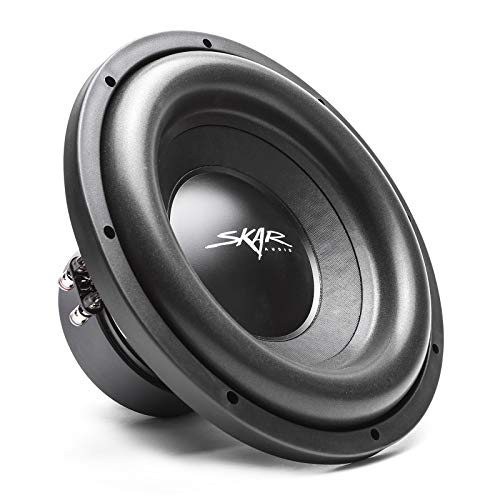
- Best for: A first serious build with a 600-watt-class mono amp and a ported box.
- Size: 12 inches
- Power handling: 600 watts RMS, 1,200 watts max
- Impedance: dual 4-ohm voice coils
- Voice coil: 2.5-inch, 4-layer high-temperature copper

- Best for: Builders who already own a strong mono amplifier and want a mainstream-brand driver.
- Size: 12 inches
- Power handling: 500 watts RMS (250 watts per coil), 1,500 watts max
- Impedance: dual 4-ohm voice coils
- Frequency response: 20 Hz – 2.3 kHz

- Best for: Sound-quality-leaning builds that still want full 600-watt output.
- Size: 12 inches
- Power handling: 600 watts RMS, 1,800 watts peak
- Impedance: dual 4-ohm voice coils with configuration jumpers
- Frequency response: 23-215 Hz
All 3 Picks at a Glance
| Product | Specs | Action |
|---|---|---|
| Skar Audio SDR-12 D4 |
| Check price on Amazon |
| Pioneer TS-A120D4 |
| Check price on Amazon |
| Alpine S2-W12D4 |
| Check price on Amazon |
Key takeaways
- Compare five 12 inch car subwoofers on RMS power, dual voice coil wiring, sensitivity and mounting depth, and pick the right one for your enclosure.
The number printed largest on most subwoofer boxes, the peak wattage figure, is close to useless for the decision you actually face. What decides whether a 12-inch sub sounds strong or strained is how its RMS rating lines up with the amplifier feeding it, and whether its voice coils can be wired to a load that amplifier is stable at. Match those two things and almost any of these drivers performs well. Get them wrong and even a costly sub distorts early, runs hot, or pushes the amp into protection.
This roundup is for people adding a first subwoofer to a daily driver, replacing a blown 12, or planning a matched amplifier and sub purchase. Every pick is a bare 12-inch component subwoofer, driver only, with no enclosure and no amplifier. Each was chosen from the specifications and title on its Amazon listing: RMS and peak power, coil configuration, sensitivity, frequency response and mounting dimensions. If you want a pre-loaded enclosure instead, none of these is that product.
Quick Picks
As an Amazon Associate we earn from qualifying purchases
| Product | Best for | Key spec from title |
|---|---|---|
| Skar Audio SDR-12 D4 | Hard-hitting first build with a proper mono amp | 1,200W max power, dual 4-ohm voice coils |
| Rockford Fosgate P3D4-12 | Maximum excursion and headroom at 600 watts | 600W RMS, 1,200W peak |
| Kicker CompC 44CWCD124 | Modest amplifiers and smaller sealed boxes | Dual voice coil, 4-ohm |
| Pioneer TS-A120D4 | Mainstream build with a healthy 500W amp | 1,500W max power |
| Alpine S2-W12D4 | Clean, controlled bass with easy coil wiring | 600W RMS, 1,800W max |
How to Choose
Match RMS Power to the Amplifier You Actually Own
RMS is the power a subwoofer can take continuously, hour after hour, and it is the only wattage figure worth shopping by. Your amplifier should deliver roughly the sub’s RMS rating at the impedance you wire it to: a 600-watt sub on a 250-watt amp gets pushed into clipping when you ask for volume, and clipping is what kills voice coils, not clean power. The five drivers here span 300 to 600 watts RMS, which maps neatly onto the most common mono amplifiers. Decide the amp first, or at least honestly, and the sub choice narrows fast.
Get the Voice Coil Wiring Right Before You Order
Every sub in this list uses dual 4-ohm voice coils, and that configuration decides what your amplifier sees. A single dual 4-ohm sub wires to either a 2-ohm or an 8-ohm load, and a pair can present 1 ohm or 4 ohms. Most mono amps make their rated power at 2 ohms, some at 1 ohm, so the coil choice is really an amplifier-matching choice. Each of these model families also sells a dual 2-ohm sibling with a nearly identical name, and the D4 versus D2 suffix is the only difference. Confirm it on the listing before ordering, because returns on a mounted sub are a hassle nobody needs.
Measure Mounting Depth and Box Volume First
A 12-inch sub needs roughly an 11-inch cutout, but depth and air space are where installs actually fail. Motors on high-excursion drivers run deep, and a sub lowered into a box that is too shallow either will not seat or will vent against the back wall. Manufacturers publish a minimum sealed volume and a ported range for each driver, and those numbers matter more than the box’s outside dimensions. Measure the space you are genuinely willing to give up in the trunk, check the driver’s depth against the enclosure’s internal depth, and only then fall in love with a spec sheet.
Use Sensitivity and Low-End Response to Predict Output
Sensitivity, rated in decibels at one watt, tells you how much output a sub makes before power even enters the picture. The Kicker below is rated at 88.3 dB and the Pioneer at 77 dB, an unusually wide spread that means the Pioneer needs substantially more amplifier power to reach the same volume. Pair that with the low end of the frequency response: drivers rated down to 22 or 23 Hz will reproduce the lowest synth and pipe-organ notes that a sub rolling off higher simply skips. Neither figure tells the whole story alone, but together they predict whether a build will feel loud, deep, both, or neither.
The 5 Best Options
Skar Audio SDR-12 D4
- Best for: A first serious build with a 600-watt-class mono amp and a ported box.
- Size: 12 inches
- Power handling: 600 watts RMS, 1,200 watts max
- Impedance: dual 4-ohm voice coils
- Voice coil: 2.5-inch, 4-layer high-temperature copper
A first serious build with a 600-watt-class mono amp and a ported box.
The listing’s mounting depth figure is 7.62 inches, so measure your enclosure’s internal depth before ordering; this is not a shallow-mount driver.
The SDR-12 D4 is the value-heavy way into a genuinely loud single-sub build. It is rated for 600 watts RMS behind a 2.5-inch, four-layer high-temperature copper voice coil and a high-flux ferrite motor, with a rated response reaching down to 22 Hz. The high-roll foam surround and 13.5 mm of one-way excursion suit a ported enclosure tuned for bass-heavy music, and the signature red spider is more than decoration, since it helps keep the coil centered at long travel. Sensitivity is a modest 84.7 dB, so plan on feeding it close to its full rating from a real mono amplifier rather than a borrowed bridged channel.
Rockford Fosgate P3D4-12
The Punch P3 has been Rockford Fosgate’s benchmark 12 for years, and the spec that explains why is excursion: 15.9 mm of one-way Xmax, the most in this group, on a 600-watt RMS platform. Its resonant frequency of 27.7 Hz points to a driver comfortable playing low in either a sealed box, where it stays tight and controlled, or a ported one when output matters more. The custom 10-AWG nickel-plated push terminals accept heavy-gauge speaker wire without spade adapters, a small detail that installers appreciate. This is the pick for someone stepping up from an entry-level sub who wants headroom the old driver never had.
Specs
- Size: 12 inches
- Power handling: 600 watts RMS, 1,200 watts peak
- Impedance: dual 4-ohm voice coils
- Xmax: 15.9 mm
- Resonant frequency (Fs): 27.7 Hz
- Terminals: custom 10-AWG nickel-plated push terminals
- Included: subwoofer, painted aluminum trim ring, installation hardware, manual
Best for: Listeners who want the deepest, hardest-hitting single 12 here and have the amplifier to feed it.
Watch out for: The same listing family includes the dual 2-ohm P3D2-12; check that the model on the page says P3D4-12 before buying.
ASIN: B004UFHXNI
Kicker CompC 44CWCD124
The CompC is the sensible pick when the rest of the system is modest. It asks for only 300 watts RMS, and its 88.3 dB sensitivity is the highest in this roundup, so it gets respectably loud on the kind of power a small mono amp or a bridged channel actually makes. Kicker rates it for sealed or ported enclosures, publishes a minimum sealed volume of 1.25 cubic feet, and the 5-3/8-inch mounting depth fits boxes that would never swallow the deeper drivers here. Spring-loaded terminals keep the wiring simple. For a daily driver that needs real bass without an electrical-system project, this is the low-drama route.
Specs
- Size: 12 inches
- Impedance: dual 4-ohm voice coils
- Power handling: 600 watts peak, 300 watts RMS recommended
- Sensitivity: 88.3 dB at 1W/1m
- Mounting depth: 5-3/8 inches
- Minimum sealed box volume: 1.25 cubic feet
- Terminals: spring-loaded speaker terminals
- Enclosure types: sealed or ported
Best for: Stock-electrical daily drivers and smaller sealed enclosures on a limited amplifier budget.
Watch out for: Listings around this model mix in two-packs and the single-coil 44CWCS124 sibling; verify the model number 44CWCD124 on the page, and note the current offer may come from a third-party seller.
ASIN: B01N0ZAOMX
Pioneer TS-A120D4
- Best for: Builders who already own a strong mono amplifier and want a mainstream-brand driver.
- Size: 12 inches
- Power handling: 500 watts RMS (250 watts per coil), 1,500 watts max
- Impedance: dual 4-ohm voice coils
- Frequency response: 20 Hz – 2.3 kHz
Builders who already own a strong mono amplifier and want a mainstream-brand driver.
Low sensitivity means a small amplifier will leave this sub sounding weak; budget the amp honestly before choosing it.
Pioneer’s A-Series 12 is built around a carbon and mica reinforced IMPP cone, a stiff, light design that keeps the driver composed at its 500-watt RMS rating, at 250 watts per coil. The listed frequency response runs from 20 Hz to 2.3 kHz, wider than most subwoofers claim, though a low-pass filter will hand everything above the bass region to the door speakers. The trade-off is sensitivity: at 77 dB, this is the quietest driver per watt, so it leans hard on amplifier power. Pair it with a mono amp that delivers 500 watts and it rewards you; feed it half that and it will feel lazy.
Alpine S2-W12D4
- Best for: Sound-quality-leaning builds that still want full 600-watt output.
- Size: 12 inches
- Power handling: 600 watts RMS, 1,800 watts peak
- Impedance: dual 4-ohm voice coils with configuration jumpers
- Frequency response: 23-215 Hz
Sound-quality-leaning builds that still want full 600-watt output.
A dual 2-ohm S2-W12D2 sits in the same listing family, so confirm the D4 suffix; one data field on the listing shows a conflicting maximum output figure, so shop by the 600-watt RMS rating.
Alpine’s next-generation S-Series borrows its high-amplitude multi-roll H.A.M.R. surround from the company’s pricier lines and pairs it with a carbon fiber and polypropylene cone, aiming for control as much as output. The numbers support that balance: 600 watts RMS, 15 mm of one-way excursion, an 86.2 dB sensitivity that is easy on amplifier power, and response rated from 23 Hz. A nice touch is the configuration jumpers in the terminals, which set the dual 4-ohm coils to a 2-ohm or 8-ohm load without loose jumper wires to lose. It suits the buyer who wants bass that stays composed on acoustic and rock recordings, not just low notes at full tilt.
Which One Fits Your Situation
You Are Adding Bass to a Factory System
Start with the Kicker CompC. Its 300-watt appetite and high sensitivity work with a compact mono amplifier tapped into a stock head unit, and the shallow mounting depth keeps the enclosure small enough to live with daily. You give up the last layer of deep output the 600-watt drivers offer, but the trunk stays usable and the charging system never notices the extra load.
You Already Own a Mono Amp Rated Near 600 Watts
All three 600-watt drivers fit, so choose by enclosure. The Skar SDR-12 D4 makes the most sense in a ported box built for loud, low bass. The Rockford P3D4-12 is the better sealed-box driver and brings the most excursion. The Alpine S2-W12D4 splits the difference with easier wiring and a cleaner, more controlled character.
Your Trunk Space Is Genuinely Tight
The Kicker CompC is the only pick here designed around small air space, with a published minimum sealed volume of 1.25 cubic feet and the shallowest motor in the group. The Rockford P3 also behaves well sealed if you can give it a bit more room. Skip the Skar in this scenario; its depth and ported-box appetite fight against a compact install from the start.
You Play Bass-Heavy Music Loud on Long Drives
Heat is the enemy on a two-hour drive at high volume, and headroom is the cure. The Rockford P3D4-12 and Alpine S2-W12D4 both combine 600-watt ratings with 15 mm or more of excursion, so they reach your volume without living at their mechanical limits. The Skar belongs here too if the box is ported and the amplifier gain is set with a multimeter rather than by ear.
Common Mistakes
- Shopping by peak wattage, then pairing a 600-watt RMS sub with an amplifier whose honest RMS output is half that.
- Ordering the dual 2-ohm version of a sub when the build plan, and the amplifier’s stable loads, called for dual 4-ohm coils.
- Buying the subwoofer first and the enclosure second, then discovering the mounting depth or required box volume does not fit the trunk.
- Setting amplifier gain by ear until it sounds loud, which usually means clipping, and clipping is what overheats voice coils.
- Skipping the break-in period and running a brand-new, stiff suspension at full excursion on day one.
Frequently Asked Questions
Do these subwoofers come with a box or an amplifier?
No. All five picks are bare component drivers, so the purchase is the subwoofer itself, plus a trim ring or hardware where the listing says so. You still need an enclosure built to the driver’s published volume, a mono amplifier matched to its RMS rating, and a wiring kit. Loaded enclosures with the box included are a separate product category with separate listings.
Can I run a 12-inch subwoofer straight off my head unit?
Not in any way that works. A head unit delivers a small fraction of the 300 to 600 watts RMS these drivers are rated for, and its outputs are not designed for subwoofer loads. Every sub here needs a dedicated amplifier, ideally a mono class D amp rated near the sub’s RMS figure at the impedance you wire the coils to.
Should I buy the dual 2-ohm or dual 4-ohm version?
It depends on the amplifier and how many subs you plan to run. One dual 4-ohm sub wires to 2 ohms, where most mono amps make full power, which is why this roundup sticks to D4 models. One dual 2-ohm sub wires to 1 or 4 ohms instead. Pick the version that lands on the load your amplifier is rated for, not the one that happens to be in stock.
Is a sealed or ported box better for a 12-inch sub?
Sealed boxes are smaller and produce tighter, more even bass that suits rock, jazz and acoustic music. Ported boxes are larger and louder, with extra output around their tuning frequency that suits hip-hop and electronic music. Most drivers here work in either type, but the enclosure volume and port tuning must follow the manufacturer’s published figures for the result to sound right.
FAQ
Do these subwoofers come with a box or an amplifier?
Can I run a 12-inch subwoofer straight off my head unit?
Should I buy the dual 2-ohm or dual 4-ohm version?
Is a sealed or ported box better for a 12-inch sub?
More from Amazon
Programs that pair well with the guide above. Offers and eligibility are set by Amazon and may change.
Free shipping on eligible items, Prime Video and more. Eligible new members can start with a free trial.
Start a Prime free trialAudiobooks and podcasts to listen to on the go. Eligible new members can start with a free trial.
Try Audible freeAd-free music streaming. Eligible new subscribers can start with a free trial.
Try Music Unlimited freeA free business account with business pricing and bulk-buying tools for work, shop or home office.
Create a business accountAs an Amazon Associate we earn from qualifying purchases.