Key takeaways
- Newborn to about 6 months: a tub with a reclined newborn sling or contoured insert.
- Small bathroom or travel: a foldable or collapsible tub.
- Grow-with-baby: a multi-stage tub with a removable newborn insert and a seated mode.
- Sink bathing: a compact tub or sink insert sized to fit the basin.
- Older babies and toddlers: a larger tub with a non-slip base for supported sitting.
For newborns, a tub with a supportive sling or reclined newborn insert suits most families, a compact foldable tub suits small bathrooms and travel, and a larger toddler tub suits babies who can sit steadily without support. The best baby bath tub depends on your baby’s age, how you bathe (sink, bathtub or standalone) and how much storage space you have, and no tub replaces constant adult attention.
Our top picks



As an Amazon Associate we earn from qualifying purchases at no extra cost to you.
Safety first
Never leave a baby alone in a bath, even for a moment, and keep one hand on your baby throughout. Bath seats and supports are bathing aids and are not safety devices, and they can tip or slip. Test water temperature with your wrist or a thermometer before placing the baby in, and follow the water-temperature and depth guidance from your paediatrician and the tub’s manual. Look for tubs whose maker states they meet relevant safety standards in your country, and ask your paediatrician about bathing routines, especially before the umbilical cord stump has healed.
Quick answer by buyer
- Newborn to about 6 months: a tub with a reclined newborn sling or contoured insert.
- Small bathroom or travel: a foldable or collapsible tub.
- Grow-with-baby: a multi-stage tub with a removable newborn insert and a seated mode.
- Sink bathing: a compact tub or sink insert sized to fit the basin.
- Older babies and toddlers: a larger tub with a non-slip base for supported sitting.
Baby bath tubs at a glance
| Type | Best for | Typical stated features | Limits |
|---|---|---|---|
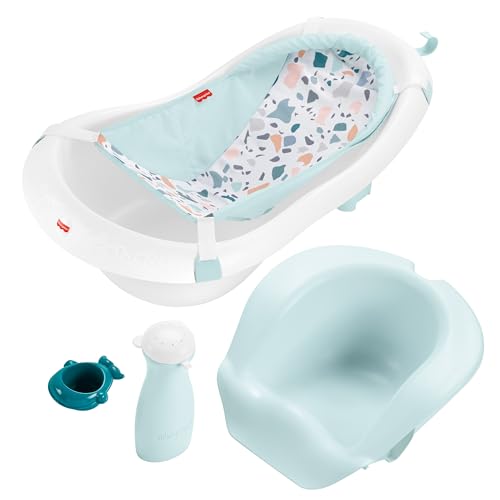
| Multi-stage tub (Skip Hop Moby style, Fisher-Price Sling ‘n Seat style) | Newborn through sitting stage | Removable sling or insert, drain plug, non-slip base, sometimes a temperature indicator | More parts to dry, size takes space |
| Foldable or collapsible tub (Stokke Flexi Bath style and similar) | Small bathrooms, travel | Folds flat, hangs to dry, often soft materials | Less stable when full, newborn support varies |
| Contoured newborn tub (Primo EuroBath style) | Newborn to sitting | Two-position design, integrated drain | Bulky, adult-height placement needs care |
| Sink insert or sink bath (Blooming Bath style) | Tiny spaces, newborns | Soft cushioned shape designed to sit in a kitchen sink | Fit depends on the sink, limited age range |
| Standalone toddler tub | Sitters, toddlers | Wide base, non-slip surface, often with a small toy tray | Not for newborns, takes more water |
What to look at
Newborn support
Newborns cannot hold their heads up, so the key feature is secure support under the head and back, with a design that keeps the baby reclined and the face clear of the water. Makers describe slings, hammocks and contoured inserts for this stage. Reviewers generally report that a good sling reduces the need to handle the baby awkwardly, but it does not replace holding the baby.
Stability and slip resistance
Wide bases and non-slip feet or a textured floor help a tub stay put. Foldable models tend to be less rigid, and some reviewers prefer them in a bathtub where the base steadies them, rather than on a counter. Do not place any tub on a raised counter where it can be knocked, and follow the maker’s installation guidance.
Drain and water depth
A drain plug makes emptying easy and avoids lifting a full tub. Some tubs include water-level markers or temperature indicators, and while helpful, they do not replace testing the water yourself. Use only a shallow depth, as advised by the maker and by your paediatrician.
Cleaning and drying
Mold can grow in damp crevices, so look for removable parts and smooth surfaces. Rinse the tub after each use, dry it, and follow the manual’s guidance on cleaning products. Tubs with a hanging hook dry more easily.
Space and storage
- Bathtub use: larger tubs sit in the adult bath, but you have to kneel or lean, so consider a kneeling pad for your comfort.
- Sink use: measure the sink to ensure the tub fits without wobbling.
- Storage: foldable tubs store flat, multi-stage tubs take shelf space, and tall tubs may not fit in a small cabinet.
- Travel: collapsible tubs pack into suitcases, but confirm they are stable on the surface where you will use them.
Budget tiers
| Tier | What to expect | Trade-off |
|---|---|---|
| Budget | Simple plastic tub, sometimes with a basic sling | Fewer features, can feel less polished |
| Mid-range | Multi-stage tubs with drain plugs, non-slip bases, and sling inserts | More parts to clean |
| Premium | Design-led foldable or well-built contoured tubs | Cost, and some designs are limited to specific ages |
Pick X if you…
| If you… | Pick |
|---|---|
| Have a newborn and want the safest set-up | Multi-stage tub with a newborn sling or contoured insert |
| Live in a small apartment | Foldable tub that hangs or stores flat |
| Bathe in the kitchen sink | Sink insert sized to your sink |
| Want one tub for the first year | Grow-with-baby multi-stage tub |
| Travel often | Collapsible tub |
| Have a sitting baby or toddler | Wide, non-slip toddler tub |
Alternatives
- Bathing in the adult bath with a parent: some families bathe the baby with a parent, which needs two adults for safe handover.
- Sponge baths: early on, many paediatric services suggest sponge baths until the umbilical stump heals, so follow your healthcare provider’s advice.
- Bath mats and supports: an inflatable or foam mat for the adult tub can provide a non-slip surface for older babies, but only with an adult in constant attendance.
Frequently Asked Questions
When can I start using a baby bath tub?
Many families start once the umbilical stump has fallen off, but your paediatrician can give guidance for your baby. Until then, sponge baths are often advised. Always follow the tub’s age and weight limits.
How deep should the water be?
Keep it shallow, as advised in the maker’s manual, and check with your paediatrician. Deep water increases risk, and a baby can drown in a small amount of water. Hold the baby at all times.
What water temperature is safe?
Lukewarm water is the general guidance. Test with your wrist or a bath thermometer, and set your home water heater according to local safety advice to reduce scald risk.
Can I use a bath seat for my baby?
Bath seats are not safety devices, and many safety organizations warn that they can tip or slip. They are not a substitute for supervision. Keep the baby within arm’s reach.
How often should I bathe my baby?
Many paediatric sources suggest that a few baths per week are enough for newborns, because frequent baths can dry skin. Your healthcare provider can advise on a routine that suits your baby.
How do I keep a tub clean?
Rinse and dry it after each use, and clean periodically with mild soap or the product recommended in the manual. Allow all parts to air-dry completely to limit mold growth.
FAQ
When can I start using a baby bath tub?
How deep should the water be?
What water temperature is safe?
Can I use a bath seat for my baby?
How often should I bathe my baby?
How do I keep a tub clean?
More from Amazon
Programs that pair well with the guide above. Offers and eligibility are set by Amazon and may change.
Free shipping on eligible items, Prime Video and more. Eligible new members can start with a free trial.
Start a Prime free trialAudiobooks and podcasts to listen to on the go. Eligible new members can start with a free trial.
Try Audible freeAd-free music streaming. Eligible new subscribers can start with a free trial.
Try Music Unlimited freeA free business account with business pricing and bulk-buying tools for work, shop or home office.
Create a business accountAs an Amazon Associate we earn from qualifying purchases.