Key takeaways
- Emergency stop: A magnetic clip or tether should stop the belt when pulled. Position it so a handler can reach it immediately.
- Side guards: Low walls can discourage stepping off sideways, but they should not block supervision or force a large dog into a cramped lane.
- Stable feet: Rubber feet and a rigid frame reduce belt movement. Place the treadmill on a level, non-slip surface rather than a thick, unstable rug.
- Small speed increments: Changes of 0.1–0.2 mph are easier to control than abrupt jumps.
- Visible controls: The stop button should be easy to identify without reaching across the moving belt.
- Cool-running motor: Repeated sessions generate heat. Airflow around the housing and a motor designed for continuous operation reduce strain.
Best Dog Treadmills for Safe Indoor Exercise
The best dog treadmills match the dog’s usable belt length, weight—not merely the advertised maximum—speed range, safety controls, and storage footprint to the way your dog will exercise. For most homes, a low-noise treadmill with a belt at least 1.5 times the dog’s standing body length, a conservative speed range, side guards, and an emergency stop is the safest starting point.
Quick picks by dog and household
| Best suited to | Recommended belt size | Useful speed range | Target weight capacity | Priority features |
|---|---|---|---|---|
| Small dogs under 15 lb | 28–35 in long × 14–18 in wide | 0.3–5 mph | At least 1.5× the dog’s weight | Very low starting speed, quiet motor, short side rails |
| Small or medium dogs, 15–40 lb | 35–45 in × 16–20 in | 0.5–7 mph | At least 1.5× the dog’s weight | Adjustable speed, emergency stop, stable frame |
| Medium or large dogs, 40–75 lb | 45–55 in × 18–22 in | 0.5–8 mph | At least 1.25× the dog’s weight | Long belt, strong handrails or side panels, good cooling |
| Large dogs over 75 lb | 55–70 in × 20–24 in | 0.5–8 mph or more | At least 1.25× the dog’s weight | Commercial-grade frame, wide belt, replaceable parts |
These are selection targets rather than guarantees. A dog that takes long strides, moves awkwardly, or is still learning may need a longer belt than its weight suggests. The dog should be able to walk without repeatedly stepping close to the front or rear edge.
Our top picks


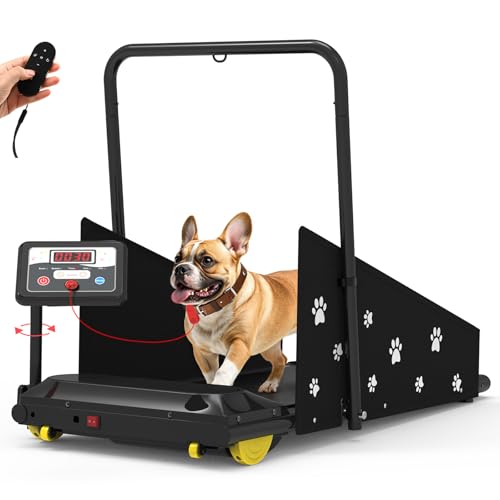

As an Amazon Associate we earn from qualifying purchases at no extra cost to you. Ratings are shown as listed on Amazon.
What makes the best dog treadmills different?
Belt dimensions matter more than maximum speed
A treadmill rated for a dog’s weight can still be unsuitable if its belt is too short. Measure from the floor to the top of the shoulders while the dog is standing, then measure the body from the chest to the base of the tail. For a practical fit check, use the longer body measurement and multiply it by 1.5. Add another 4–6 inches if the dog has a long stride or tends to speed up and slow down.
For example, a dog with a 30-inch body length should ideally use a belt about 45 inches long or longer. A 36-inch belt may support the dog’s weight but leave little room for natural movement. Belt width also affects confidence: narrow belts can make a dog hesitate, especially when side panels restrict its view.
Weight capacity needs a safety margin
Do not select a treadmill whose maximum capacity exactly matches the dog’s current weight. The motor must also handle acceleration, shifting weight, and the friction created by a belt that is not perfectly lubricated. For regular use, choose a rated capacity at least 25% above the dog’s weight; for heavier dogs, frequent sessions, or incline work, 50% above is a more comfortable margin.
A 60-pound dog should therefore use a machine rated for at least 75 pounds, and preferably 90 pounds if it will be used several times per week. Capacity ratings are not a substitute for veterinary guidance when a dog has pain, weakness, balance problems, or a recent injury.
Look for controlled, low-speed movement
Many dogs need a walking pace rather than a running pace. The most useful range begins around 0.3–0.5 mph and increases in small increments. A machine that starts at 1 mph may be too fast for a nervous beginner, a senior dog, or a small dog with short legs.
For general indoor exercise, speeds between 1.5 and 4 mph cover many walking sessions. Higher speeds can be useful for fit, experienced dogs, but they are not automatically better. A gradual speed ramp, a clearly visible display, and a wired or magnetic safety clip are more valuable than an unusually high top speed.
Decision matrix: which type fits your situation?
| Your situation | Best choice | Why | Trade-off |
|---|---|---|---|
| Occasional use and limited budget | Compact walking treadmill with a 35–45-inch belt | Usually sufficient for short, low-speed sessions | Less suitable for large dogs or running |
| Daily use by a medium or large dog | Long-belt treadmill with a metal frame and replaceable belt | Better stability and durability under repeated loading | Higher purchase price and larger footprint |
| Nervous or inexperienced dog | Low-speed model with open sides, quiet operation, and a front rail | Makes acclimation and visual supervision easier | May require more room around the machine |
| Small apartment | Folding or wheeled model with a stored depth under about 24 inches | Can be moved after each session | Folding hinges and lighter frames may reduce rigidity |
| High-frequency training | Heavy-duty model with continuous-duty motor and serviceable deck | Better suited to repeated sessions and heat management | Usually heavier, louder, and more expensive |
Safety features worth paying for
- Emergency stop: A magnetic clip or tether should stop the belt when pulled. Position it so a handler can reach it immediately.
- Side guards: Low walls can discourage stepping off sideways, but they should not block supervision or force a large dog into a cramped lane.
- Stable feet: Rubber feet and a rigid frame reduce belt movement. Place the treadmill on a level, non-slip surface rather than a thick, unstable rug.
- Small speed increments: Changes of 0.1–0.2 mph are easier to control than abrupt jumps.
- Visible controls: The stop button should be easy to identify without reaching across the moving belt.
- Cool-running motor: Repeated sessions generate heat. Airflow around the housing and a motor designed for continuous operation reduce strain.
Never attach a dog to the treadmill and leave the room. A leash can catch, a dog can panic, and even a correctly sized machine cannot respond to every change in gait. Use a flat collar or a well-fitting harness only when appropriate, and avoid dangling tags or loose clothing near the belt.
How to introduce a dog to a treadmill
- Let the dog investigate it while it is switched off. Reward calm behavior near the machine. Do not lift or force the dog onto the belt.
- Practice standing on the stationary belt. Keep all four paws on the surface briefly, then end the session before the dog becomes worried.
- Start at the lowest speed. Stand beside the treadmill, use a calm voice, and watch the dog’s feet and posture. Begin with roughly 30–60 seconds.
- Increase duration before speed. Add a minute or two over several sessions if the dog remains relaxed. Only then increase speed in small steps.
- Stop for warning signs. Repeatedly looking back, crouching, scrambling, limping, excessive panting, refusing food rewards, or trying to jump off means the session should end.
A treadmill should supplement—not replace—outdoor opportunities for sniffing, varied surfaces, and social interaction. If a dog shows a new limp, pain, unusual fatigue, or a major change in gait, stop using the machine and consult a veterinarian or qualified rehabilitation professional.
Storage, maintenance, and ownership costs
Measure the machine in both operating and folded positions. Leave at least 24 inches of clear space on each side and more room at the front and rear for supervision. A treadmill that technically fits under a bed but is too heavy to move will probably be used less often than expected.
The belt and deck are usually the first wear points. Hair and grit increase friction, so vacuum around the motor housing and under the side edges regularly. Wipe the running surface with a barely damp cloth and use only the lubricant specified by the manufacturer. Over-lubricating can cause slipping and attract debris, while neglecting lubrication can increase motor load.
Check belt alignment before each session. A belt drifting to one side can rub the frame and wear the edge. Inspect the emergency clip, power cord, feet, and side panels monthly. Replace a cracked belt, frayed cord, or unreliable stop mechanism rather than continuing to use it.
As a simple ownership calculation, a $700 treadmill used four times per week for three years provides about 624 sessions. Before repairs or electricity, that is approximately $1.12 per session. A cheaper model costing $350 but used only once weekly for the same period costs about $2.24 per session. The better value is usually the machine whose size, noise level, and storage arrangement make regular use realistic.
Bottom line
The best dog treadmills are not necessarily the fastest or smallest. Choose a belt long enough for a natural stride, capacity with a safety margin, a starting speed below your dog’s comfortable walking pace, dependable emergency controls, and a storage design you will actually use. For uncertain sizing or dogs with medical, orthopedic, or neurological concerns, confirm the choice with a veterinarian or canine rehabilitation professional before beginning treadmill exercise.