Key takeaways
- Small trout streams: A 3-weight or 4-weight rod, 7 to 8 feet long, with moderate or moderate-fast action. It loads easily at short range and helps protect light tippets.
- General trout fishing: A 5-weight, 9-foot, four-piece rod with medium-fast or fast action. This is the most versatile choice for rivers, lakes, dry flies, nymphs, and modest streamers.
- Large rivers and windy conditions: A 6-weight, 9-foot rod with fast action. It carries heavier flies, longer leaders, and sinking lines more effectively than a typical 5-weight.
- Beginner casting: A 5-weight, 9-foot, moderate-fast rod. It provides enough feedback to learn timing without feeling as unforgiving as an extremely fast rod.
- Saltwater flats: An 8-weight, 9-foot rod with fast action, corrosion-resistant components, and a fighting butt. Choose a 9-weight or 10-weight when targeting larger species or casting bulky flies in strong wind.
The best fly fishing rods are matched first to the water and fish, then to your casting ability: choose a 3- to 5-weight rod for most trout streams, a 5- to 6-weight for larger rivers and general freshwater use, and a 7- to 9-weight for saltwater and powerful fish.
Our top picks

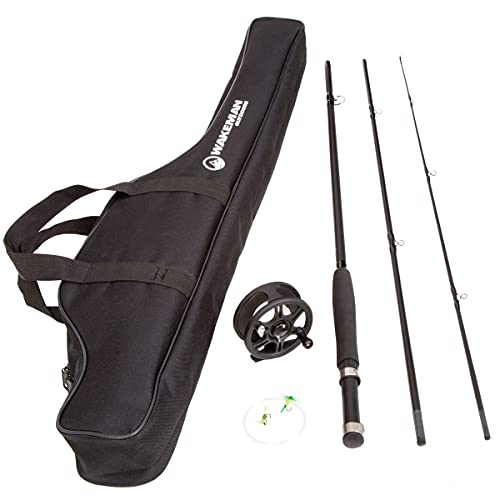


As an Amazon Associate we earn from qualifying purchases at no extra cost to you. Ratings are shown as listed on Amazon.
Quick picks by fishing situation
- Small trout streams: A 3-weight or 4-weight rod, 7 to 8 feet long, with moderate or moderate-fast action. It loads easily at short range and helps protect light tippets.
- General trout fishing: A 5-weight, 9-foot, four-piece rod with medium-fast or fast action. This is the most versatile choice for rivers, lakes, dry flies, nymphs, and modest streamers.
- Large rivers and windy conditions: A 6-weight, 9-foot rod with fast action. It carries heavier flies, longer leaders, and sinking lines more effectively than a typical 5-weight.
- Beginner casting: A 5-weight, 9-foot, moderate-fast rod. It provides enough feedback to learn timing without feeling as unforgiving as an extremely fast rod.
- Saltwater flats: An 8-weight, 9-foot rod with fast action, corrosion-resistant components, and a fighting butt. Choose a 9-weight or 10-weight when targeting larger species or casting bulky flies in strong wind.
What rod weight actually changes
Rod weight describes the fly line the rod is designed to cast, not the weight of the fish. A 3-weight line is light and delicate; an 8-weight line carries more momentum and turns over larger flies and leaders. Heavier rods are generally more powerful but also less pleasant for small flies and light tippets.
| Rod weight | Typical length | Best use | Practical limitations |
|---|---|---|---|
| 2-3 wt | 6’6"-8′ | Tiny streams, small trout, delicate presentations | Limited distance, wind performance, and fly size |
| 4 wt | 7’6"-9′ | Small to medium trout water, dry flies, light nymphs | Less authority with heavy indicators and streamers |
| 5 wt | 8’6"-9′ | All-around trout fishing and learning | Not ideal for very large flies or strong saltwater fish |
| 6 wt | 9′-10′ | Large rivers, wind, streamers, heavier nymph rigs | Can feel excessive on small water |
| 7-8 wt | 9′ | Bass, salmon, light saltwater, flats fishing | More tiring and less delicate for small trout |
| 9-10 wt | 9′ | Large saltwater species, big flies, strong wind | Requires more casting effort and heavier tackle |
Length and action: the two choices beginners notice most
Length
A 9-foot rod is the safest general-purpose length because it balances line control, reach, mending ability, and transport. Choose a shorter rod when bankside vegetation and tight backcasts are the main problem. A 7- to 8-foot rod is easier to maneuver on narrow mountain streams, although it gives up some reach and line control.
Longer rods, including 10-foot 4-weights and 5-weights, are useful for high-sticking and European-style nymphing because they keep more line off the water. They are less convenient in dense brush and may feel cumbersome for conventional dry-fly casting.
Action
- Moderate action: The blank bends farther down the rod. It slows the casting stroke, provides clear feedback, and is forgiving when timing is inconsistent. It is well suited to short-range dry-fly fishing and beginners.
- Moderate-fast action: A versatile middle ground. It loads at ordinary trout-fishing distances but still provides enough recovery speed for mending, roll casts, and moderate wind.
- Fast action: The tip recovers quickly and the rod stores power efficiently. It excels at distance, wind, heavy flies, and saltwater, but poor timing can make it feel stiff and difficult to load at short range.
For a first rod, moderate-fast is usually a better decision than choosing the fastest model available. A rod that loads with 20 to 40 feet of line is easier to learn on than one designed primarily for long-distance casting.
Materials, pieces, and durability
Most modern fly rods are made from graphite, also called carbon fiber. Higher-modulus graphite can produce a lighter, faster rod, but stiffness alone does not determine quality. Resin systems, blank design, ferrule construction, guides, and quality control also affect feel and durability.
Fiberglass rods remain attractive for short-range trout fishing because they bend deeply, cast smoothly, and tolerate casual handling well. They are usually heavier and slower than graphite rods, and they are not the first choice for long casts or strong wind.
A four-piece rod is the practical default. It fits in a vehicle or carry-on-sized rod tube more easily than a two-piece model and is usually no less capable when properly assembled. A two-piece rod can offer a simple, traditional feel, but its longer case is inconvenient for travel. More sections, such as a six- or eight-piece travel rod, improve portability but add ferrules and require more careful assembly.
The parts most likely to suffer in ownership are the tip section, stripping guides, ceramic inserts, cork grip, and ferrules. Never use a fly rod to lift a fish, shut a car door on the blank, or pull a snag by sharply loading the rod. Pull directly on the line while keeping the rod low. After saltwater use, rinse the rod, reel, and line with fresh water and allow them to dry before storage.
Decision matrix: choose by experience, budget, and frequency
| Your situation | Recommended specification | Why it fits | Typical market range |
|---|---|---|---|
| First rod, occasional trout trips | 9′ 5 wt, four-piece, moderate-fast graphite | Versatile and forgiving without outgrowing beginner skills | About $100-$250 for a complete outfit |
| Frequent small-stream fishing | 7’6"-8′ 3 or 4 wt, moderate action | Shorter length improves accuracy around branches | About $150-$500 for the rod |
| One rod for varied trout water | 9′ 5 wt, four-piece, medium-fast or fast | Handles dries, nymphs, streamers, and moderate wind | About $200-$1,000 for the rod |
| Large rivers and frequent streamer use | 9′ 6 wt, fast action | More line speed and lifting power for bulky rigs | About $250-$1,100 for the rod |
| Travel with limited luggage space | 8’6"-9′ four- or six-piece rod | Short tube reduces transport problems | About $200-$900 for the rod |
| Saltwater flats | 9′ 8 wt, fast action, fighting butt | Turns over bulky flies and resists wind | About $300-$1,200 for the rod |
Rod families worth considering
For value-oriented trout fishing, established entry-level families such as the Orvis Clearwater, Redington Classic Trout, and Echo Base are common choices. They cover practical trout sizes without requiring premium pricing.
For anglers who fish often and want lighter weight, faster recovery, and more refined components, premium lines such as the Scott Centric, Sage R8, and G. Loomis NRX+ represent the performance-focused end of the market. Their advantages matter most when casting frequently, fishing varied distances, or demanding precise line control; they will not compensate for an incorrectly matched line or poor timing.
For small-stream specialists, compare fiberglass and shorter graphite rods rather than automatically buying a standard 9-foot 5-weight. For saltwater, prioritize corrosion resistance, a strong fighting butt, durable guides, and a manufacturer’s repair support over an especially light scale weight.
Set up the rod correctly before judging it
- Match the line weight: Start with a line labeled for the rod’s specified weight. A 5-weight rod normally needs a 5-weight line, though specialized “half-size heavy” lines may load some rods more quickly at short range.
- Assemble the sections: Align the guides and seat each ferrule firmly with a gentle twisting motion. Do not force sections together by striking them against the ground.
- Attach backing, line, leader, and tippet: A typical trout setup uses backing on the reel, weight-forward fly line, a 7.5- to 9-foot tapered leader, and 2 to 4 feet of tippet.
- Check the guides: Run a cloth or cotton swab through each guide. Snags can reveal a chipped insert that may cut fly line or leader.
- Practice at realistic distance: Begin with 25 to 35 feet of line outside the rod tip. If the rod feels dead, check the line match and casting tempo before replacing it.
Ownership costs and common mistakes
The rod is only part of the system. Fly line, leaders, tippet, backing, reel maintenance, and replacement tips contribute to long-term cost. A quality fly line may last several seasons with regular cleaning, while leaders and tippet are consumables replaced throughout the year. Cleaning the line periodically with the manufacturer’s approved dressing helps preserve flotation and shooting performance.
The most common buying mistake is selecting by maximum casting distance rather than the distance actually fished. Another is using a 5-weight for every situation: it can work for trout, but a 3-weight is more enjoyable on small water and a 6-weight is safer when throwing large streamers or fishing heavy wind. If you fish one type of water most of the time, optimize for that water; if you fish varied locations, a 9-foot 5-weight moderate-fast rod remains the strongest starting point.
Frequently asked questions
Is a 5-weight rod the best first fly rod?
For most new anglers, yes. A 9-foot 5-weight covers common trout conditions, teaches fundamental casting, and has enough power for moderate wind and ordinary nymph or streamer rigs.
Should beginners choose a slow or fast rod?
A moderate-fast rod is usually the best compromise. Slow rods are pleasant at short range, while fast rods are powerful but demand more precise timing and can feel difficult to load during short casts.
Can one rod handle trout and bass?
A 6-weight can bridge those uses better than a 5-weight, especially when bass flies are bulky. For small trout streams, however, it will feel unnecessarily heavy.
How much should be spent?
Buy the best-supported outfit that fits the water you fish. Entry-level rods can cast effectively, while higher-priced rods mainly add lighter weight, faster recovery, refined balance, and stronger warranty or repair support. Correct weight and line matching matter more than choosing the most expensive blank.