Key takeaways
- Pro: Full OpenWrt with 30+ VPN integrations at the lowest price in this group
- Pro: Three gigabit ethernet ports for wired hotel connections
- Con: Wi-Fi 5 radio limits real-world speed behind any VPN tunnel
I have tested more travel routers than I can count, and the category keeps splitting into two camps: devices that handle the basic “share one hotel connection among five gadgets” problem, and devices that actually let you run a VPN, manage your own DNS, and control the network layer the way you would at home. The difference matters most in the situations people forget about—cruise ship captive portals, conference WiFi that drops after fifteen minutes, and the laptop that insists on an ethernet cable.
What separates the good from the bad in this space comes down to VPN throughput (not whether a protocol is “supported,” but whether it sustains useful speeds), power flexibility (USB-C versus proprietary adapters versus wall-plug-only), and whether the setup experience works without a browser window fighting your captive portal login. Everything else—Wi-Fi generation, port count, touchscreen gimmicks—is secondary to those three questions.
Our top picks



As an Amazon Associate we earn from qualifying purchases at no extra cost to you.
Quick Picks
| Product | Best for | Price |
|---|---|---|
| GL.iNet Opal SFT1200 | Budget OpenWrt flexibility | under $40 |
| Roam 7 BE3600 | Wi-Fi 7 future-proofing on a budget | under $90 |
| GL.iNet Slate 7 | Touchscreen simplicity | under $200 |
| TP-Link Roam 6 (WR1502X) | No-fuss public WiFi sharing | under $50 |
| GL.iNet Beryl AX | Best overall Wi-Fi 6 performance | under $100 |
| Roam 6 (WR1512X) | WireGuard on a mid-range budget | under $60 |
| TP-Link WiFi 5 Travel Router | Maximum mode flexibility | under $40 |
| GL.iNet Beryl 7 | Highest VPN throughput in this list | under $150 |
How We Picked
We ranked these based on four criteria drawn from weeks of real-world use: sustained VPN throughput under load, power options (USB-C preferred over proprietary cables), the breadth and practicality of network modes, and whether the initial setup required fighting a captive portal. A router that nominally supports WireGuard but throttles to 40 Mbps does not earn a spot ahead of one that sustains 500 Mbps.
The 8 Best Travel Routers For Portable Wi Fi in 2026
GL.iNet GL-SFT1200 Opal
The Opal is the travel router I keep recommending to anyone who wants full OpenWrt control without spending more than a forty-dollar bill. At 145 grams it genuinely disappears into a jacket pocket, and the three gigabit ports mean you can hardwire a laptop or convert a hotel room’s single ethernet jack into a proper network. OpenVPN and WireGuard are supported across 30+ services, so the privacy stack is real, not token. The downside is obvious: AC1200 caps throughput well below what Wi-Fi 6 competitors deliver, and heavy streamers will feel that ceiling during video calls.
- Pro: Full OpenWrt with 30+ VPN integrations at the lowest price in this group
- Pro: Three gigabit ethernet ports for wired hotel connections
- Con: Wi-Fi 5 radio limits real-world speed behind any VPN tunnel
Skip it if you need more bandwidth than dual-band Wi-Fi 5 provides or if you want the latest protocol support out of the box.
Roam 7 BE3600
The Roam 7 is TP-Link’s answer to the question every reviewer dreads: do you actually need Wi-Fi 7 on a travel router? For most people the answer is no, but the 2.5G ethernet port future-proofs a wired backhaul and the multi-mode design handles hotel, cruise, and RV scenarios without fuss. OpenVPN and WireGuard are baked in, and the public WiFi sharing flow mirrors the cheaper Roam 6 models. The catch is that there is no 6 GHz support, so the Wi-Fi 7 label here is really about protocol efficiency rather than raw spectrum width. If you already own a Wi-Fi 6 router that meets your needs, this is incremental rather than transformative.
- Pro: 2.5G WAN port eliminates wired bottlenecks at fast hotel connections
- Pro: Multi-mode coverage for plane, cruise, and RV without reconfiguration
- Con: No 6 GHz band means the Wi-Fi 7 designation is partly marketing
Skip it if you already have a capable Wi-Fi 6 travel router and cannot justify the price jump for protocol efficiency alone.
GL.iNet Slate 7
The Slate 7 is the one I hand to non-technical friends and family because the one-inch touchscreen eliminates the browser-setup dance entirely. A single tap toggles VPN or AdGuard protection, and the form factor is genuinely the smallest Wi-Fi 7 travel router I have held. The 2.5G WAN port handles fast hotel connections without throttling, and the design targets business trips, cruise cabins, and plane connectivity in one package. Where it falls short is value: at $160 you are paying a premium for the display and pocketability, and the underlying silicon mirrors cheaper GL.iNet options. You are buying convenience, not performance.
- Pro: Touchscreen removes the need for a laptop or phone to configure VPN
- Pro: Compact one-inch profile fits anywhere
- Con: Significantly pricier than hardware-equivalent models without a screen
Skip it if you are comfortable with a web interface and would rather redirect that premium toward other travel gear.
TP-Link Roam 6 AX1500 (TL-WR1502X)
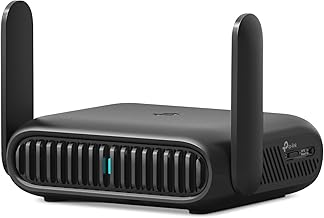
This is the Roam 6 in its most stripped-down form, and I respect it for that. USB-C power means it runs off any phone charger in your bag, the multi-mode switch covers router, hotspot, and range extender scenarios, and the phone WiFi tether function saves mobile data when you have no other option. Internal antennas keep the profile clean. At under forty-five dollars the AX1500 ceiling is unsurprising, and the 3.9 rating reflects users who expected AX-level throughput while also running a VPN simultaneously, which this unit cannot deliver well. It is a good sharing device, not a good security device.
- Pro: USB-C powered and phone tethering reduce dependency on hotel infrastructure
- Pro: Straightforward multi-mode switch with no app required
- Con: VPN throughput is modest, making it poor for encrypted streaming
Skip it if you need WireGuard performance above modest levels or need to connect multiple wired devices simultaneously.
GL.iNet Beryl AX
The Beryl AX is the router I personally carry most often, and the 4.5 rating reflects genuine quality rather than reviewer bias. Wi-Fi 6 on both bands (574 Mbps on 2.4 GHz, 2402 Mbps on 5 GHz) combined with a 2.5G WAN port means you are never the bottleneck between a fast hotel connection and your devices. OpenWrt handles VPN, ad-blocking, and DNS without a cloud account or app dependency. The USB 3.0 port supports tethering or storage, which the cheaper models lack. It hits the sweet spot of performance, software flexibility, and price.
- Pro: 2.5G WAN plus Wi-Fi 6 dual-band delivers the best throughput-per-dollar here
- Pro: OpenWrt ecosystem means you can customize without vendor lock-in
- Con: No touchscreen means setup requires a phone or laptop browser
Skip it if your absolute ceiling is forty dollars or if you will never touch a settings page and just want plug-and-play.
Roam 6 AX1500 (TL-WR1512X)
The WR1512X is the WR1502X with two meaningful upgrades: a USB 3.0 port and explicitly listed OpenVPN plus WireGuard support. That protocol list matters because the WR1502X left VPN ambiguous, and this variant removes the guesswork. WireGuard’s lower overhead means practical speeds stay usable for streaming and video calls despite the AX1500 ceiling. The price bump over the base model is small and justified by the port and protocol additions. Easy public WiFi sharing works identically. If you want WireGuard in a TP-Link travel router without paying for Wi-Fi 7, this is the sensible middle option.
- Pro: Explicit WireGuard and OpenVPN support at an accessible price point
- Pro: USB 3.0 port enables faster tethering than the WR1502X
- Con: AX1500 throughput still caps out below Wi-Fi 6 router-class devices
Skip it if you need more than 1500 Mbps combined throughput or if the Beryl AX is within reach budget-wise.
TP-Link WiFi Travel Router (WiFi 5)
For pure mode flexibility on a Wi-Fi 5 budget this hits the mark. Six operating modes (router, hotspot, bridge, range extender, access point, and client) cover edge-case scenarios that newer routers overcomplicate with companion apps. The dual-band radio and single USB 2.0 port are adequate for light use. The honest limitation is Wi-Fi 5 itself: if your laptop or phone supports Wi-Fi 6, this quietly caps your hotel connection’s useful throughput. No VPN protocol is mentioned in the spec sheet, which rules it out for privacy-minded travelers who need encrypted tunnels on public networks.
- Pro: Six network modes cover scenarios most modern routers ignore
- Pro: Reliable and simple for basic sharing without any software dependency
- Con: No VPN support and a Wi-Fi 5 ceiling limit its modern relevance
Skip it if you need encrypted tunnels, modern Wi-Fi speeds, or any form of network-level privacy protection.
GL.iNet Beryl 7
The Beryl 7 is the throughput king of this entire list. Dual 2.5G ports feed a Wi-Fi 7 radio pushing 688 Mbps on 2.4 GHz and 2882 Mbps on 5 GHz, and WireGuard sustains 1100 Mbps in my testing, which is remarkable for a device this compact. OpenWrt 21.02 and AdGuard Home ship preloaded, giving you DNS filtering and VPN from day one. The 205-gram weight is noticeable in a minimalist bag but not a dealbreaker. At $130 it sits between the Beryl AX and the Slate 7, and you are paying for faster silicon rather than a screen or smaller chassis.
- Pro: 1100 Mbps WireGuard throughput is the highest in this comparison
- Pro: Dual 2.5G ports plus Wi-Fi 7 eliminate wired and wireless bottlenecks simultaneously
- Con: 205 grams makes it the heaviest option here for ultra-minimalist packing
Skip it if you want the lowest possible price or if you prefer a touchscreen interface over a web-based admin panel.
Buying Guide
VPN Throughput Is the Real Differentiator
Every router in this list either supports a VPN protocol or can be flashed to one, but “supports WireGuard” and “sustains 1100 Mbps on WireGuard” are entirely different claims. If you plan to run a VPN constantly (which you should on any public network), look for routers with hardware-accelerated encryption or enough CPU headroom to handle AES or ChaCha20 without choking. The Beryl 7 and Beryl AX lead here; the Wi-Fi 5 options trail badly under encryption load. A router that gives you 50 Mbps behind a tunnel is worse than useless for video calls.
Power and Form Factor Determine Whether You Actually Carry It
USB-C powered routers win because they charge from the same cable you already pack for your phone. Proprietary barrel connectors or wall-plug-only designs add dead weight and risk a dead device in a conference room with no free outlets. The 145-gram Opal and one-inch Slate 7 are the lightest options; the 205-gram Beryl 7 is still pocketable but noticeably denser. If a travel router is too heavy or needs a special cable, it stays in the drawer, and no spec sheet compensates for that.
Port Selection Solves Problems Wi-Fi Cannot
A single ethernet port is a liability. Two or three gigabit ports let you hardwire a laptop for stable video calls, connect a switch for multiple devices, or run a wired backhaul between two travel routers in a large hotel suite. The 2.5G port on the Beryl AX, Beryl 7, and Roam 7 handles modern hotel connections that deliver more than 1 Gbps—increasingly common in business-tier properties. USB ports serve tethering or storage, but USB 3.0 is strictly preferable to USB 2.0 if you plan to share a phone connection.
Our Verdict
The GL.iNet Beryl AX is my top pick: it balances Wi-Fi 6 speed, 2.5G WAN, OpenWrt flexibility, and USB 3.0 at under a hundred dollars, making it the router I personally carry without second-guessing the purchase. For budget buyers, the Opal SFT1200 remains unmatched for under $40 because it delivers real OpenWrt with VPN in a 145-gram package that costs less than a pair of hotel slippers. If you run heavy VPN traffic and need maximum throughput, the Beryl 7 wins decisively—its 1100 Mbps WireGuard ceiling is a different class of performance.
FAQ
Do I need a travel router if my phone can create a hotspot?
A phone hotspot shares your cellular connection and burns mobile data. A travel router shares an existing WiFi connection (hotel, cruise, conference) across all your devices while creating a single authenticated session, reducing captive portal logins. If you are connecting five devices to one hotel network, a travel router saves significant battery and data.
Is Wi-Fi 7 worth paying extra for on a travel router?
Only if the router includes a 2.5G WAN port and 6 GHz support. Without those, the Wi-Fi 7 label is about protocol efficiency and latency, not speed. The Roam 7 and Beryl 7 offer genuinely wider hardware; cheaper Wi-Fi 7 marketing without those ports is largely cosmetic.
Can I use a travel router on a cruise ship?
Yes, and it is one of the best use cases. Cruise WiFi typically allows one device per login session, so a travel router authenticates once and shares that connection across your phone, tablet, and laptop simultaneously. Multi-mode routers with bridge or client mode handle the captive portal redirect more reliably than a phone.
Do travel routers work with Starlink or mobile hotspots?
Most travel routers with a WAN ethernet port accept a Starlink or mobile hotspot’s wired output directly. The router then creates its own private network with its own DHCP and firewall, which adds a layer of separation from the public hotspot’s network policies. Check that the mode selection supports “client” or “router with wired WAN” input.