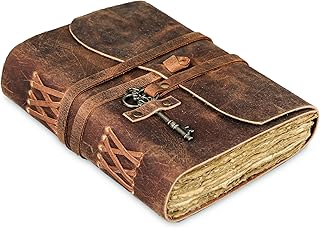
Finding the ideal leather journal for writing and sketching requires balancing tactile aesthetics with functional performance. Whether you are capturing daily thoughts, drafting your next novel, or rendering quick watercolor sketches on the go, the tactile nature of leather combined with archival-grade paper creates an irreplaceable creative companion. The market offers an overwhelming array of options, making it easy to get distracted by flashy exterior designs while overlooking the core mechanical features that dictate daily usability.
This guide cuts through the marketing fluff to focus on what actually matters when investing in a quality notebook. From understanding how different tanning processes affect durability to matching paper weight with your preferred medium, making an informed choice ensures your journal ages gracefully alongside your work. Let’s break down the essential specifications, common pitfalls, and structural elements you need to evaluate before making a purchase.
As an Amazon Associate we earn from qualifying purchases at no extra cost to you.
Understanding Leather Grades and Tanning Methods
The type of leather used for the cover dictates not only how the journal looks on day one, but how it will age over the next decade. Full-grain leather is the gold standard because it retains the entire natural grain layer, allowing it to develop a rich patina through daily handling and exposure to oils. Top-grain leather has been sanded to remove imperfections, making it more uniform and slightly softer immediately, though it lacks the rugged longevity of full-grain. Avoid bonded leather entirely, as it consists of leather scraps glued together and will crack and peel under stress. Furthermore, consider the tanning process: vegetable-tanned leather uses organic tannins and develops a gorgeous patina, while chrome-tanned leather is softer and more water-resistant out of the box but lacks traditional aging characteristics.
Paper Weight and Medium Compatibility
Paper is the heart of any journal, yet it is frequently treated as an afterthought by manufacturers targeting casual buyers. If you primarily use a fine-nib ballpoint pen or pencil, a standard 80 GSM paper stock will suffice without bleeding through to the reverse side. However, fountain pen users, marker enthusiasts, and sketchers require significantly heavier stock. For fountain pens and light marker work, look for a minimum of 100 to 120 GSM paper with sizing that prevents feathering. If your creative process involves wet media like watercolor washes, gouache, or ink washes, you need specialized mixed-media or watercolor paper rated at 140 GSM or higher, combined with internal sizing to prevent buckling.
Evaluating Binding Integrity and Lay-Flat Performance
A beautiful cover means little if the binding fails after three months of active use. Case-bound notebooks glued at the spine often struggle to stay open on a desk, forcing you to hold them down while writing or sketching. Smyth-sewn or coptic-stitched bindings are vastly superior because the signatures are physically sewn together and glued, allowing the book to naturally relax and lay completely flat at a one-hundred-eighty-degree angle. If you opt for a refillable leather traveler’s notebook style held together by elastic bands, check the thickness of the elastic and ensure the interior booklets can be easily swapped out without stretching or snapping the core cording over time.
Sizing, Portability, and Page Count Considerations
Choosing the right physical dimensions depends entirely on your workflow environment. Pocket-sized journals are exceptional for impromptu notes and pocket carry, but they offer severely limited space for sketching or extended prose. The standard A5 format remains the sweet spot for most creators, offering ample workspace while remaining genuinely portable in a backpack or tote bag. Larger formats like B5 or full letter sizes provide maximum canvas area for expansive layouts, but they quickly become cumbersome for standing or lap-based writing. Always cross-reference the physical dimensions with the page count to ensure the spine thickness remains manageable and comfortable to grip.
Common Mistakes to Avoid When Buying
Many buyers fall into the trap of prioritizing cover thickness over grain quality, assuming that a rigid, ultra-thick cover equals durability when it often just means unyielding stiffness. Another frequent mistake is ignoring closure mechanisms; unfastened journals tucked loosely into bags frequently suffer from bent page corners and accumulated lint in the binding crease. Finally, do not assume that higher price tags automatically guarantee archival-grade paper neutrality. Always verify whether the paper is acid-free to ensure your ink and graphite do not yellow, degrade, or eat through the page fibers over long periods of storage.
When to Spend More on Artisanal Journals
Mass-produced factory notebooks can serve everyday utilitarian note-taking perfectly well, but there are clear scenarios where stepping up to a higher budget tier makes logical sense. Hand-tooled leather, custom monogramming, custom paper insertions, and heritage-grade vegetable-tanned hides from renowned tanneries command higher prices because of the intense labor involved in their construction. If you view your journal as an heirloom object meant to archive decades of personal history, creative sketches, or professional notes, investing in artisanal craftsmanship pays off in structural integrity, repairability, and aesthetic satisfaction that mass-market alternatives simply cannot replicate.
Related Guides
If you are actively comparing specific models currently available on the market, take a look at our Best Leather Journals for Writing and Sketching in 2026: Compared and Ranked roundup to see which options performed best during our hands-on evaluation process.
FAQ
Can I use watercolors in a standard leather journal?
Standard notebooks with thin paper will buckle, warp, and bleed through when exposed to wet media. To use watercolors successfully, look for journals featuring heavy paper stock of at least 140 GSM with proper internal sizing.
How do I maintain and condition real leather covers?
Real leather benefits from occasional conditioning using a neutral leather balm or wax every six to twelve months to maintain flexibility. Avoid exposing the leather to prolonged direct sunlight or excessive moisture, which can dry out the natural fibers.
Are refillable journals better than bound ones?
Refillable systems are ideal if you fill notebooks quickly and want to archive completed inserts while keeping a favorite cover. Bound journals offer a more cohesive, permanent book structure that feels sturdier for heavy daily artistic use.
Does leather quality impact how the journal lays flat?
The leather cover itself influences flexibility, but true lay-flat performance is primarily determined by the interior binding technique rather than the leather hide. Smyth-sewn and coptic-stitched bindings allow books to rest flat regardless of cover rigidity.