Maintaining a sprawling lawn requires moving beyond manual labor or small push spreaders, which is why property owners turn to pull-behind models. However, buying the right unit isn’t just about picking the largest hopper on the shelf; it requires matching mechanical specifications to your specific turf layout, tractor type, and seasonal material needs. As landscaping standards continue to evolve, manufacturers offer a wider array of hitch configurations and drive systems, making it crucial to separate marketing gimmicks from durable engineering.
This decision guide cuts through the confusion to focus on what actually determines long-term performance. Whether you are distributing heavy winter rock salt, lightweight spring fertilizer, or bulky grass seed, understanding the interplay between hopper materials, gear mechanisms, and frame construction will ensure you invest in a tool that lasts for years rather than failing after a single season.
As an Amazon Associate we earn from qualifying purchases at no extra cost to you.
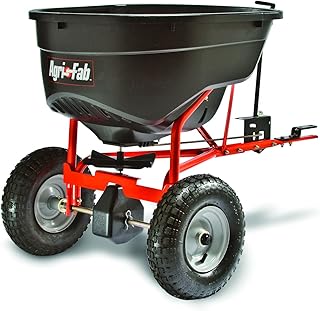
Understanding Hopper Capacity and Yard Size
Hopper capacity is often the first spec buyers look at, but bigger isn’t always better if your property has tight corners, steep inclines, or narrow gates. Spreaders typically range from smaller 100-pound capacities up to heavy-duty 175-pound or larger commercial designs. If you have an acre or less, a mid-sized hopper prevents excessive weight from straining your lawn tractor while still minimizing the number of refill stops.
When calculating capacity, remember that different materials have vastly different densities. A hopper holding 130 pounds of dense fertilizer will weigh significantly more than the same volume of fluffy grass seed. Ensure your riding mower or ATV has the towing capacity to handle a fully loaded hopper, especially when pulling up slopes where traction can become an issue.
Hitch Compatibility and Universal Pins
Nothing is more frustrating than unboxing a new implement only to discover the hitch height or pin mechanism does not align with your lawn tractor. Most tow-behind spreaders utilize a standard clevis pin hitch, but the mounting height varies significantly between zero-turn mowers, lawn tractors, and utility vehicles.
Look for spreaders that offer adjustable hitch heights. If your mower sits lower or higher than the spreader frame, the hopper will tilt. A tilted hopper causes material to pool on one side, resulting in uneven application rates and potential starvation of the drop mechanism. A level ride ensures the flow gate meters material evenly across the spinning rotor.
Gearbox Construction: Nylon vs. Cast Iron
The gearbox is the literal heart of any broadcast spreader, transferring rotational energy from the towing wheels to the spinner plate. Budget models frequently utilize enclosed nylon or plastic gears. While lightweight and rust-resistant, these gears can strip under heavy loads or if moisture enters the housing and freezes during cold-weather seeding.
For longevity, prioritize units featuring enclosed metal gears, such as cast iron or heavy-duty aluminum alloys, preferably with grease fittings for ongoing maintenance. A sealed gearbox keeps out corrosive fertilizers, dust, and grass clippings, ensuring smooth rotation season after season without binding or slipping.
Spread Width and Pattern Uniformity
Spread width dictates how many passes you will need to cover your lawn, with most units offering a swath between 10 and 15 feet wide. While a wider spread pattern reduces overall mowing time, it also makes it harder to maintain overlap accuracy, which can lead to unsightly green stripes or missed patches.
Look for spreaders equipped with an adjustable directional pattern control or side-deflector shield. This feature lets you narrow the spread swath when working near flower beds, sidewalks, or property lines, preventing expensive chemicals from landing where they shouldn’t. Uniformity is driven by the shape of the agitator inside the hopper; robust vertical or horizontal bars break up clumps before they reach the drop port.
Frame Durability and Corrosion Resistance
Fertilizers, ice melters, and agricultural amendments are notoriously corrosive. A painted steel frame will inevitably scratch, rust, and eventually weaken if it isn’t properly protected. Powder-coated steel frames offer much better resistance, while premium models may feature stainless steel hardware and polymer hoppers that will never rust.
Inspect the gauge of the steel tubing used in the chassis. Thicker tubing resists the constant bouncing and twisting forces experienced when towing across uneven terrain, bumps, and tree roots. Avoid flimsy, stamped-metal brackets that flex under load, as they will eventually warp and misalign the axle drive system.
Flow Control Placement and Cable Integrity
Operating the flow control lever while driving a lawn tractor requires careful ergonomic consideration. Poorly designed units place the lever too far forward on the tongue, forcing you to turn awkwardly in your seat to open or close the gate at row ends.
The best designs feature a remote cable-control system that mounts near the driver’s right hand on the tractor fender or dash. Check the thickness of the control cable; thin bike-brake-style cables stretch and snap easily. A heavy-duty, shielded push-pull cable ensures crisp, positive gate openings every time you pull the lever.
Related Guides
To explore specific manufacturer lineups and find the right model for your property, read our Best Tow Behind Spreaders in 2026: Compared and Ranked. If you find that a pull-behind model is too large for your landscaping needs, check out our alternative recommendations in the Best Broadcast Spreaders in 2026: Compared and Ranked roundup.
FAQ
Can I use a tow-behind spreader for winter salt?
Yes, many tow-behind spreaders handle rock salt and ice melt, provided the hopper and frame are made of corrosion-resistant materials like poly or stainless steel. Always wash and dry the unit thoroughly after salt application to prevent premature rust.
How fast should I drive when pulling a spreader?
You should generally maintain a slow, steady speed of around 3 to 4 miles per hour. Driving too fast causes the spinning disc to throw material too far and can bounce the hopper violently, leading to erratic distribution patterns.
Why is my spreader leaving heavy streaks of fertilizer?
Streaking is usually caused by incorrect wheel calibration, a tilted hopper, or material clumping inside the hopper. Ensure your tires are properly inflated, the hitch is level, and use a screen inside the hopper to catch lumps before they drop.
Do tow-behind spreaders work on rough terrain?
They can handle gentle slopes and bumps, but extremely rough terrain can cause the drive wheels to skip and lose traction. Models with pneumatic rubber tires offer better shock absorption and traction on bumpy lawns than solid plastic wheels.