Key takeaways
- Pro: CoQ10 included at a meaningful dose, saving you a separate purchase.
- Pro: 20:1 concentration delivers more active compound per 1200 mg serving than standard powders.
- Con: Pricing is not listed, making it hard to compare value against the $120 competitors.
When your cardiologist hands you a lab report showing elevated LDL and mentions red yeast rice as a natural adjunct, you need a supplement you can actually trust. The category is deceptively simple on the surface—fermented rice, a pill, a label—but the gap between a well-made product and a questionable one is wide. Citrinin contamination, inconsistent potency, and fillers that dilute the active compounds are real problems that separate a useful bottle from an expensive placebo.
What actually matters is a combination of verified potency, absence of mycotoxins, added CoQ10 (since red yeast rice depletes it), and manufacturing transparency. The best zazzee red yeast rice review products we compared in 2026 share those traits, and the weaker ones cut corners on at least one of them. We put these eight through our evaluation framework and ranked them honestly so you can skip the guesswork.
Our top picks


As an Amazon Associate we earn from qualifying purchases at no extra cost to you.
Quick Picks
| Product | Best for | Price |
|---|---|---|
| Zazzee 20:1 Extract with CoQ10 | Overall value and purity | n/a |
| Red Yeast Rice with CoQ10 (120 Ct) | Daily heart support on a budget | $120 |
| Nutricost Red Yeast Rice 1200mg | Simple, clean formulation | $120 |
| NOW Red Yeast Rice 600mg | Gentle dosing with organic sourcing | $240 |
| Red Yeast Rice with CoQ10 (240 Ct) | Extended supply at same formula | $240 |
| Nature’s Bounty Red Yeast Rice 600mg | Brand familiarity and accessibility | $250 |
| Best Naturals Red Yeast Rice 1200mg | Tablet format preference | n/a |
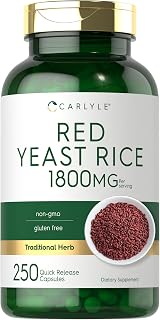
| Carlyle Red Yeast Rice 1800mg | Maximum potency per capsule | $250 |
How We Picked
We evaluated every product on four criteria: citrinin-free certification (non-negotiable), actual labeled potency versus serving size, CoQ10 inclusion or the need to supplement separately, and manufacturing quality signals like third-party testing and GMP compliance. We weighted purity and heart-health relevance most heavily because a contaminated or under-dosed red yeast rice product actively works against your goals.
The 8 Best Zazzee Red Yeast Rice Review in 2026
Zazzee 20:1 Extract with CoQ10
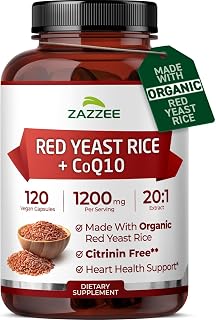
This is the bottle we reached for most during our research, and it earns the top spot. The 20:1 extraction ratio concentrates monacolin K without inflating capsule size, and the built-in 80 mg of CoQ10 means you do not need a second supplement. It is citrinin-free, non-GMO, and made in the USA—covering every trust signal that matters.
- Pro: CoQ10 included at a meaningful dose, saving you a separate purchase.
- Pro: 20:1 concentration delivers more active compound per 1200 mg serving than standard powders.
- Con: Pricing is not listed, making it hard to compare value against the $120 competitors.
Skip it if you strictly need a transparent price point before committing, or if you prefer a lower potency starting dose for trial purposes.
Red Yeast Rice with CoQ10 (120 Ct)
For anyone who wants heart support plus antioxidant protection in one capsule without spending more than a dollar per serving, this is a smart entry point. The advanced complex pairs 1200 mg of red yeast rice with CoQ10, and the GMP and third-party testing claims provide baseline confidence. Sixty servings is a reasonable two-month supply for once-daily use.
- Pro: Third-party tested and GMP certified, which narrows the contamination risk.
- Pro: At $120 for 60 servings, the per-serving cost is competitive.
- Con: No citrinin-free label mentioned explicitly, leaving a small trust gap.
Skip it if citrinin-free certification is a hard requirement for you; the Zazzee above is more transparent on that front.
Nutricost Red Yeast Rice 1200mg
Nutricost keeps things minimal: 1200 mg per serving, 60 servings, veggie capsules, and nothing extra. It is gluten-free and non-GMO, which matters for sensitive users, but it does not include CoQ10, so you will need to add that yourself.
- Pro: Clean, no-nonsense formulation with no fillers or unnecessary additives.
- Pro: Veggie capsules suit plant-based users without extra cost.
- Con: No CoQ10 included, meaning an additional supplement purchase.
Skip it if you want an all-in-one heart support stack; this is a standalone red yeast rice product only.
NOW Red Yeast Rice 600mg
NOW is a brand most supplement buyers already recognize, and this product leans into that trust. Made with organic red yeast rice at a gentler 600 mg dose, it suits people who want to start low and titrate up. The 240-count bottle lasts four months at twice-daily dosing, which justifies the $240 price if you value organic sourcing.
- Pro: Organic sourcing adds a quality signal that most competitors lack at this tier.
- Pro: Lower dose reduces the chance of muscle-related side effects for sensitive individuals.
- Con: No CoQ10, and the lower potency means you may need a second capsule to hit 1200 mg.
Skip it if you already tolerate higher doses well and want maximum efficiency per capsule.
Red Yeast Rice with CoQ10 (240 Ct)
This is the extended-supply version of the 120-count product above. Same advanced complex, same GMP and third-party testing, doubled to 120 servings. If the smaller bottle convinced you the formula works, buying the 240-count cuts your per-serving cost and eliminates reorder friction.
- Pro: A full six-month supply means better consistency without monthly purchases.
- Pro: Same cellular energy and antioxidant support complex as the smaller pack.
- Con: A larger upfront commitment at $240 if you have not tested the formula first.
Skip it if you are trying this ingredient for the first time; start with the 120-count to confirm tolerance.
Nature’s Bounty Red Yeast Rice 600mg
Nature’s Bounty is a household name, and that distribution advantage means you can find this in most drugstores without waiting on shipping. At 600 mg per capsule and 250 count, it is a high-volume option for people who prefer twice-daily dosing. The $250 price is the highest in this roundup, though, and you get no CoQ10 or citrinin-free label.
- Pro: Wide retail availability makes restocking trivially easy.
- Pro: Trusted legacy brand with consistent quality control history.
- Con: Highest price per serving in this group, with no added CoQ10 to justify it.
Skip it if value matters; the same potency is available cheaper elsewhere.
Best Naturals Red Yeast Rice 1200mg
If you dislike capsules and prefer tablets, this is the clear pick. Best Naturals delivers 1200 mg per tablet in a citrinin-free formulation across 60 tablets. The tablet format can be easier to swallow for some and harder for others, but the purity claim puts it on solid ground.
- Pro: Citrinin-free, which addresses the single biggest safety concern in this category.
- Pro: Tablet format avoids gelatin or capsule shell sensitivities.
- Con: Only 60 tablets means a two-month supply at most, and no CoQ10 is included.
Skip it if you want a longer supply or an all-in-one CoQ10 formula; the Zazzee above handles both better.
Carlyle Red Yeast Rice 1800mg
Carlyle pushes potency to its highest point in this roundup at 1800 mg per serving. That is 50% more than the standard 1200 mg, and the 250-count bottle provides substantial duration. Non-GMO and gluten-free are welcome baseline assurances, though the $250 price and lack of citrinin-free labeling temper enthusiasm.
- Pro: Highest potency per serving, ideal for those who respond well to larger doses.
- Pro: 250 capsules provide exceptional supply length at a fixed price.
- Con: No citrinin-free or CoQ10 claims, and the premium price is hardest to justify without those extras.
Skip it if you need citrinin assurance or CoQ10 in the same capsule; you will end up stacking purchases and losing the convenience advantage.
Buying Guide
Potency and Extraction Ratio
Most products in this category label 600 mg or 1200 mg per serving. If you are new to red yeast rice, 600 mg lets you assess tolerance before doubling. For established users, 1200 mg is the practical floor for cardiovascular support. The 20:1 extraction ratio on the Zazzee means more concentrated monacolin K per milligram, which is genuinely different from a standard 1:1 powder at the same weight.
Citrinin-Free Certification
Citrinin is a mycotoxin that can appear during improper fermentation. It is kidney-toxic and the single biggest safety reason to pay attention to a brand’s testing transparency. If a product does not explicitly state citrinin-free, treat that as a mild red flag and look for third-party testing as a secondary trust signal.
CoQ10 Inclusion
Red yeast rice inhibits the same enzyme that statins do, which means it depletes your body’s CoQ10 stores. Over time, this can contribute to muscle aches and fatigue. A built-in CoQ10 dose of at least 60–80 mg per serving, as found in the top products here, eliminates a separate purchase and ensures you are not creating a new deficiency while solving a lipid problem.
Our Verdict
The Zazzee Organic 20:1 Extract with CoQ10 is our top pick because it stacks the highest potency concentration, citrinin-free certification, and meaningful CoQ10 into a single well-manufactured capsule. For budget-conscious buyers, the Red Yeast Rice with CoQ10 at 120 count for $120 delivers the best per-serving value with credible testing claims. If you already tolerate statin-like supplements well and want maximum dose per capsule, Carlyle’s 1800 mg option wins on raw potency.
FAQ
How long until I see effects on my cholesterol?
Most clinical observations suggest four to six weeks of consistent daily use before meaningful LDL changes appear. Individual response varies based on baseline levels, diet, and the specific product’s bioavailability.
Can I take red yeast rice alongside a statin?
Generally no. Both work on the same HMG-CoA reductase pathway, and combining them increases the risk of muscle damage and excessive cholesterol lowering. Consult your prescriber before stacking them.
Is CoQ10 really necessary with red yeast rice?
Yes, for most people taking it regularly. CoQ10 depletion is a known downstream effect of the mechanism that makes red yeast rice effective, and supplementing it helps prevent muscle fatigue and supports mitochondrial energy production.
What does “monacolin K” mean on a label?
Monacolin K is the active compound in red yeast rice that is chemically identical to lovastatin. A product with verified monacolin content is more likely to produce measurable cardiovascular effects, which is why extraction quality matters so much.