Key takeaways
- Clean both customer-facing and staff-facing surfaces, including the lower edge and support joints.
- Use a separate cloth for the guard and food-contact work surfaces to reduce cross-contamination between cleaning tasks.
- Remove spills promptly; dried sauces and starches require more pressure, which increases scratching risk.
- Inspect fasteners, clamps, rubber feet, and seams weekly in high-use operations.
- Replace panels with deep scratches, cracks, cloudy chemical damage, or loose mounting points.
Best Commercial Sneeze Guards for Food Service
The best commercial sneeze guard for most food-service operations is a clear polycarbonate or tempered-glass guard sized to cover the full serving area, with a height and mounting style that protect food without obstructing staff access.
The right choice depends less on brand than on four practical questions: how much counter or buffet space must be covered, how often the guard will be cleaned or moved, whether maximum optical clarity matters, and whether the installation is permanent or temporary. A small countertop guard can work well for pastries or plated foods, while a full-length modular system is usually better for cafeterias, salad bars, and high-volume self-service lines.
Our top picks
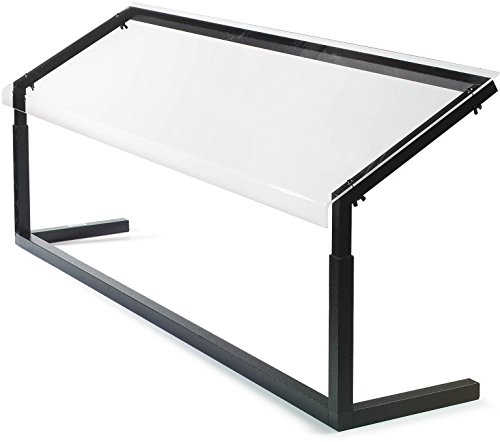 Carlisle FoodService Products Buffet Bar Adjustable Sneeze
- Specifically designed for Five Star Buffet Bars, the…
- This sneeze guard isn't one-size-fits-all
- Adapt to your buffet's unique needs with a…
 Carlisle FoodService Products Sneeze Guard Single Sided
- The adjustable single-sided sneeze guard is designed to…
- Made with a sturdy aluminum frame and acrylic…
- The adjustable sneeze guard has a maximum opening…
 Carlisle FoodService Products Buffet Bar Adjustable Sneeze
- Designed to fit Five Star Buffet Bars
- Min opening height 11.25"
- Aluminum frame for light weight and resistance to…
| Product | Key specs | |
|---|---|---|
| Carlisle FoodService Products Buffet Bar Adjustable Sneeze | Specifically designed for Five Star Buffet Bars, the… This sneeze guard isn't one-size-fits-all Adapt to your buffet's unique needs with a… | Check price |
| Carlisle FoodService Products Sneeze Guard Single Sided | The adjustable single-sided sneeze guard is designed to… Made with a sturdy aluminum frame and acrylic… The adjustable sneeze guard has a maximum opening… | Check price |
| Carlisle FoodService Products Buffet Bar Adjustable Sneeze | Designed to fit Five Star Buffet Bars Min opening height 11.25" Aluminum frame for light weight and resistance to… | Check price |
 Carlisle FoodService Products Buffet Bar Adjustable Sneeze | Designed to fit Five Star Buffet Bars Min opening height 11.25" Aluminum frame for light weight and resistance to… | Check price |
As an Amazon Associate we earn from qualifying purchases at no extra cost to you.
Quick comparison of commercial sneeze guard types
| Guard type | Typical panel sizes | Common materials | Best mounting style | Typical market range | Best for |
|---|---|---|---|---|---|
| Compact countertop guard | 24–36 in wide; 18–24 in high | 1/4 in acrylic or polycarbonate | Weighted feet or clamp-on brackets | $80–$220 | Cash-and-carry displays, bakeries, small counters |
| Standard buffet guard | 36–60 in wide; 24–30 in high | 1/4 in acrylic, polycarbonate, or tempered glass | Post-and-base or countertop supports | $180–$600 | Buffets, salad bars, school and workplace dining |
| Modular serving-line system | 48–96 in per section; 24–30 in high | Tempered glass or thick polycarbonate | Bolted posts, rails, and end panels | $500–$2,000+ | High-volume cafeterias and permanent installations |
| Portable folding guard | 24–72 in overall width; 18–24 in high | Acrylic or polycarbonate | Hinged feet or folding frame | $120–$450 | Events, pop-ups, changing counter layouts |
These are general 2026 market ranges rather than fixed prices. Freight, custom widths, heat lamps, pass-through openings, stainless-steel framing, and installation can substantially increase the total.
Best choice by food-service situation
| Your situation | Recommended configuration | Why it fits |
|---|---|---|
| Limited budget or occasional use | 24–36 inch acrylic or polycarbonate countertop guard | Low initial cost and easy relocation |
| Daily buffet service | 36–60 inch guard with two or more fixed supports | Better stability and coverage than a single-foot unit |
| Heavy cleaning and frequent contact | Polycarbonate panel with rounded, accessible supports | Better impact resistance and fewer fragile edges |
| Permanent cafeteria line | Modular tempered-glass system with end panels | Professional appearance, broad coverage, and easy section replacement |
| Pastries or retail display | Low-profile clear guard, 18–24 inches high | Maintains visibility while covering the exposed product area |
| Temporary event or shared counter | Folding or clamp-on guard | Stores compactly and avoids permanent countertop alterations |
Material comparison: acrylic, polycarbonate, and glass
Acrylic: clearest on a budget
Acrylic is often the least expensive transparent option and provides good visual clarity for bakery cases, condiment areas, and light-duty counters. It is lighter than glass, so a portable unit is easier to move. The trade-off is that acrylic can crack if dropped and scratches more readily when cleaned with abrasive pads or gritty towels.
Choose acrylic when the guard will remain in place, staff can handle it carefully, and the main priorities are appearance and cost. Avoid using ammonia-based cleaners unless the manufacturer specifically approves them, because some chemical formulas can damage or craze acrylic surfaces.
Polycarbonate: the practical heavy-use option
Polycarbonate is usually the strongest choice for busy food-service environments. It resists impact better than acrylic and is useful where trays, carts, or serving utensils may contact the panel. It can still scratch, however, so impact resistance does not make it scratch-proof.
Polycarbonate is a strong match for schools, institutional dining, cafeterias, and mobile service stations. Look for a panel at least 1/4 inch thick for a typical countertop span, with additional support when the width approaches 60 inches or more.
Tempered glass: premium clarity and long-term appearance
Tempered glass offers excellent optical clarity and resists many of the fine scratches that accumulate on plastic panels. It is also heavier and can shatter if subjected to a severe impact, although tempered glass is designed to break into smaller pieces rather than large sharp shards. Its weight demands sturdy posts, properly levelled bases, and careful installation.
Glass is most suitable for permanent serving lines where appearance matters and the panel will not be repeatedly transported. Check whether replacement panels and compatible hardware are available before committing to a proprietary system.
Dimensions and serving-line coverage
Measure the food exposure zone rather than simply matching the counter width. The guard should cover the trays, bowls, and utensils that sit closest to the customer side. A panel that ends several inches before the last pan leaves an unprotected gap even if it looks substantial.
For a straight line, calculate coverage this way:
Required panel width = total exposed serving width + overlap between sections.
For example, a 72-inch serving line using two 36-inch panels may need 2–4 inches of overlap if the support design leaves a seam. That means ordering two 38-inch panels, or selecting a modular system designed for a continuous 72-inch run. Confirm the manufacturer’s usable width, because listed dimensions may include end caps or support hardware.
Height is a balance. A 18–24 inch panel is often adequate for a small counter or pastry display. A 24–30 inch panel gives more vertical coverage for buffet pans and self-service lines, but excessive height can make staff replenishment awkward and may interfere with heat lamps or overhead shelving. Measure from the food surface to the lowest obstruction, then leave enough clearance for lifting pans safely.
Mounting styles compared
Weighted countertop bases
These are the simplest option for renters, temporary counters, and low-to-moderate traffic. A broad stainless-steel or coated base reduces tipping, but it occupies serving space and can collect crumbs around its feet. Choose a base with non-skid pads and enough weight for the panel width.
Clamp-on brackets
Clamps preserve more usable counter space and can be removed without drilling. They work best on sturdy, square-edged counters. Before buying, measure the countertop thickness and confirm that the clamp opening matches it. Clamps are a poor fit for rounded edges, thin laminate, or counters that flex under load.
Bolted posts and rails
Permanent posts provide the best stability for a long serving line. They distribute the panel’s weight and withstand repeated cleaning and customer contact. Installation takes longer and may require drilling through the counter, so verify the location of plumbing, electrical lines, and food-equipment clearances first.
Folding and hinged frames
Folding guards are convenient for events and multipurpose rooms, but hinges and locking joints are the parts most likely to loosen or collect residue. Inspect the hinges regularly and avoid carrying a folded unit by the panel itself.
Cleaning and ownership realities
Cleaning instructions vary by material, but a safe general routine is to remove loose particles with a soft cloth, wash with warm water and mild detergent, rinse, and dry with a clean microfiber cloth. Do not use scouring powder, steel wool, razor blades, or rough scrub pads on transparent panels.
- Clean both customer-facing and staff-facing surfaces, including the lower edge and support joints.
- Use a separate cloth for the guard and food-contact work surfaces to reduce cross-contamination between cleaning tasks.
- Remove spills promptly; dried sauces and starches require more pressure, which increases scratching risk.
- Inspect fasteners, clamps, rubber feet, and seams weekly in high-use operations.
- Replace panels with deep scratches, cracks, cloudy chemical damage, or loose mounting points.
The panel is not usually the first component to fail. On portable units, rubber feet can flatten, clamp threads can wear, and lightweight bases can bend. On permanent systems, gasket material, post fasteners, and sliding brackets often need attention before the transparent panel does. Keep replacement hardware available if the guard is critical to daily service.
What to check before ordering
- Actual opening: Confirm whether the design includes a pass-through gap and whether it is large enough for trays but small enough to provide useful coverage.
- Panel thickness: Prefer approximately 1/4 inch for general commercial use; larger spans may need thicker material or additional supports.
- Support spacing: A wide panel with only two narrow feet may flex or wobble. Look for a support plan appropriate to the width.
- Food and heat equipment: Keep plastic panels away from direct flame and high heat unless they are specifically rated for that use.
- Replacement availability: A replaceable panel is more economical than discarding an entire frame after damage.
- Cleaning compatibility: Check the material and manufacturer’s chemical guidance before using sanitizer concentrates or glass cleaners.
Bottom line
Choose a compact acrylic guard for light-duty, budget-conscious protection; polycarbonate for demanding daily service and better impact resistance; and tempered glass for a permanent line where clarity and scratch resistance justify the added weight and cost. Measure the complete exposed serving area, allow for section overlap, and select mounting hardware that matches the counter rather than choosing by panel appearance alone. A correctly supported guard with a simple cleaning routine will usually deliver better long-term value than a larger but unstable or difficult-to-maintain model.