Key takeaways
- Battery life: Most rechargeable masks provide 30-60 minutes of total runtime per full charge. That equals 3 to 6 sessions of 10 minutes. Flexible silicone masks generally use USB-C charging with 2-3 hour recharge times. Rigid masks charge similarly but may drain faster due to higher LED counts (100+ LEDs vs. 60-90 LEDs).
- Comfort: Flexible silicone spreads weight evenly and stays cooler. Rigid shells concentrate weight on the nose bridge and forehead; look for silicone padding at those points. If you overheat easily, avoid masks with non-breathable backing and take breaks between sessions rather than stacking treatments back-to-back.
- Recommended session times: Follow the manufacturer’s protocol to avoid overexposure. Typical is 10 minutes, 3-5 times per week for 4-6 weeks, then 2-3 times per week for maintenance. Masks with higher irradiance use shorter windows (3-9 minutes). More time does not equal faster results and may increase temporary redness or dryness.
- Eye protection: Red and near-infrared light is bright but not UV. Even so, direct bright exposure can cause eye strain or discomfort. Use included eye shields, keep eyes closed if shields are not provided, and do not stare directly at LEDs at close range. If you have a diagnosed eye condition or photosensitivity, talk to an eye care professional before use.
The best red light therapy masks for most people in 2026 are the Omnilux Contour Face for clinical-grade coverage and flexible silicone fit, the CurrentBody Skin LED Light Therapy Mask for balanced wavelength options and comfort, and the Dr. Dennis Gross DRx SpectraLite FaceWare Pro for short session times and a rigid hands-free design.
Choosing between them comes down to wavelength mix, irradiance, how much of your face and neck gets treated, and whether you prioritize comfort and battery freedom over maximum power. Below is how the leading types compare on the specs that actually affect results and daily use.
Our top picks
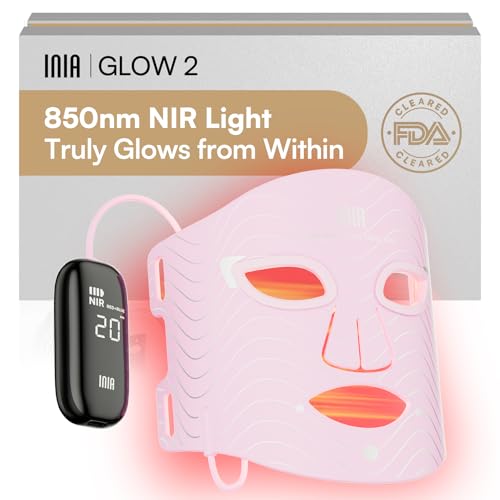 INIA Red Light Therapy Mask for Face
- Dual-Wavelength Revitalization: The INIA Red Light Mask combines…
- 4 Light Modes, Fully Customizable Routines: Personalize your…
- Visible Results with 220 High-Energy LED Chips: Step…
 Red Light Therapy Mask for Face &
- 【680 Light Beads & Full Coverage】This LED Light…
- 【Hassle‑Free Wireless & Skin‑Friendly Design】INTEO LED light mask…
- 【4 Light Modes for Multi‑purpose Skincare】 Our facial…
 Shark CryoGlow LED Face Mask
- CryoGlow is an at-home LED face mask combining…
- MOST AWARDED LED MASK IN THE U.S.*: Real…
- Developed by Shark Beauty alongside optical light experts…
| Product | Key specs | |
|---|---|---|
| INIA Red Light Therapy Mask for Face | Dual-Wavelength Revitalization: The INIA Red Light Mask combines… 4 Light Modes, Fully Customizable Routines: Personalize your… Visible Results with 220 High-Energy LED Chips: Step… | Check price |
| Red Light Therapy Mask for Face & | 【680 Light Beads & Full Coverage】This LED Light… 【Hassle‑Free Wireless & Skin‑Friendly Design】INTEO LED light mask… 【4 Light Modes for Multi‑purpose Skincare】 Our facial… | Check price |
| Shark CryoGlow LED Face Mask | CryoGlow is an at-home LED face mask combining… MOST AWARDED LED MASK IN THE U.S.*: Real… Developed by Shark Beauty alongside optical light experts… | Check price |
 INIA Red Light Therapy Mask for Face INIA Red Light Therapy Mask for Face | Dual-Wavelength Revitalization: The INIA Red Light Mask combines… 4 Light Modes, Fully Customizable Routines: Personalize your… Visible Results with 220 High-Energy LED Chips: Step… | Check price |
As an Amazon Associate we earn from qualifying purchases at no extra cost to you.
Spec Comparison: What Separates Top Masks
Most at-home masks use red light around 630-660nm, often paired with near-infrared around 830-850nm and sometimes blue light around 415nm for blemish-prone skin. Irradiance, treatment area, and session length matter more than marketing claims about total LEDs.
| Mask Type / Model | Wavelengths (nm) | Reported Irradiance | Treatment Coverage | Fit & Material | Battery & Session Time | Weight |
|---|---|---|---|---|---|---|
| Omnilux Contour Face | 633 (red) + 830 (near-infrared) | ~30-35 mW/cm² at skin surface | Full face, wraps to jawline | Flexible medical-grade silicone, adjustable Velcro straps | Rechargeable, ~3-4 sessions per charge; 10 min recommended | ~180g controller + mask |
| CurrentBody Skin LED Light Therapy Mask (Series 2) | 633 + 830 + 1072 (deep near-infrared) in newer version | ~30 mW/cm² | Full face, nose cutout, covers forehead to chin | Flexible silicone with eye inserts, strap | Rechargeable, ~10 min session | ~210g |
| Dr. Dennis Gross DRx SpectraLite FaceWare Pro | 630 (red) + 880 (near-infrared) and 415 (blue) in alternate mode | ~25-30 mW/cm² | Full face, rigid shell with chin rest | Hard plastic shell, silicone eye protection built-in | Rechargeable, 3 min per treatment mode | ~340g |
| HigherDOSE Red Light Face Mask | 630 + 830 | ~20-25 mW/cm² | Full face | Flexible silicone, adjustable straps | Rechargeable, 10-20 min session | ~190g |
| TheraFace Mask by Therabody | 633 + 830 + 415 (optional vibration + blue light modes) | ~25-30 mW/cm² (red/NIR mode) | Full face with eye openings, includes tension-relief attachment | Flexible silicone with QX-Micro vibration | Rechargeable, 9 min red/NIR, 3 min blue | ~260g |
Wavelength matters because 630-660nm primarily targets the epidermis and 830-880nm penetrates deeper toward the dermis. Irradiance measured in mW/cm² determines dose per minute; a lower irradiance mask simply needs a longer session to deliver a comparable total dose (J/cm²). Brands report irradiance differently (at the LED vs. at skin distance), so compare recommended session times rather than raw numbers alone.
How to Choose: Decision Matrix by Situation
Use your main priority to narrow the field quickly:
If your priority is maximum coverage and comfort for regular use
Choose a flexible silicone mask like Omnilux Contour Face or CurrentBody Skin. They conform to different face shapes, sit closer to the skin which helps maintain irradiance, and distribute light more evenly across cheeks, forehead, and jawline. They are lighter and better for lying down or sitting upright without pressure points.
If your priority is shortest treatment time
Choose a rigid mask like Dr. Dennis Gross SpectraLite FaceWare Pro or TheraFace Mask. Their 3-minute to 9-minute protocols are easier to stick to daily. The trade-off is a less customizable fit; people with smaller or larger faces may see light gaps near the nose or temples.
If you want multi-wavelength versatility
Choose CurrentBody Series 2 or TheraFace if you want red + near-infrared plus an extra option. CurrentBody adds 1072nm for deeper near-infrared, while Dr. Dennis Gross and TheraFace add 415nm blue light for blemish-focused routines. If you only want red and near-infrared for general skin maintenance, a dual-wavelength mask is simpler and typically more efficient per session.
If you wear contacts, have light sensitivity, or want built-in eye protection
Choose a mask with opaque eye inserts or integrated eye shields. Flexible silicone masks often include removable silicone eye covers; rigid masks like Dr. Dennis Gross have built-in eye protection so you do not need separate goggles. If a mask has open eye holes without shields, you will need to keep eyes closed or use provided goggles, which some users find less comfortable.
If you travel or share a bathroom
Choose a lightweight flexible mask with a compact controller. Masks under 220g and controllers that hold 3+ sessions per charge pack easier than bulky rigid shells. Check strap design too – Velcro with silicone feels more secure than elastic-only straps during movement.
Battery Life, Comfort, and Session Times Explained
Battery life is not just convenience; it affects dose consistency. A low battery can reduce irradiance on some masks before shutoff.
- Battery life: Most rechargeable masks provide 30-60 minutes of total runtime per full charge. That equals 3 to 6 sessions of 10 minutes. Flexible silicone masks generally use USB-C charging with 2-3 hour recharge times. Rigid masks charge similarly but may drain faster due to higher LED counts (100+ LEDs vs. 60-90 LEDs).
- Comfort: Flexible silicone spreads weight evenly and stays cooler. Rigid shells concentrate weight on the nose bridge and forehead; look for silicone padding at those points. If you overheat easily, avoid masks with non-breathable backing and take breaks between sessions rather than stacking treatments back-to-back.
- Recommended session times: Follow the manufacturer’s protocol to avoid overexposure. Typical is 10 minutes, 3-5 times per week for 4-6 weeks, then 2-3 times per week for maintenance. Masks with higher irradiance use shorter windows (3-9 minutes). More time does not equal faster results and may increase temporary redness or dryness.
- Eye protection: Red and near-infrared light is bright but not UV. Even so, direct bright exposure can cause eye strain or discomfort. Use included eye shields, keep eyes closed if shields are not provided, and do not stare directly at LEDs at close range. If you have a diagnosed eye condition or photosensitivity, talk to an eye care professional before use.
Worked Calculation: Total Dose and Cost Per Use
Understanding dose helps you compare a 3-minute mask to a 10-minute mask honestly.
1. Estimate dose per session: Dose (J/cm²) = Irradiance (W/cm²) x Time (seconds). For a mask reporting 30 mW/cm² (0.03 W/cm²) for 600 seconds (10 minutes): 0.03 x 600 = 18 J/cm² at the skin surface. A mask reporting 28 mW/cm² for 180 seconds (3 minutes): 0.028 x 180 = ~5 J/cm². Both can be within effective at-home ranges, but they are not equivalent per session. Brands calibrate LEDs and distance to hit a target dose in their recommended window, which is why staying inside that window matters more than extending it.
2. Estimate cost per use: At-home masks in 2026 typically range from about $150 for entry-level flexible masks to $400-$600 for premium flexible or rigid models with multiple wavelengths. Take general price range divided by uses. Example: A mid-range mask at $350 used 4 times per week for one year (208 uses) = $1.68 per use in year one, dropping to $0.84 per use if you continue a second year at the same frequency. Consumables are minimal, but factor in replacement straps and eye inserts over time.
This is general information only and not medical advice. If you have a skin condition, are taking photosensitizing medications, or are pregnant, consult a healthcare professional before starting light therapy.
Durability and Ownership Realities
Masks are electronics worn on the face, so hygiene and material aging determine how long they last.
- What wears first: Straps lose elasticity in 6-12 months of frequent use, silicone eye inserts can tear at the edges, and charging ports collect skin oils and dust. Flexible silicone can yellow slightly with mineral sunscreen residue if not cleaned promptly.
- Cleaning: Wipe interior and exterior with a soft, lint-free cloth lightly dampened with water or 70% isopropyl alcohol after each use once the device is off and cool. Do not submerge, do not use abrasive cleaners, and never spray liquid directly onto LEDs. Let it air dry fully before storing.
- Storage: Store flat or on its stand, away from direct sunlight and heat. Folding a flexible mask tightly for travel can crease LEDs over time; use the provided storage bag and avoid stacking heavy objects on it.
- Common mistakes: Applying heavy occlusive serums or oils immediately before treatment can reflect light and leave residue on LEDs. Using the mask on broken or freshly exfoliated skin can increase irritation. Running two sessions back-to-back to “catch up” does not improve outcomes and may cause temporary redness or dryness. Skipping eye protection on open-eye designs is another frequent error.
Which Mask Should You Buy?
For best overall balance of fit, coverage, and session efficiency, the Omnilux Contour Face and CurrentBody Skin LED Light Therapy Mask are the safest starting points for most face shapes and routines. If you know you will only stick to a routine that takes under 5 minutes, the Dr. Dennis Gross DRx SpectraLite FaceWare Pro’s 3-minute protocol solves the adherence problem, with the concession of a heavier rigid fit. For an option that blends skincare and relaxation features like vibration, the TheraFace Mask adds versatility without sacrificing red and near-infrared coverage.
Before buying, measure fit if the brand offers a sizing guide, confirm wavelength listings on the official specs sheet, and verify the return window. A mask that does not sit within 1-2 cm of your skin across the cheeks and forehead will deliver less consistent dosing regardless of LED count.
Frequently Asked Questions
How often should you use a red light therapy mask?
Most manufacturers recommend 3-5 sessions per week for the first month, then 2-3 sessions per week for maintenance. Always follow the specific model’s instructions rather than adding extra sessions, and allow at least 24 hours between treatments if you notice transient redness.
Is red light the same as near-infrared light?
No. Red light (around 630-660nm) is visible red and acts more superficially, while near-infrared (around 830-880nm) is invisible and penetrates deeper. Many masks combine both to cover different skin layers. Some add blue light (around 415nm) which targets surface bacteria associated with blemishes and is used separately from red/near-infrared modes.
Can you use skincare products with the mask?
Use the mask on clean, dry skin for best light transmission. Apply serums and moisturizers after the session, not before. Avoid photosensitizing ingredients like certain acids or retinoids immediately before use unless your dermatologist advises otherwise, and always use sunscreen during the day as part of a general skincare routine.
Do these masks work on all skin tones?
Red and near-infrared light devices are generally designed for all skin tones because they do not target melanin like laser treatments. However, if you have a history of hyperpigmentation, melasma, or sensitivity to light, speak with a dermatologist before starting and start with the shortest recommended protocol to assess tolerance.