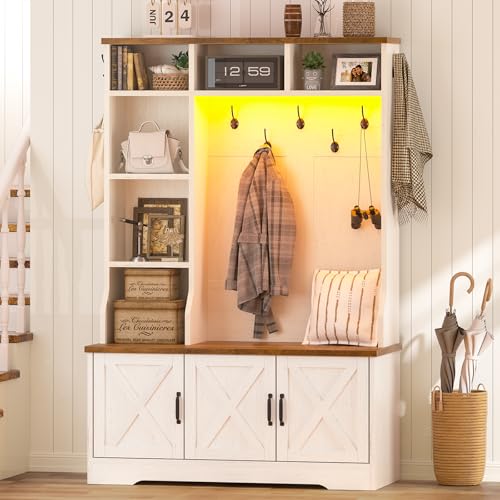
For most entryways, a hall tree with a bench, shoe storage and four to eight hooks is the best all-round choice, while narrow hallways suit a slim coat rack with a shelf and renters with little space may prefer a wall-mounted rack. A hall tree is a single piece of furniture that combines hooks, a seat and storage, so the right one depends on how many people use the entry, how wide the space is and how much weight you plan to hang on it. Brands that appear often in entryway roundups include IKEA, Prepac, Way Basics, Linon, Tribesigns, Safavieh and Sauder, with retailer-label pieces filling out the lower and mid ranges.
Our top picks


As an Amazon Associate we earn from qualifying purchases at no extra cost to you.
Hall Trees at a Glance
| Style | Best for | Typical stated features | Limits |
|---|---|---|---|
| Bench with shoe cubbies and hooks (Prepac, Linon, Sauder-type designs) | Families with shoes and bags to corral | Seat for putting on shoes, open or closed cubbies, four to eight hooks | Needs about 15 to 20 inches of depth; assembly can take time |
| Slim coat rack with top shelf | Narrow hallways and apartments | Smaller footprint, shelf for hats and keys, hooks along the upright | Little or no seating or shoe storage |
| Hall tree with mirror and storage bench | Households that like a last-look mirror | Mirror panel, lift-top bench, hooks above | Taller and heavier; wall anchoring matters |
| Modular entryway systems (IKEA-style) | Buyers who want to customize width and layout | Mix and match cabinets, benches, hooks and shelves | More parts, more planning, can cost more once configured |
| Wall-mounted rack with shelf | Very small spaces and renters with solid wall studs | No floor footprint, hooks on a rail | Needs secure mounting; no seat |
| Metal-frame hall tree with wood-look bench (Tribesigns, Safavieh-type) | Industrial or modern interiors | Open frame, lighter feel, sturdy hooks | Open frames offer less hidden storage |
What to Check Before Buying
Measure Your Space First
Write down the width, depth and ceiling height of the spot. Most hall trees are 15 to 20 inches deep and between about 30 and 50 inches wide, with heights near 65 to 80 inches. If the door swings into the hall, leave room for it to open fully and for people to walk past. Keep exits clear. Fire safety guidance generally warns against blocking an exit route with furniture, so do not place a tall unit where it narrows an escape path.
Material and Build
Solid wood and plywood are heavier and sturdier than particleboard or medium-density fiberboard, but they cost more. Many budget and mid-range hall trees use engineered wood with a laminate or veneer finish. Reviewers note that engineered wood hall trees are fine for light daily use but can chip along edges and swell if water from wet boots gets into the seams. A metal frame can feel more robust under hooks that carry heavy coats, but check weight limits.
Weight Capacity
Makers often list a seat capacity and sometimes a per-hook limit. Seat limits for bench-style units commonly fall in the low hundreds of pounds, while hooks are rated far lower. Do not treat the bench as a ladder or step stool. If you often hang heavy backpacks, choose metal hooks that are screwed or bolted into the frame instead of thin plastic or small wooden pegs.
Wall Anchoring and Stability
Tall furniture can tip when children climb it or when a heavy load is hung on one side. Makers usually include anti-tip hardware, and consumer safety agencies advise anchoring tall furniture to the wall studs according to the manual. Use the supplied hardware and the correct anchors for your wall type. If you rent, ask the landlord about drilling or use a unit that stands low and has a wide base.
Assembly
Almost every hall tree ships flat. Reviewers estimate assembly can take an hour or two for simple models and longer for large ones, with two people helpful for lifting. Dowels and cam-lock fasteners require careful alignment, so read the instructions through before starting, and tighten fasteners again after a few weeks of use.
Features That Matter by Household
Families With Children
Choose a unit with low hooks, cubbies for each child and a bench that is sturdy enough for sitting to put on shoes. Rounded corners and anchoring hardware are valuable, and a closed storage bench keeps small items out of sight. Avoid thin wood pegs for school bags.
Pet Owners
Wipeable finishes help with muddy paws and wet leashes. A lower shelf or basket can hold leashes and waste bags. Keep chewable items out of reach, and avoid fabric cushions that trap fur unless the cover is removable.
Narrow Entryways
A slim coat rack with a shelf, or a wall-mounted rail with a small shoe bench below, protects walking room. Some units are listed at under 12 inches deep, which suits tight hallways, but they hold fewer coats.
Large Entryways and Mudrooms
A wide hall tree or a modular wall system with lockers, benches and hooks organizes a busy household. Plan extra storage for seasonal gear and consider a rubber boot tray to protect the finish.
Budget Tier Trade-offs
| Tier | What you typically get | What you give up |
|---|---|---|
| Budget | Engineered wood or light metal, a few hooks, small shelf, simple finishes | Heavier-duty hardware, thicker panels, long-term durability |
| Mid-range | Better laminate or veneer, storage bench, more hooks, mirror options, thicker boards | Solid-wood construction and bespoke finishes |
| Premium | Solid wood or high-grade plywood, dovetail joinery on some, custom or modular configurations | Low cost; some premium pieces need professional installation |
Pick X If… Decision Table
| Pick this | If you |
|---|---|
| Bench with cubbies and hooks | Have a family and want everything in one place |
| Slim coat rack with shelf | Have a narrow hallway or apartment foyer |
| Hall tree with mirror | Want a final check on the way out and have wall height |
| Modular system | Want to tailor width, storage and hook layout |
| Wall-mounted rack | Have almost no floor space and can mount into studs |
| Metal-frame hall tree | Prefer an industrial look and a lighter appearance |
Care Tips
Wipe laminate and painted surfaces with a lightly damp cloth and dry them immediately. Place a mat or boot tray under wet shoes to protect the base. Avoid harsh solvents, which can dull finishes. Check hooks and fasteners every few months, since screws can loosen where coats are repeatedly pulled on and off. Rotate heavy items so one hook does not carry the whole load, and keep to the maker’s stated limits.
Alternatives to Consider
- Standalone bench and wall hooks: More flexible and often easier to fit around doors and radiators.
- Console table with baskets: Gives a place for keys and mail with hidden shoe storage below.
- Freestanding coat rack: A simple pole-style rack suits guests and small spaces but offers no storage and can tip if overloaded.
- Built-in cubbies: Best for a permanent mudroom, though they require carpentry.
Quick Buying Checklist
Before you order, confirm the overall height against your ceiling and any wall-mounted lighting, and check the bench height, which is usually around 17 to 19 inches for comfortable sitting. Count your household’s coats, bags and shoes to decide how many hooks and cubbies you need, and add room for seasonal growth. Look at the instruction manual online if the maker publishes it, to see how many people are needed for assembly and whether wall anchors are included. Consider the floor type: felt pads under the feet protect hardwood, and a boot tray protects the base from salt and moisture in winter. Finally, read the return terms for bulky furniture, since shipping a damaged or wrong-sized piece back can be difficult.
Frequently Asked Questions
How much space does a hall tree need?
Most need between 15 and 20 inches of depth and 30 to 50 inches of width, plus clear floor in front so you can sit and open doors. Measure the spot and the door swing before ordering, and leave a clear walking path.
Do I need to anchor a hall tree to the wall?
Makers and consumer safety agencies advise anchoring tall furniture to prevent tipping, especially in homes with children. Use the hardware provided and fix it into studs or with anchors suited to your wall type, following the manual.
How many hooks should I look for?
Plan about two hooks per regular user plus a few spare for guests. A household of four often does well with six to eight hooks, with lower hooks for children. Check each hook’s weight guidance on the product listing.
Are engineered wood hall trees durable?
They work well for light to moderate use if kept dry and assembled carefully. Reviewers note that edges can chip and boards can swell if exposed to water, so a boot tray and quick wiping help. Solid wood lasts longer but costs more.
Can a hall tree work in a small apartment?
Yes, if you pick a slim model, a wall-mounted rack or a corner design. Compact units with a shelf, a few hooks and a narrow bench can fit entries under 12 inches deep. Keep exit paths clear.
What is the difference between a hall tree and a coat rack?
A hall tree usually combines hooks with a bench, storage or a mirror, while a coat rack mainly offers hooks and sometimes a shelf. Choose a hall tree if you need seating and shoe storage and a coat rack if you only need hanging space.
FAQ
How much space does a hall tree need?
Do I need to anchor a hall tree to the wall?
How many hooks should I look for?
Are engineered wood hall trees durable?
Can a hall tree work in a small apartment?
What is the difference between a hall tree and a coat rack?
More from Amazon
Programs that pair well with the guide above. Offers and eligibility are set by Amazon and may change.
Free shipping on eligible items, Prime Video and more. Eligible new members can start with a free trial.
Start a Prime free trialAudiobooks and podcasts to listen to on the go. Eligible new members can start with a free trial.
Try Audible freeAd-free music streaming. Eligible new subscribers can start with a free trial.
Try Music Unlimited freeA free business account with business pricing and bulk-buying tools for work, shop or home office.
Create a business accountAs an Amazon Associate we earn from qualifying purchases.