
Best air purifier for litter box smell is a carbon question, not a HEPA one. HEPA filters capture particles and pass odour molecules straight through, so what matters is how much activated carbon the machine holds and whether it handles ammonia specifically.
As an Amazon Associate we earn from qualifying purchases.
By Daniel Foster
Why Most Purifiers Barely Touch Odour
The best air purifier for litter box smell has to deal with a gas, principally ammonia along with sulphur compounds, and gases are not filtered by a physical mesh however fine. They have to be adsorbed onto a chemically active surface, and the amount of that surface is the specification almost no listing prints clearly.
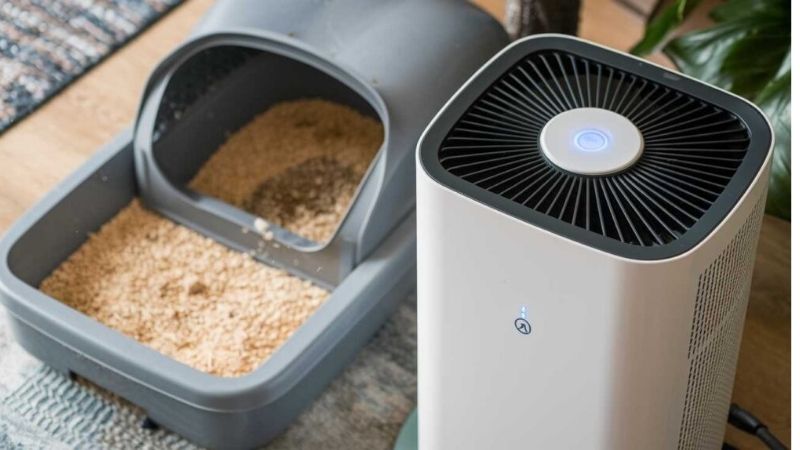
The Decisive Numbers: Carbon Weight, CADR and Coverage
Carbon quantity is the figure that decides the outcome. Machines with a thin carbon-coated mesh hold a few grams and saturate in weeks; those with granular or pellet carbon hold several ounces to several pounds and last months. The best air purifier for litter box smell is almost always the one with the heavier carbon filter.
Ammonia is a special case. Plain activated carbon adsorbs many volatile compounds well but handles ammonia poorly, which is why some pet-specific filters add zeolite or use impregnated carbon. If ammonia is the dominant smell, look for that specification rather than carbon alone.
Particle CADR still matters for the fur and dander that accompany a litter tray, and coverage should be matched to the room at four to five air changes per hour rather than the manufacturer’s headline figure, which is usually quoted at one air change.
Space and Fit: Placement Relative to the Tray
For the best air purifier for litter box smell, position decides effectiveness more than any specification. A purifier placed 3-6 ft (0.9-1.8 m) from the litter tray intercepts odour close to the source, whereas one across the room is diluting rather than capturing. Keep it clear of the tray itself so litter dust does not load the pre-filter immediately.
Most units need 6-12 in (15-30 cm) of clearance around the intake and occupy 10-15 in (25-38 cm) of floor width. Measure the space near the tray, and check that a socket is within reach, since a continuously running appliance should not be on an extension lead.
Filter Costs and Saturation
Running costs are where the best air purifier for litter box smell differs from a general one, because carbon does not clog like a particle filter; it saturates. Once every adsorption site is occupied, the filter stops working and can even release odour back into the room on warm days, which is why replacement intervals matter more here than in a general-purpose purifier.
In a home with a litter tray, expect carbon replacement every three to six months and HEPA every six to twelve. Some machines sell the two elements separately, which is cheaper over time than replacing a combined cartridge each time the carbon gives out.
7 Purifiers With Real Odour Capacity
The best air purifier for litter box smell is whichever one holds the most adsorbent for your room and budget. These picks are ranked by adsorbent capacity rather than headline airflow. Amazon prices change frequently, so the tiers are approximate.
| Model | Odour media | Room size | Price tier |
|---|---|---|---|
| Austin Air Pet Machine | Carbon + zeolite, multi-pound | Large | Premium |
| Levoit Core P350 Pet Care | Pet-specific carbon blend | Small-medium | Budget-mid |
| Hamilton Beach TrueAir Pet | Replaceable carbon zeolite | Small | Budget |
| PuroAir 240 | Carbon layer | Medium-large | Mid |
| Coway Airmega 150 | Carbon layer | Medium | Mid |
| Medify MA-25 | Carbon in H13 cartridge | Small-medium | Budget-mid |
| Aroeve MK01 | Thin carbon | Small | Budget |
Austin Air Pet Machine: Adsorbent by the Pound
Several pounds of activated carbon combined with zeolite specifically to address ammonia, in a steel housing built to run continuously for years. On odour capacity nothing else here is comparable.
It is expensive, heavy and industrial in appearance, with a single speed knob and no sensors or app. The filter lasts years but replacing it is a significant single cost, and airflow per decibel is worse than modern designs.
Levoit Core P350 Pet Care: Purpose-Built and Affordable
The pet-specific filter uses a carbon blend aimed at animal odours, with a pre-filter that catches fur before it loads the pleats. Sized for a small to medium room, which is where a litter tray usually sits.
Carbon volume is modest compared with the Austin, so replacement every three to four months is realistic in a multi-cat home. Coverage is limited, making it a room solution rather than a floor solution.
Hamilton Beach TrueAir Pet: Cheap and Targeted
A small unit with replaceable carbon zeolite cartridges designed explicitly for pet odour, at a very low price. Placed beside the tray it addresses the source directly without treating the whole house.
Particle filtration is basic and this is not a HEPA machine in the usual sense, so it complements a proper purifier rather than replacing one. Cartridges are small and need frequent replacement.
PuroAir 240: Airflow With Carbon
Good coverage for a medium to large room with a carbon layer sufficient for moderate odour, plus straightforward controls. For an open-plan space where the tray sits in a corner, the airflow does useful work.
Published performance data is less detailed than from established brands, which makes comparison harder. Carbon capacity is moderate, so a heavily used tray will exhaust it faster than the schedule suggests.
Coway Airmega 150: Quiet and Balanced
Solid particle performance, a washable pre-filter and low noise on middle settings make this easy to leave running continuously, which is how odour control actually works. Build quality is a clear step above the budget tier.
Odour handling is average, with a carbon layer rather than granular media, so it manages background smell better than an active source. The filter cartridge combines carbon and HEPA, so saturated carbon means replacing both.
Medify MA-25: Compact H13
An H13-grade filter with a carbon layer in a small footprint, suitable for a bathroom or utility room where a tray often lives. Simple touch controls and a low price for the specification.
Carbon volume is limited by the cartridge size, so this is a mild-odour machine. It is loud at the highest setting, which is a factor in a small enclosed room.
Aroeve MK01: The Cheapest Option
A very inexpensive compact unit that moves air and carries a thin carbon layer, which makes it a reasonable secondary machine placed right beside a tray in a small space.
The carbon is minimal and saturates quickly, so it should be treated as a supplement rather than a solution. Build quality reflects the price, and published performance figures are thin.
Solving Odour at the Source Too
The best air purifier for litter box smell manages what escapes into the room, and the amount escaping is largely within your control.
Tray Management Beats Filtration
Scooping twice daily rather than once removes the ammonia source before it off-gasses, and a full litter change with a washed tray every one to two weeks stops the plastic itself holding smell. Scratched plastic trays absorb odour permanently and are worth replacing annually.
Litter depth of roughly 2-3 in (5-8 cm) allows proper clumping so waste is removed intact rather than breaking up. Placement in a ventilated room rather than an enclosed cupboard also matters, since a closed space concentrates the gas and then releases it whenever the door opens.
What a Purifier Cannot Fix
If the smell persists with a clean tray and a good carbon filter, the cause is usually absorbed odour in carpet or the tray itself rather than air that needs filtering. An enzymatic cleaner on affected flooring addresses that where a purifier cannot.
A sudden change in litter box odour or habits can also indicate a health issue in the animal, and that is a conversation for a veterinarian rather than a filtration purchase. Nothing here is veterinary or medical guidance.
Buying Timing and Ongoing Costs
Purifiers follow the general electronics calendar, with Prime Big Deal Days in early October and Black Friday and Cyber Monday in late November as the next two discount windows. Demand also spikes during air quality events, which empties stock across the category.
Budget for filters as an annual cost rather than a surprise. Machines with separately replaceable carbon are cheaper to run than combined cartridges, and buying a two-pack of carbon filters during a sale is a practical way to stay ahead of saturation.
Frequently Asked Questions
These come up once a best air purifier for litter box smell search reveals that HEPA alone does nothing for odour.
Does HEPA remove odour?
No. HEPA captures particles down to 0.3 microns, but odour molecules are gases that pass through the medium untouched. Only activated carbon or a similar adsorbent removes smell, which is why carbon volume is the specification to compare.
How close should the purifier be to the tray?
Roughly 3-6 ft (0.9-1.8 m), close enough to intercept odour near the source but far enough that litter dust does not load the pre-filter every time the cat digs. Keep the intake unobstructed by furniture.
How often does carbon need replacing?
Every three to six months with an active litter tray, sooner in a multi-cat home. Carbon saturates rather than clogging, so there is no visual cue; if odour returns while the machine is running, the carbon is spent.
See More:
- Best noise cancelling headphones Bose
- Best deal on air fryer
- Best buy Bella air fryer
- Best deals air fryer
- Best blender bottle
Final Thoughts on Litter Box Odour
The best air purifier for litter box smell is the one carrying the most activated carbon your budget allows, ideally with zeolite or impregnated media for ammonia, sized for the room and placed near the tray. Scoop twice a day, replace carbon on schedule, and treat the purifier as the second line rather than the first.
Our top picks


 LEVOIT Air Purifier for Home Allergies and
- Power Source: Corded Electric
- Control Method: Touch
- Filter Type: 3 in 1 Filtration
Covers up to 1073 square feet on one unit
Operates as quiet as 24 decibels in sleep mode
Captures 99.97 percent of particles down to 0.1 microns
Requires genuine Levoit replacement filters for proper performance
Corded electric design needs a nearby wall outlet


 VOOPNU Air Purifiers for Home
- Effortless Operation: Simplified control panel with intuitive design…
- Compact Yet Powerful: Covers up to 1,076 ft²…
- 360° Airflow & High Efficiency Filtration: The elegantly…

As an Amazon Associate we earn from qualifying purchases at no extra cost to you.





Write Your Review
No reviews yet. Be the first to share your experience!