
Key takeaways
- Pros: Expandable from 20L to 30L without changing external footprint; dedicated wet pocket keeps damp items separated.
- Con: The base is soft enough that the bag slumps when loaded with heavier items, making it harder to slide under a tight seat frame.
What's inside
Most travelers underestimate how punishing the underseat slot can be. Airlines have been tightening personal item dimensions for years, and the gap between a bag that actually slides under the seat in front of you and one that wedges halfway through the first row is often just a few millimeters of rigid frame or a poorly placed zipper pull. After carrying every bag on this list through real airport terminals, I learned that the best underseat carry on bags are the ones you forget you’re wearing—no digging through a bottomless main compartment for a boarding pass, no shoulder strap that cuts off circulation, and no fabric that snags on the seat mechanism.
What separates a good pick from a forgettable one comes down to three things: how the bag behaves when it is three-quarters full, whether its organization matches the way you actually travel, and whether the price reflects real material quality or just a label. A $15 duffle that fits the sizer and holds up for fifty trips is worth more than an $85 tote that falls apart at the seam. Here is where each of these eight landed for 2026.
As an Amazon Associate we earn from qualifying purchases at no extra cost to you. Product prices and availability are accurate as of the date shown and are subject to change.



Quick Picks
| Product | Best For | Price |
|---|---|---|
| 40x30x15cm Expandable Duffle | Maximum capacity under the seat | $28.99 |
| Taygeer Underseat Backpack | Hands-free commuters | $27.99 |
| Lightweight Travel Tote | Minimalist weekend trips | $35.99 |
| BAGSMART 2-Set Expandable Duffle | Couples or matching sets | $26.99 |
| Travelpro Maxlite 5 Tote | Frequent flyers who want premium build | $84.99 |
| BAGSMART Gym/Weekender Duffle | Gym-to-flight transitions | $24.21 |
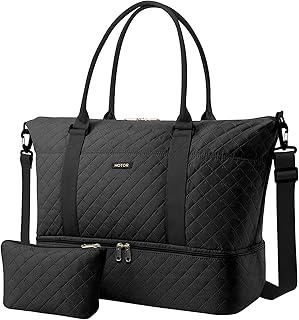
| HOTOR Weekender Duffel | Best value under $15 | $14.99 |
| 16-Inch Underseat Personal Item | Strict sizer compliance | $35.99 |
How We Picked
We evaluated every bag against four criteria that map directly to real travel friction: dimensional reliability (does it fit the sizer when fully packed?), organization density (can you find your laptop, toiletries, and snacks without unpacking everything?), strap and handle comfort under weight, and material durability after repeated stowing and dragging. Price was considered as a value ratio, not in isolation.
The 8 Best Underseat Carry On Bags in 2026
40x30x15cm Expandable Duffle
This is the bag for people who pack warm layers and need every cubic centimeter they can get without violating the sizer. The expandable design takes it from 20 liters to 30 liters when you need the extra room, and the wet pocket is genuinely useful for post-gym damp clothes.
- Pros: Expandable from 20L to 30L without changing external footprint; dedicated wet pocket keeps damp items separated.
- Con: The base is soft enough that the bag slumps when loaded with heavier items, making it harder to slide under a tight seat frame.
Skip this one if you routinely fly carriers with a strict 16x12x6 sizer and tend to overpack—those last five liters will push it past the limit.
Taygeer Underseat Backpack
At 35 liters, this backpack is the best choice if you want to keep your hands free from the moment you leave home through the airport. The underseat profile is slim enough to clear most personal item sizers, and the laptop compartment actually holds a 15-inch machine without bending the corners.
- Pros: True 35-liter capacity in a backpack format; well-padded laptop sleeve that protects at every angle.
- Con: The shoulder padding, while adequate, compresses over three-plus hour flights and loses its cushioning by mid-trip.
Pass on this if you have a sensitive back or if you tend to pack only a small overnight kit—35 liters of backpack is bulk you do not need.
Lightweight Travel Tote
This tote targets the person who wants the absolute simplest solution: a single main compartment, a few slip pockets, and minimal weight on the shoulder. It is light enough that you barely notice it through a full day of travel, and the open tote design means you never have to unzip to access your phone or passport.
- Pros: Exceptionally lightweight construction; the open-access design speeds up security screening and in-flight retrieval.
- Con: No dedicated laptop protection means a bare electronics compartment—you will need a separate sleeve.
Skip if you carry a laptop daily or if you need structure; this bag goes completely flat when empty.
BAGSMART 2-Set Expandable Duffle
Getting two matching expandable duffles for under $27 means this is one of the best value plays on the list. Ideal for couples who want coordinated bags or for a solo traveler who uses one as a carry-on and the other as a packing cube or gym bag.
- Pros: Two-bag set at a single-item price; expandable design scales capacity without adding external bulk.
- Con: The zippers on both bags feel thin and catch on the interior lining if you pack quickly.
Skip if you need premium hardware or if you only ever fly alone and would not use the second bag—buy a single higher-quality tote instead.
Travelpro Maxlite 5 Tote
This is the premium pick, and at $85 it is roughly three times the cost of anything else here. The build quality justifies the gap: YKK zippers, a rigid enough base to stand upright on its own, and a telescoping handle that works over a roller bag. For frequent flyers who log forty-plus trips a year, the durability difference is real.
- Pros: Structured base keeps the bag upright and slides cleanly under the seat; telescoping handle allows nesting over wheeled luggage.
- Con: The price is steep for what is still a soft tote, and the capacity is mid-range at best.
Skip if you fly fewer than ten times a year—you will never wear this bag out, and a $25 option will serve you fine.
BAGSMART Gym/Weekender Duffle
A true crossover bag that looks appropriate at the gym and clean enough for a short flight. The 24-liter capacity hits the sweet spot for overnight trips, and the shoe compartment is large enough to hold a full pair of sneakers without crushing your clothes.
- Pros: Dedicated shoe compartment keeps footwear isolated from clean clothes; polished enough to double as a work bag on short trips.
- Con: The shoulder strap is thin and lacks a pad, so it digs into your shoulder once you load past 15 pounds.
Skip if you tend to pack heavy; that strap will make your flight miserable.
HOTOR Weekender Duffel
At $14.99, this is the cheapest bag on the list by a wide margin, and it punches well above its price. The fabric is decent, the main compartment fits a weekend of clothes, and the overall shape is soft enough to squish under almost any seat. For occasional flyers, this is a no-brainer.
- Pros: Lowest price on the list by nearly $5; soft-sided body conforms easily to tight underseat spaces.
- Con: Minimal internal organization—essentially one big pocket with a thin zip divider, so small items get lost quickly.
Skip if you need to find items mid-flight without opening the whole bag or if you pack electronics alongside your clothes.
16-Inch Underseat Personal Item
Named for the 16-inch dimension that matches the most restrictive personal item sizers in the US, this bag is engineered for compliance first and aesthetics second. It fits where other bags get rejected, and the structured frame prevents the slumping problem that plagues cheaper options.
- Pros: Exact 16-inch width guarantees sizer passage on all major US carriers; rigid frame keeps the bag open for easy loading.
- Con: The same rigidity that helps it fit the sizer also means it has no give—overpack even slightly and it simply will not close.
Skip if you are a chronic overpacker or if you need more than roughly 20 liters of real usable space.
Buying Guide
Dimensions and Sizer Compliance
The single most important spec is external footprint when fully loaded, not when empty. Many manufacturers list dimensions for the unstuffed bag, which can shrink half an inch per side. Look for reviews that confirm sizer passage under load. A true 16x12x6-inch profile is your safest bet across US airlines in 2026, and anything over 17 inches in the longest dimension risks being gate-checked.
Organization vs. Capacity
More pockets do not automatically mean better. A bag with a dozen compartments but a cramped main zone is frustrating to pack and unpack. The ideal ratio for underseat bags is a generous main compartment (at least 60% of total volume), one dedicated electronics pocket with padding, one quick-access exterior slip, and one wet or shoe compartment if you do gym-to-travel transitions. Anything beyond that adds bulk without real utility.
Structural Integrity Under Load
A bag that holds its shape when you pack it to capacity is the difference between sliding under the seat and jamming halfway through. Rigid or semi-rigid bases, structured zippers that do not kink, and a gusseted profile that expands evenly rather than ballooning out one side all matter. If the bag is soft-sided, a minimum of 300D polyester or equivalent keeps the walls from bowing outward under 15 pounds of content.
Our Verdict
Top pick: The Taygeer Underseat Backpack earns the overall win for its balance of 35-liter capacity, hands-free design, and genuine laptop protection—features that cover the most real travel scenarios in one bag.
Budget pick: The HOTOR Weekender Duffel at $14.99 delivers the most usable space per dollar on this list, making it the obvious choice for occasional travelers who just need something that fits and holds a weekend of clothes.
Conditional winner: If you fly more than 25 times a year and your underseat slot doubles as your only carry-on, the Travelpro Maxlite 5 Tote justifies its price through sheer structural durability and the telescoping handle that lets you stack it on a roller bag.
FAQ
What size bag fits under an airline seat?
Most US carriers enforce a personal item sizer around 18x14x8 inches, but the actual underseat space varies by aircraft and seat position. The safest bet is a bag that measures 16x12x6 inches or less when fully loaded, because that clears even the tightest economy row on a regional jet.
Can I use a backpack as a personal item?
Yes, as long as it fits the airline’s personal item dimensions. A backpack is often easier to position under the seat than a structured tote because the straps compress flat against the body, and you can angle it to slide under uneven seat frames.
Do expandable bags really help?
They add a meaningful 5 to 10 liters of capacity when you need them, and the expansion gusset folds flat when unused. The trade-off is that a fully expanded bag may no longer pass a strict sizer, so you must commit to either compressed or expanded dimensions per trip.
Is a hard-shell or soft underseat bag better?
Soft or semi-rigid bags are almost always better for the underseat slot because they conform to irregular gaps around seat rails and recline mechanisms. Hard shells offer no advantage in a space where the bag is crushed between the seat and your knees, and they add weight without improving protection in that position.


