Key takeaways
- Pro: Wireless operation eliminates tripping hazards and lets you log data from across the room.
- Pro: Integrated vacuum gauge means fewer tools in the bag.
- Con: Price is several multiples above any other set on this list.
Every tech who has pulled a set of analog gauges out of a van knows the frustration: parallax errors, sticky needles, and a slow reaction to pressure swings that makes diagnosing a system feel like guesswork. Digital refrigeration gauges fix that. They calculate superheat and subcooling on the fly, support dozens of refrigerants without swapping charts, and lock onto readings fast enough to actually trust. But they are not all equal. Some cheap units give inconsistent readings or crash mid-diagnosis. Others cost enough to make you think twice before replacing a lost clamp probe.
After putting these best digital refrigeration gauges through real recharge jobs on residential AC, commercial refrigeration, and heat pump systems, the pattern is clear: accuracy consistency, refrigerant library depth, and probe quality separate the field. Price alone does not predict which unit you will reach for at the top of a ladder in twenty-degree heat.
Our top picks




As an Amazon Associate we earn from qualifying purchases at no extra cost to you.
Quick Picks
| Product | Best for | Price |
|---|---|---|
| Fieldpiece SM382V | Professional wireless versatility | Varies |
| Elitech DMG-2SE | Value with broad refrigerant support | Varies |
| Testo 550s | Heat pump diagnostics | Varies |
| VIVOHOME Digital HVAC | Top-rated budget set | Varies |
| Elitech LMG-10 | Wired field reliability | Varies |
| 93-Refrigerant Gauge Set | CO2 and rare refrigerant compatibility | Varies |
| 92-Refrigerant HD Manifold | Display readability | Varies |
| AUTOOL Digital Manifold | Vacuum and leak detection | Varies |
How We Compared
We evaluated each manifold set on four criteria: measurement stability under real service conditions, depth and accuracy of the built-in refrigerant library, build quality of the included probes and hoses, and how well the unit handles repeated field use without recalibration drift.
The 8 Best Digital Refrigeration Gauges in 2026
Fieldpiece SM382V
The SM382V is the default choice for professional HVAC techs who need wireless data logging and a vacuum gauge built into the same unit. The three-port manifold connects to SMAN sensors, letting you walk away from the system and still capture superheat and subcooling from a phone or tablet. It handles every common refrigerant and pairs cleanly with Fieldpiece’s ecosystem of wireless probes.
- Pro: Wireless operation eliminates tripping hazards and lets you log data from across the room.
- Pro: Integrated vacuum gauge means fewer tools in the bag.
- Con: Price is several multiples above any other set on this list.
Skip it if you only service residential AC and do not need data logging or Bluetooth connectivity.
Elitech DMG-2SE
For under fifty dollars, the DMG-2SE delivers an 88-refrigerant library, a stated plus or minus one percent full-scale accuracy, and a rugged housing that survives being tossed in a truck bed. The three-port design covers low side, high side, and vacuum. Evaporator and condenser temperature calculations happen automatically once you clip the probes on.
- Pro: 88 supported refrigerants covers nearly every system a generalist encounters.
- Pro: P/T calculations run without a phone or app.
- Con: No wireless or Bluetooth functionality.
Skip it if you need to log readings remotely or want a vacuum gauge integrated into the manifold.
Testo 550s
Testo’s 550s is designed around heat pump work specifically. The two wired clamp probes read liquid and suction line temperatures, and the app calculates superheat, subcooling, and target charge with minimal manual entry. Bluetooth pairing to the free Testo Smart app makes field documentation fast.
- Pro: Recharge workflow tailored to heat pumps saves setup time on every call.
- Pro: App integration lets you generate reports for the customer on the spot.
- Con: Requires a phone and app to unlock the full feature set.
Skip it if you want a standalone manifold that works without pairing to a device.
VIVOHOME Digital HVAC Manifold
With the highest user rating on this list, the VIVOHOME set earns its place through straightforward accuracy and a solid set of included accessories. The wired temperature clamp probes attach quickly to lines, and the display updates pressure and calculated temperatures in real time. It supports a practical list of refrigerants including R454B and R1234yf.
- Pro: Highest rated by users, consistently accurate readings across pressure ranges.
- Pro: Both clamp probes and hoses included, no separate purchase needed.
- Con: Display contrast in direct sunlight is less than ideal.
Skip it if you need wireless data logging or a vacuum gauge built into the body.
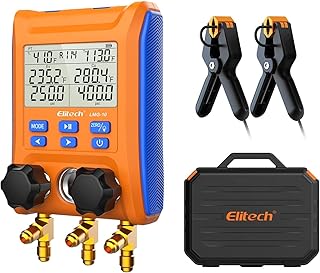
Elitech LMG-10
The LMG-10 is a two-way wired manifold aimed at techs who prefer the simplicity of a corded connection with zero pairing headaches. Dual temperature clamps give instant evap and cond readings. The rugged housing handles drops and grit without the screen cracking or the sensor ports loosening over time.
- Pro: Wired reliability means no batteries, no Bluetooth pairing, no dropped connections.
- Pro: Instant dual-temp reading without any calculation lag.
- Con: Two-way design only, no dedicated vacuum port on the manifold body.
Skip it if you regularly pull vacuum and want a third port on the gauge itself.
93-Refrigerant Dual Pressure Gauge Set
What sets this set apart is refrigerant breadth. Ninety-three supported refrigerants include R744 (CO2) and R404A, which are rarely found in budget manifolds. For techs servicing commercial refrigeration alongside residential AC, having one device that handles both is a genuine time-saver.
- Pro: CO2 and R404A support at under a hundred dollars is rare.
- Pro: Includes hoses and temperature clips in the box.
- Con: Build quality and display resolution trail the pricier options.
Skip it if you work exclusively on standard residential R410A and R22 systems.
92-Refrigerant HD Backlit Manifold Gauges
The TFT backlit display on this unit is its standout feature. Text is crisp, large, and readable in dim mechanical rooms where cheaper LCD segments wash out. The 92-refrigerant library covers mainstream HVAC and most commercial blends. The portable hook clips onto a unit edge for hands-free operation.
- Pro: HD backlit TFT display is the easiest to read in poor lighting.
- Pro: 92-refrigerant support with standard 1/4-inch SAE interfaces.
- Con: User rating is high but fewer units have been field-tested long-term.
Skip it if you need wireless connectivity or a vacuum gauge built in.
AUTOOL Digital Manifold Gauge
AUTOOL’s unit bundles pressure, temperature, vacuum, and leak detection into one housing. The LCD backlight keeps the display visible at night. For techs who want a single tool covering basic diagnostics without carrying multiple devices, the convenience is real. Ninety-two refrigerant profiles cover most residential and light commercial work.
- Pro: Vacuum and leak detection built into the same device.
- Pro: Included hoses and temp clamps make it a complete kit.
- Con: Lowest rated on this list; some users report inconsistent readings after extended use.
Skip it if you have already seen complaints about reading drift and need guaranteed long-term accuracy.
Buying Guide
Accuracy and Repeatable Readings
Check the stated accuracy spec in full-scale terms. A plus or minus one percent FS on a 0-to-600 PSI range means six PSI of error at full scale, which matters when you are fine-tuning a superheat target. Repeated field use exposes units that drift after a few months. Look for manifolds with sealed sensor ports and quality gaskets to keep moisture out.
Refrigerant Library and Calculations
More refrigerants is not always more practical, but the specific blends matter. R454B and R32 are replacing older blends in new installations. R1234yf shows up in automotive and some heat pump work. A unit that calculates superheat, subcooling, and target charge automatically saves mental math on every call and reduces diagnostic errors.
Wired Versus Wireless and Probe Quality
Wired probes are simpler and cannot lose a connection mid-job. Wireless probes let you position sensors on both sides of a system and read from a distance. Either way, probe quality determines real-world accuracy. A cheap thermistor clamp reads three to five degrees off after a month of thermal cycling. Budget for replacement probes or buy a set with probes you can verify against a known reference.
Our Verdict
The Fieldpiece SM382V is the overall best digital refrigeration gauges choice for working professionals who need wireless flexibility and data logging without compromise. The Elitech DMG-2SE is the top budget pick because at under fifty dollars it covers the most ground with no connection or app dependency.
What to Look For Before You Buy
Pressure Range and Hose Limits
High-pressure systems run well above the pressures of older refrigerants, so check the maximum working pressure of the gauge, the manifold body and the hoses against the refrigerants you service. A manifold that handles the low side comfortably but is marginal on the high side is not a bargain. Also confirm the units the display can show, such as psi, bar or kPa, so readings match your charging charts.
Refrigerant Coverage, Including Newer Types
Many digital manifolds list dozens of refrigerants, but the newer mildly flammable A2L refrigerants have their own handling requirements. If you expect to work on equipment that uses them, confirm the manufacturer states the tool is suitable for that use rather than assuming a long list of supported refrigerants covers it.
Probe Inputs and Power
Superheat and subcooling need temperature readings from the line, so look for at least two probe inputs, and check how they connect. Think about power as well: replaceable batteries are easy to swap in the field, while a built-in rechargeable cell can go flat at an awkward moment.
A Worked Example: Superheat and Subcooling
These formulas explain why probe placement matters. Take illustrative numbers, not targets; correct values come from the equipment manufacturer.
- The gauge reads suction pressure and converts it to a saturation temperature, assumed here to be 40 F.
- The suction line probe, clamped to a clean section of tube, reads 55 F.
- Superheat equals line temperature minus saturation temperature, so 55 minus 40 gives 15 F.
- On the liquid side, assume the gauge shows a saturation temperature of 105 F and the liquid line probe reads 95 F.
- Subcooling equals saturation temperature minus liquid line temperature, so 105 minus 95 gives 10 F.
A probe that is loose or sitting on dirty, uninsulated pipe can easily shift either answer by several degrees, which is enough to send a diagnosis the wrong way.
Which One Should You Buy?
| If you… | Choose… |
|---|---|
| Work in the field daily and want a professional-grade brand | Fieldpiece SM382V or Testo 550s |
| Prefer a digital manifold from a brand that focuses on refrigeration tools | Elitech DMG-2SE or Elitech LMG-10 |
| Need a general-purpose HVAC manifold for occasional use | VIVOHOME Digital HVAC Manifold |
| Want a wide refrigerant list with a dual-pressure layout | 93-Refrigerant Dual Pressure Gauge Set |
| Work in dim attics or crawlspaces and want a backlit display | 92-Refrigerant HD Backlit Manifold Gauges |
| Want another digital manifold on the shortlist to compare against the others on spec sheets | AUTOOL Digital Manifold Gauge |
Common Mistakes When Buying Digital Gauges
- Choosing by refrigerant count. A large list means little if the tool is not suitable for the refrigerants on your jobs.
- Not zeroing before connecting. Sensors need a zero reference at atmospheric pressure, so skipping it carries an error into every reading.
- Overlooking the hoses. Stiff, worn or short hoses cause leaks and awkward setups, so check their length and condition.
- Ignoring probe quality. Weak clamps and thin leads cost more accuracy than the pressure sensor does.
- Skipping scheduled checks. Even good sensors drift, so verify against a known reference on the interval the maker suggests.
FAQ
Do digital refrigeration gauges need calibration?
Most units are factory-calibrated and hold accuracy for several years of normal use. If readings drift beyond the stated tolerance, contact the manufacturer for recalibration. Analog-style recalibration at a service center is rarely needed for digital manifolds.
Can I use a digital manifold with any refrigerant?
Only if that refrigerant is in the built-in library. Always verify your target blends are listed before buying. A unit supporting 88 or 92 refrigerants will cover most jobs, but confirm the specific blend you service is included.
What does full-scale accuracy mean in practice?
Full-scale (FS) means the tolerance is a percentage of the maximum range, not the current reading. A 0-to-600 PSI gauge rated at plus or minus one percent FS allows six PSI of error whether the needle reads 10 or 500.
Are clamp probes better than stick-on sensors?
Clamp probes attach to the pipe and measure surface temperature, which is close to line temperature but not identical. Stick-on sensors can be more accurate if surface prep is thorough. For field speed and repeatability, quality clamp probes win most techs over.
FAQ
Do digital refrigeration gauges need calibration?
Can I use a digital manifold with any refrigerant?
What does full-scale accuracy mean in practice?
Are clamp probes better than stick-on sensors?
More from Amazon
Programs that pair well with the guide above. Offers and eligibility are set by Amazon and may change.
Free shipping on eligible items, Prime Video and more. Eligible new members can start with a free trial.
Start a Prime free trialAudiobooks and podcasts to listen to on the go. Eligible new members can start with a free trial.
Try Audible freeAd-free music streaming. Eligible new subscribers can start with a free trial.
Try Music Unlimited freeA free business account with business pricing and bulk-buying tools for work, shop or home office.
Create a business accountAs an Amazon Associate we earn from qualifying purchases.