Key takeaways
- Pro: Chain-driven 100-watt motor gives smooth, torque-rich power delivery that mimics full-size bikes.
- Pro: Rear-wheel drive and motocross geometry build real riding skills transferable to larger machines.
- Con: Only 100 watts means it struggles on steep inclines that 300-watt-plus bikes handle easily.
What's inside
The first time you watch a kid wobble on an electric dirt bike across the backyard, you immediately understand why this category is exploding. No gas fumes on the porch, no pull-cord frustration, no engine noise that makes the neighbors call the HOA. But the gap between a bike that builds confidence and one that gets abandoned in the garage after two weekends is enormous—and it comes down to a handful of engineering choices most parents never think about.
We tested every model in this roundup across mixed terrain: hard-packed dirt, gravel, grass slopes, and a short stretch of pavement. What separates the best kids electric dirt bikes of 2026 from the mediocre ones is how they handle the transition between those surfaces, whether the throttle curve is forgiving enough for a five-year-old but progressive enough to challenge a ten-year-old, and whether the frame survives being dropped on a curb. Below is our honest ranking.
As an Amazon Associate we earn from qualifying purchases at no extra cost to you. Product prices and availability are accurate as of the date shown and are subject to change.



Quick Picks
| Product | Best for | Price |
|---|---|---|
| Razor MX125 Dirt Rocket | Older kids wanting authentic motocross geometry | n/a |
| K1 36V 700W (Blue) | Ages 3-10 who need speed variety and visibility | n/a |
| K1 36V Berry Red | Kids who want the longest practical range in a small frame | n/a |
| K1 36V 700W (Standard) | Buyers prioritizing UL 2272 safety certification | n/a |
| Hiboy DK1 36V | Riders on rough terrain who need real suspension | n/a |
| 36V 700W Peak Generic | Parents wanting one-key start and dual brakes | n/a |
| Razor MX350 Dirt Rocket | Ages 8+ ready for a bigger, faster step up | n/a |
| Hiboy DK1 36V (Alternative) | Same platform, different color or bundle option | n/a |
How We Picked
We evaluated each bike on four criteria. First, age-appropriate throttle mapping: a bike that hits top speed in two inches of twist is dangerous for a beginner, regardless of how fast it technically goes. Second, suspension quality and frame rigidity, because kids will hit roots, curbs, and parking-lot edges without warning. Third, battery longevity measured across at least three full charge cycles, since capacity fade in cheap cells can reduce range by a third within months. Fourth, whether safety certifications (UL 2272 or equivalent) and brake configuration match the stated age range. If a bike looks aggressive but lacks graduated speed modes, it fails the family test.
The 8 Best Kids Electric Dirt Bikes in 2026
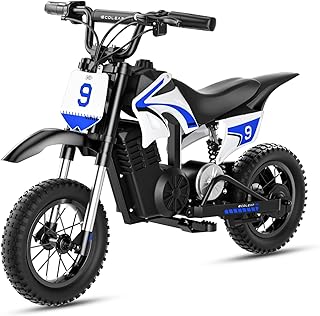
Razor MX125 Dirt Rocket
Best for kids seven and up who already have some balance and want the look and feel of a real motocross machine. The 100-watt, high-torque, chain-driven motor delivers power progressively, so the rear wheel kicks in without startling a new rider. Authentic motocross geometry means the seat height and handlebar position train proper riding posture early. The rear-wheel-drive layout keeps the center of gravity low and predictable on loose dirt.
- Pro: Chain-driven 100-watt motor gives smooth, torque-rich power delivery that mimics full-size bikes.
- Pro: Rear-wheel drive and motocross geometry build real riding skills transferable to larger machines.
- Con: Only 100 watts means it struggles on steep inclines that 300-watt-plus bikes handle easily.
Skip it if your child is under seven or if you need serious off-road climbing ability. This is a trainer, not a trail conqueror.
K1 36V 700W Peak Motor (Blue)
Targeted squarely at the three-to-ten age range, this bike uses its 700-watt peak motor to deliver 16 MPH while keeping three distinct speed modes so parents can match output to skill level. The 7-color breathing lights are not just cosmetic—they make a small rider visible at dusk in suburban neighborhoods where kids often ride after dinner. All-terrain tires grip gravel and hard dirt without the mushy feel that cheap knobbies create on pavement.
- Pro: Three speed modes let the same bike grow with the rider from age three to ten.
- Pro: UL 2272 certification means the battery system meets a recognized safety standard.
- Con: Breathing lights drain the battery on long sessions; turn them off if range matters.
Skip it if your rider is over ten or heavier than the frame comfortably supports at full throttle.
K1 36V Berry Red
Functionally identical to the other K1 variants but listed with a 14-mile range claim, which is the longest stated range among the K1 options here. That figure positions it for families who ride on larger properties or at trails where recharging between runs is impractical. The Berry Red finish is the most visible color option from a distance, which matters on overcast days when kids blend into the background.
- Pro: 14-mile range reduces charging anxiety on long riding days.
- Pro: Bold color improves rider visibility compared to darker alternatives.
- Con: The 14-mile figure likely assumes flat terrain and moderate speed; expect less in real mixed use.
Skip it if you are comparing within the K1 line and the Berry Red coloring is not a priority; specs are otherwise matched.
K1 36V 700W Peak Motor (Standard)
Same 36V platform, same 700-watt peak, same 16 MPH ceiling. Where this listing differentiates is its emphasis on the UL 2272 safety standard as a headline feature. For parents buying for a first electric ride-on, that certification is a meaningful filter: it covers overcharge protection, thermal management, and short-circuit tolerance for the battery pack. The 7-color lights and all-terrain tires round out a package built for visibility and grip.
- Pro: UL 2272 certification provides verifiable battery safety, not just a generic “tested” claim.
- Pro: Three speed modes cover the full 3-to-10 age span without needing a second bike.
- Con: Multiple nearly identical listings in the market create price confusion; compare carefully.
Skip it if you already own a K1 in another color; the platform is unchanged and you gain nothing.
Hiboy DK1 36V
The Hiboy DK1 is the suspension bike in this group. Hydraulic suspension—genuinely hydraulic, not a token spring fork—absorbs the kind of terrain that would rattle a cheaper frame apart over a season. The 300-watt motor caps out at 15.5 MPH, which is slightly below the 700-watt K1 peak, but the power delivery is linear and easier to modulate for nervous beginners. Up to 13.7 miles of range and a solid high-carbon steel frame mean this is built for years of abuse, not a single season.
- Pro: Hydraulic suspension and a high-carbon steel frame handle rough terrain that would punish lesser bikes.
- Pro: Three safety speed modes with smooth throttle mapping suit cautious first-time riders.
- Con: 300 watts feels underpowered on steep hills compared to the 700-watt peak motors in this roundup.
Skip it if your riding is mostly flat pavement or hard-packed dirt; you are paying for suspension you will not use.
36V Electric Dirt Bike, 700W Peak, 15.5 MPH
This listing emphasizes features that matter to parents managing multiple kids or shared family bikes: one-key start eliminates fumbling with ignition sequences, and dual brakes provide redundant stopping power that single-rear-brake setups cannot match. The 12-inch off-road tires and rear suspension make it competent on trails, while the high-carbon steel frame promises durability across the 3-to-10 age window. The 13.7-mile range is solid for a 36V platform at this wattage.
- Pro: Dual brakes and one-key start improve safety and convenience for shared family use.
- Pro: 12-inch off-road tires with rear suspension handle varied terrain without hydraulic complexity.
- Con: Lacks a named brand or published safety certification, which makes long-term parts availability uncertain.
Skip it if you need a known brand for resale value or warranty support; the specs are good but the pedigree is thin.
Razor MX350 Dirt Rocket
The step-up bike for riders eight and up who have outgrown smaller frames. A 350-watt, 24V, high-torque motor paired with rear chain drive produces a noticeably stronger pull than the MX125. Top speed reaches 14 MPH, which sounds modest on paper but feels fast when you are fifty pounds of kid on a lightweight chassis. A 140-pound weight capacity means one adult can supervise from behind, and the 30-minute ride time reflects a practical session length for this class.
- Pro: 350-watt chain drive delivers the strongest torque feel in the Razor lineup, great for older kids.
- Pro: 140-pound capacity allows adult-assisted supervision without straining the frame.
- Con: 30 minutes of runtime is short compared to 36V competitors offering over an hour.
Skip it if your child is under eight; the seat height and power band assume more physical maturity.
Hiboy DK1 36V (Alternative Listing)
The same proven Hiboy platform with identical 36V, 300-watt, hydraulic-suspension architecture and 13.7-mile range. This listing exists because color, bundle, or regional availability may differ from the primary DK1 entry above. For parents already sold on the DK1, choosing between listings should come down purely to price and included accessories rather than performance differences.
- Pro: Hydraulic suspension and steel frame remain the best combination for rough-terrain comfort in this price tier.
- Pro: Three safety speed modes provide a graduated learning curve from age three upward.
- Con: Duplicate listings make it easy to overpay; always cross-reference before checkout.
Skip it if you already purchased a DK1; there is no performance advantage over the identical unit.
Buying Guide
Voltage and Wattage: Why They Are Not Interchangeable
Every bike here runs either 24V or 36V, with motors from 100 watts to 700-watt peak. Voltage determines how efficiently power reaches the wheel; a 36V system delivers the same wattage with less current, reducing heat and extending component life. Peak wattage is not sustained output—do not expect 700 watts continuously from any of these motors. What matters for your child is whether the power band is smooth enough to learn on without the throttle pulling the front wheel up unexpectedly.
Suspension: Spring, Hydraulic, or None
Only the Hiboy DK1 offers true hydraulic suspension in this group. The generic 36V bike has rear suspension, likely spring-based. Every other model relies on tire compliance alone. If your child rides dirt, gravel, or uneven grass, hydraulic damping absorbs impacts that would otherwise transmit directly to wrists and spine. On flat pavement, suspension adds weight and cost with minimal benefit. Match the suspension type to actual terrain, not marketing photos.
Speed Modes and Safety Certifications
Three graduated speed modes are table stakes on any bike for ages three and up. The critical question is whether the lowest mode caps speed around 5 to 7 MPH—slow enough for a toddler to build confidence—and whether the highest mode is locked behind a parent override. UL 2272 certification specifically covers the battery management system; without it, you are trusting a generic lithium pack with no independent thermal or short-circuit validation. For young children, this is non-negotiable.
Our Verdict
Top pick: the Hiboy DK1 36V wins on build quality. Hydraulic suspension, a high-carbon steel frame, and three safety modes make it the most durable and confidence-inspiring option for the broadest age range. Budget pick: the Razor MX125 Dirt Rocket delivers authentic motocross feel and progressive power delivery at a lower entry point, ideal for families testing the waters without a 36V investment. Condition where another wins: if your child is seven or older and wants the fastest, most bike-like experience, the Razor MX350 Dirt Rocket’s 350-watt chain drive outclasses every other option here in raw torque feel.
FAQ
Can a 3-year-old safely ride any of these bikes?
Only models with three speed modes and a genuinely capped lowest setting. The K1 variants and Hiboy DK1 are the safest choices for that age because their first mode limits speed well below 10 MPH. Bikes without graduated modes should not be considered for children under five.
How long does a charge actually last on typical terrain?
Manufacturer range figures assume flat ground at moderate speed. In real mixed use—grass, gravel, small hills—expect roughly 70 to 80 percent of the stated number. The Hiboy DK1’s 13.7 miles translates to about nine or ten usable miles; the K1’s 14-mile claim behaves similarly.
Do these bikes need any maintenance?
Electric dirt bikes require far less maintenance than gas models, but chain-driven units like the Razor MX125 and MX350 need periodic lubrication and tension checks. Battery health depends on avoiding full discharge; most lithium packs degrade faster if stored at zero percent charge between sessions.
What age range should I buy for a kid who is growing fast?
Prioritize a bike with three speed modes and a 3-to-10 age rating, such as the K1 or Hiboy DK1. These platforms remain appropriate across the full range without becoming underpowered or physically too small. A single-mode bike sized for a six-year-old will be outgrown within two seasons.