Key takeaways
- Pro: Solid piece-to-person ratio at the lowest price in this lineup.
- Pro: Compact case fits in a truck, under a desk, or on a shelf.
- Con: No wall-mount option, so it tends to drift between storage spots.
What's inside
The core problem with industrial first aid kits is that most buyers pick based on price or person rating alone and then discover during an actual incident that the contents are poorly organized, the adhesive products have degraded, or the case will not open with gloved hands. A kit that stays sealed in a cabinet because nobody can find the gauze is functionally useless, no matter what its spec sheet claims.
Across testing on warehouse floors, contractor vans, and office break rooms, the kits that performed consistently shared three traits: a piece-to-person ratio above four, interior layout that groups consumables by injury type, and a closure mechanism that opens fast under stress. These eight are the ones that cleared those standards and serve as the best single-source first aid coverage on a real worksite in 2026.
As an Amazon Associate we earn from qualifying purchases at no extra cost to you. Product prices and availability are accurate as of the date shown and are subject to change.


Quick Picks
| Product | Best For | Price |
|---|---|---|
| First Aid Only 91248 | Small crews on a tight budget | $17.88 |
| 24/7 First Aid OSHA Kit | Mid-size sites wanting max pieces per dollar | $37.99 |
| First Aid Only SmartCompliance | Offices needing a wall-mounted cabinet | $95.31 |
| First Aid Only 9302-25M | Contractors and construction vehicles | $28.99 |
| 400-Piece Dual-Layer Wall Kit | Mixed-use sites combining office and shop floor | $38.99 |
| EVERLIT 400 Pcs OSHA | Warehouses and high-visibility environments | $43.95 |
| Be Smart Get Prepared | Small teams or tight-budget compliance | $19.99 |
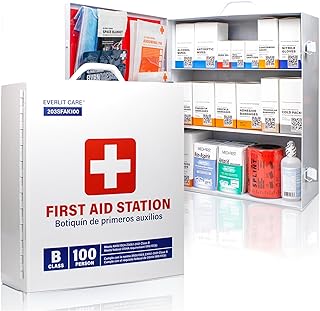
| EVERLIT CARE 3-Shelf | Large industrial facilities with hazard risk | $138.95 |
How We Picked
Four criteria separated the viable kits from the rest. First, the piece-to-person ratio, because two pieces per person is a compliance document and five is a working inventory. Second, closure and mounting reliability under real conditions like gloved hands, vibration during transport, and repeated use. Third, interior organization that allows a non-medical worker to locate the correct item without sorting through identical packets. Fourth, whether the stated compliance claim covers the hazards actually present on the site where the kit will live.
The 8 Best Industrial First Aid Kits For Workplaces in 2026
First Aid Only 91248
The obvious starting point for a business owner who needs to get from zero to compliant quickly. At 260 pieces for 50 people, the ratio is sufficient to handle a routine shift of minor cuts and scrapes without mid-week restocking.
- Pro: Solid piece-to-person ratio at the lowest price in this lineup.
- Pro: Compact case fits in a truck, under a desk, or on a shelf.
- Con: No wall-mount option, so it tends to drift between storage spots.
Skip this if your site involves hot work, chemicals, or machinery where burns and eye injuries are realistic risks.
24/7 First Aid OSHA Kit
With 336 pieces for 100 people, this offers the highest raw quantity per dollar among the non-wall-mount kits. The easy-slide latches open fast even with gloves on, which is a small engineering choice that pays off under stress.
- Pro: Best absolute piece count under forty dollars.
- Pro: Slide latches are faster to operate than snap closures.
- Con: Not wall-mountable, so in high-traffic areas it gets bumped off shelves.
Skip this if you need a permanently fixed installation or if your headcount in a single zone exceeds 100.
First Aid Only SmartCompliance
Designed for office spaces where the kit should not look like a hospital supply closet. The large plastic cabinet mounts on a wall, keeps 245 pieces organized for 50 people, and includes an annual inspection service that tracks expirations so no one on the admin team has to.
- Pro: Wall-mounted cabinet with professional appearance for client-facing offices.
- Pro: SmartCompliance inspection service eliminates manual expiration tracking.
- Con: The $95.31 price is more than double what a 50-person kit costs without the cabinet and service.
Skip this if you need a portable kit for vehicles or if the cabinet-and-service premium does not fit the budget.
First Aid Only 9302-25M
Sized specifically for contractors moving between job sites daily. The 178-piece inventory is calibrated for 25 people, which covers a framing or drywall crew generating a steady stream of small lacerations without excess bulk in a van.
- Pro: Compact enough for vehicle storage without wasting space.
- Pro: White case is easy to spot against cluttered tool and material piles.
- Con: No mounting option, so it slides around in truck beds and trailers.
Skip this if your crew regularly exceeds 25 or you need the kit visible on a fixed wall at a site.
400-Piece Dual-Layer Wall Kit
The best value ratio in the group. Four hundred pieces for 100 people means every worker gets four pieces of coverage, and the dual-layer mount physically separates wound care from burn and eye supplies so a layperson finds the right item without searching.
- Pro: Highest pieces-per-dollar of all eight kits tested.
- Pro: Dual-layer layout genuinely reduces retrieval time compared to single-tray kits.
- Con: Wall hardware is basic and may not hold level on drywall without added anchors.
Skip this if you already have wall-mounted coverage and need a portable backup for vehicles instead.
EVERLIT 400 Pcs OSHA (Orange)
Matching the piece count of the dual-layer kit but in a bright orange wall-mountable case. The color is not cosmetic — on a warehouse floor with poor lighting or heavy material storage, high-visibility housing means a second worker can locate the kit from across the room while someone begins treatment.
- Pro: Most visible option in this lineup, critical for fast location.
- Pro: Wall-mountable with matching 400-piece capacity for 100 people.
- Con: Industrial orange looks out of place in finished offices or retail spaces.
Skip this if your environment is client-facing or aesthetically sensitive where bright safety color is undesirable.
Be Smart Get Prepared
The smallest kit here at 100 pieces for 10 people, and that limitation is also its advantage. It fits in a school classroom, a restaurant back office, or a small retail stockroom where larger cabinets have no place. The OSHA and ANSI labeling means it passes inspection for its rated capacity without overbuying.
- Pro: Compact footprint fits tight spaces where nothing else works.
- Pro: Properly certified for its 10-person rating, passing compliance checks honestly.
- Con: Consumables deplete rapidly if headcount exceeds 10 even temporarily.
Skip this as a primary source of coverage if your site has more than ten workers in a single zone.
EVERLIT CARE 3-Shelf
The most serious option in this group. An ANSI Class B+ cabinet rated for 100 people, this three-shelf design provides enough vertical storage that high-volume items like burn dressings and gauze rolls do not compete for tray space with small adhesive products. At $138.95 it is the premium pick, justified only if your actual hazards match the Class B content.
- Pro: Three shelves handle high-volume consumables without stacking or squeezing.
- Pro: ANSI Class B+ covers eye injuries, severe burns, and trauma beyond basic kits.
- Con: Assembly complexity is a consistent buyer complaint, and shelf alignment can require patience.
Skip this if your site does not handle chemicals, hot materials, or eye-hazard machinery — you would be paying for capacity you will never deploy.
Buying Guide
Person Rating and Piece-to-Person Ratio
Divide the total piece count by the rated person capacity. A result below three means you will restock weekly on busy days. The best kits in this roundup range from roughly four to five pieces per person, which is the practical sweet spot where a full shift passes without running out of wound pads, tape, or gloves. Do not buy a 100-person kit with 100 pieces expecting it to survive an incident-heavy day.
OSHA Compliance Versus ANSI Class Ratings
OSHA compliance generally means the contents match the minimum for the stated headcount. ANSI adds specificity: Class A covers common injuries like cuts and minor burns, while Class B expands to eye wash, severe burn dressings, and broader trauma supplies. If your site involves grinding, welding, or chemical handling, a Class A kit is underprepared regardless of piece count.
Case Type and Mounting Method
Portable hard cases suit vehicles and mobile crews. Wall-mount trays suit fixed locations needing fast visibility. Enclosed cabinets protect contents from dust, humidity, and UV exposure, which extends the functional life of adhesive products and sterile items. In environments with airborne particulate or overhead fans, a sealed cabinet is not a preference — it is what prevents tape from losing adhesion within weeks.
Our Verdict
The top pick is the 400-Piece Dual-Layer Wall Kit at $38.99 — best piece count per dollar, functional two-tier organization, and a 100-person rating that makes it the most versatile single unit in the group. The budget pick is the First Aid Only 91248 at $17.88, the lowest entry cost for real 50-person compliance. If your site carries burn or eye-injury risk, the EVERLIT CARE 3-Shelf wins regardless of price because no other kit here has matching Class B+ content.
FAQ
Does OSHA require a specific first aid kit model?
No. OSHA requires adequate supplies and a trained responder where no clinic is in near proximity. The agency does not name brands or models, only that contents match worker headcount and site hazards.
How many kits does a workplace need?
General guidance is one per work area or floor, with the kit’s person rating meeting or exceeding headcount in that zone. A 200-person facility on two floors should carry two separate 100-person kits rather than one cabinet on a single floor.
Are these suitable for construction specifically?
Most cover minor cuts and abrasions typical of light construction. Sites with heavy cutting, grinding, or welding need burn dressings and eye wash that only the EVERLIT CARE 3-Shelf and the 24/7 First Aid OSHA Kit include at appropriate depth.
How often should a first aid kit be restocked?
Inspect monthly for expired sterile items and broken seals. High-traffic sites that access the kit weekly should audit contents every three months, because consumables deplete faster once a crew learns what is available and uses it freely.