Key takeaways
What's inside
Air purifier for bedroom performance directly impacts sleep quality by removing airborne allergens, fine dust, and pet dander. Selecting an effective unit requires balancing certified CADR airflow with whisper-quiet acoustics under 24 dB, avoiding disruptive fan whine while refreshing sleeping zone air continuously.
By Daniel Foster
As an Amazon Associate we earn from qualifying purchases.
Decisive Air Purifier Metrics and Bedroom Placement Rules
Investing in a reliable air purifier for bedroom environments requires evaluating CADR ratings, operating noise levels, and room dimensions. Understanding how these mechanical variables interact prevents buying noisy, undersized units that disrupt nighttime rest while failing to clean ambient indoor air properly.
Core Deciding Numbers: CADR Airflow and Filter Certifications
Clean Air Delivery Rate, or CADR, measures cubic feet per minute of filtered air across smoke, dust, and pollen. For undisturbed sleep, your unit must deliver at least 140 cfm (238 m³/h) to achieve 4 to 5 air changes per hour (ACH), which health-conscious homeowners require for noticeable particle reduction.
True HEPA filtration certified under DOE standards captures 99.97% of airborne particles down to 0.3 microns. Avoid unverified HEPA-type marketing labels that lack standardized testing. Beware of ozone-generating ionizers; pure mechanical filtration remains the safest method for nocturnal breathing spaces.
Space and Fit: Calculating Room Coverage and Physical Footprint
Matching an air purifier for bedroom dimensions ensures that the motor cycles air at least four times per hour without excessive strain. A standard 10×12 ft (3×3.6 m) bedroom spans 120 sq ft (11 m²), whereas a 15×20 ft (4.5×6 m) primary suite covers 300 sq ft (28 m²), requiring proportionally higher airflow capacity.
Always measure your bedroom’s physical dimensions and clearance before ordering any floor console. Purifiers require at least 15 to 20 inches (38 to 50 cm) of open clearance from walls and bedding. Cramming a bulky 18-inch (45 cm) cylindrical unit into a tight walkway restricts air intake and creates trip hazards.
Sleep Mode Acoustics and Light Controls for Restful Nights
Acoustic output defines bedroom usability more than daytime air volume. Sleep settings should maintain sound output below 24 dB, mimicking a gentle rustle of leaves. Units that exceed 30 dB in lowest gear frequently trigger sleep fragmentation, forcing light sleepers to shut off filtration during the night.
Display darkness represents another critical nocturnal feature. Blue or white LED control panels illuminate dark bedrooms like nightlights, interfering with melatonin production. Select models with complete display-shutoff functions or ambient light sensors that automatically dim glowing indicators at dusk.
Seasonal Smoke Peaks and Recurring Filter Replacement Budgets
According to EPA air quality reports (2026), seasonal wildfire smoke events create severe particulate spikes (AQI exceeding 150) across late summer and early autumn. During these hazardous events, bedroom purifiers must run continuously on medium speeds, accelerating filter saturation faster than normal.
Replacement filters function as a mandatory recurring cost that buyers frequently overlook during initial purchase. Genuine True HEPA barrels generally require renewal every 6 to 12 months, adding ongoing annual expenses. Budgeting for verified replacement cartridges avoids degraded airflow and motor burnout.
Dense carbon stages also exhaust their adsorption capacity within 3 to 6 months when exposed to persistent smoke or household odors. Tracking replacement timelines prevents running clogged filters that drop CADR rates below acceptable thresholds while drawing unnecessary wattage from residential wall sockets.
Top 7 Air Purifiers for Bedroom Spaces: Detailed Evaluations
Choosing the right air purifier for bedroom demands requires comparing certified CADR outputs, sleep mode decibels, and filtration stages. The following seven models excel across diverse bedroom footprints, providing proven particulate capture while preserving quiet restful environments throughout the night.
| Model | Coverage (sq ft / m²) | Smoke CADR | Sleep Noise | Filter Type | Price Tier |
|---|---|---|---|---|---|
| Levoit Core 300S | 219 sq ft / 20 m² | 141 cfm (240 m³/h) | 22 dB | True HEPA + Carbon | Budget |
| Coway AP-1512HH | 361 sq ft / 34 m² | 246 cfm (418 m³/h) | 24.4 dB | True HEPA + Carbon | Mid-range |
| Winix 5500-2 | 360 sq ft / 33 m² | 232 cfm (394 m³/h) | 27.8 dB | True HEPA + AOC Carbon | Mid-range |
| Blueair 411i Max | 219 sq ft / 20 m² | 141 cfm (240 m³/h) | 18 dB | HEPASilent + Carbon | Budget |
| Levoit Vital 200S | 380 sq ft / 35 m² | 245 cfm (416 m³/h) | 24 dB | True HEPA + Carbon | Mid-range |
| Medify MA-25 | 250 sq ft / 23 m² | 147 cfm (250 m³/h) | 35 dB | Dual H13 True HEPA | Mid-range |
| Honeywell HPA300 | 465 sq ft / 43 m² | 300 cfm (510 m³/h) | 38 dB | True HEPA + Pre-filter | Mid-range |
Levoit Core 300S: Best Overall Smart Air Purifier for Bedrooms
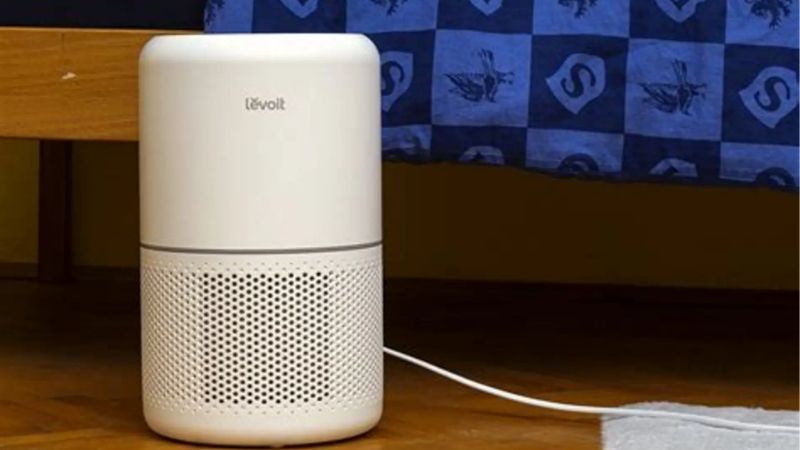
The Levoit Core 300S represents a top air purifier for bedroom use due to its compact circular profile and whisper-quiet nocturnal operation. It delivers a certified smoke CADR of 141 cfm (240 m³/h), refreshing a 219 sq ft (20 m²) bedroom 4.8 times hourly while consuming a modest 26 watts on maximum fan power.
In sleep mode, the Core 300S operates at a barely audible 22 dB with all console lights fully extinguished. The companion app enables off-bed scheduling, though the lightweight carbon sheet inside the cylindrical filter struggles with heavy cooking odors, requiring earlier replacement under smoky conditions.
Coway Airmega AP-1512HH: Best High-Efficiency Purifier for Medium Rooms
The Coway Airmega AP-1512HH delivers robust air movement with a smoke CADR of 246 cfm (418 m³/h), effectively serving bedrooms up to 361 sq ft (34 m²) at 4 ACH. Its four-stage filtration system integrates a washable pre-filter, odor-absorbing carbon, and a genuine True HEPA barrier that captures microscopic allergens.
Its sleep mode registers 24.4 dB, ensuring quiet rest while an eco-mode shuts down the fan when air remains clean for thirty minutes. However, its ionizer button must be manually switched off to prevent unintended ionization, and the bright air-quality ring requires manual deactivation before lights out.
Winix 5500-2: Best True HEPA Unit with Washable Carbon Filter
The Winix 5500-2 features a potent smoke CADR of 232 cfm (394 m³/h), making it suitable for sleeping quarters reaching 360 sq ft (33 m²). Its primary advantage lies in the washable advanced odor control (AOC) carbon filter, which uses genuine activated carbon pellets to neutralize volatile bedroom smells.
Smart light sensors automatically drop fan speed to sleep mode and dim the console when the room goes dark, registering 27.8 dB. On the downside, its substantial 23.6-inch (60 cm) tower profile demands ample floor area, and the PlasmaWave technology produces faint electrical ticking that bothers light sleepers.
Blueair Blue Pure 411i Max: Best Compact Purifier for Small Bedrooms
For tight urban rooms, selecting an air purifier for bedroom corners like the 411i Max ensures pristine airflow without occupying space. Rated for 219 sq ft (20 m²) at 4.8 ACH, it delivers a smoke CADR of 141 cfm (240 m³/h) using proprietary HEPASilent electrostatic and mechanical dual-filtration mechanisms.
At minimum speed, this cylindrical unit produces an ultra-quiet 18 dB, creating negligible noise while drawing only 4 to 20 watts of power. However, the outer washable fabric pre-filter accumulates visible pet lint quickly, requiring frequent vacuuming to prevent airflow throttling and motor strain.
Levoit Vital 200S: Best Purifier for Pet Owners and Larger Bedrooms
The Levoit Vital 200S provides high-volume circulation with a smoke CADR of 245 cfm (416 m³/h), clearing larger 380 sq ft (35 m²) bedrooms at 5 ACH. Its U-shaped air inlet prevents pet hair clogs, drawing dander directly into a washable pre-filter before particles reach the True HEPA filtration core.
Sleep mode drops acoustic output to 24 dB while turning off all display LEDs completely, preserving total darkness. The companion app offers comprehensive pet schedules, though its 50-watt top speed creates noticeable high-frequency turbulence that proves distracting if positioned right beside the bed.
Medify MA-25: Best Medical-Grade Dual H13 Filtration for Allergies
The Medify MA-25 incorporates dual H13 True HEPA filters on opposing sides, producing a CADR of 147 cfm (250 m³/h) for rooms up to 250 sq ft (23 m²) at 5 ACH. Medical-grade H13 media traps 99.9% of particles down to 0.1 microns, offering superior particulate capture for severe seasonal allergy sufferers.
Its tempered glass touch surface resists scratches and cleans effortlessly, while drawing approximately 25 watts on mid settings. However, its lowest fan speed registers around 35 dB, which feels noticeably louder than competing bedroom units, and replacement sets require purchasing two filters simultaneously.
Honeywell HPA300: Best High-Volume Air Purifier for Master Suites
The Honeywell HPA300 remains a classic heavy-duty workhorse with an exceptional smoke CADR of 300 cfm (510 m³/h), servicing large 465 sq ft (43 m²) bedrooms at 4.8 ACH. Certified by AHAM, this rugged console uses three separate True HEPA filters alongside an activated carbon pre-filter wrap for broad coverage.
Its mechanical controls offer durable longevity without app connection failures, though its lowest setting produces roughly 38 dB of steady air rumble. Measuring 20.8 inches (53 cm) wide and drawing up to 130 watts on turbo, this bulky unit demands substantial floor space and yields higher electricity bills.
Long-Term Durability, Maintenance, and Buying Considerations
Maintaining your air purifier for bedroom longevity requires routine upkeep, monitoring motor wear, and replacing saturated filter media. Evaluating internal build quality, seasonal ventilation challenges, and manufacturer warranties ensures consistent air purification without premature component breakdowns.
Mechanical Wear, Fan Bearing Longevity, and Sensor Drift
Over 12 to 24 months of continuous nocturnal running, cheap sleeve bearings inside budget fans degrade, developing high-pitched rattles and friction hums. Choosing units equipped with sealed brushless DC motors ensures durable acoustics and maintains low wattage consumption across years of daily bedroom service.
Onboard infrared PM2.5 particle sensors also suffer optical drift as dust coats internal lenses after six months of operation. Vacuuming sensor intake ports every 90 days prevents erratic fan spikes during auto mode, ensuring the machine does not suddenly ramp up to maximum speed while occupants are sleeping.
Winter Sealing Demands and Strategic Seasonal Buying Timelines
During winter months, tightly sealed windows trap carbon dioxide, dust mites, and respiratory droplets, degrading nocturnal indoor air quality. Increasing ventilation through dedicated bedroom filtration alleviates stuffy bedroom symptoms without admitting freezing outdoor air through opened sashes.
Purchasing timing substantially impacts hardware acquisition budgets. Major retail events like Amazon Prime Day in late June and Black Friday in late November represent the rare annual windows when mid-tier and premium air purification appliances experience significant price reductions from brand storefronts.
Shopping during these promotional calendar peaks also allows bundling authentic replacement filter multi-packs at reduced rates. Securing backup cartridges in advance ensures uninterrupted filtration during springtime tree pollination or unpredicted wildfire smoke seasons without facing out-of-stock delays.
Warranty Protections and Aftermarket Filter Verification
Manufacturer warranty policies vary widely across consumer brands. Premium manufacturers often provide three to five years of motor protection, whereas budget offerings restrict coverage to a single year. Inspecting whether warranty terms require official brand filter replacements preserves your consumer rights.
Third-party generic filters often sell for half the price of genuine replacements, yet frequently feature looser pleat densities and unsealed gaskets. Air slips around unsealed filter edges, reducing real particulate capture efficiency and exposing fan impellers to abrasive household dust over extended periods.
See More:
- Best eyeshadow blender brush
- Best frozen foods for air fryer
- Best frozen food for air fryer
- Best way to reheat steak in air fryer
- Best air fryer recipes book
Final Recommendation on Choosing Your Ideal Bedroom Purifier
Selecting the best air purifier for bedroom air quality ultimately depends on room square footage, acoustic tolerance, and filter upkeep. Compact spaces benefit most from whisper-quiet cylinders like the Levoit Core 300S or Blueair 411i Max, delivering clean air while preserving peaceful sleeping environments.
For larger suites or homes with shedding pets, high-capacity consoles like the Coway AP-1512HH or Levoit Vital 200S offer the airflow volume needed to maintain four air changes hourly. Remember to verify room dimensions, confirm True HEPA certifications, and avoid uncertified ozone-generating ionizers
While high-efficiency air cleaners remove airborne allergens, they complement rather than replace professional medical advice for respiratory ailments. Factor in ongoing filter replacement costs, inspect decibel levels at low fan settings, and establish a quiet sanctuary for restorative sleep every single night.
As an Amazon Associate we earn from qualifying purchases at no extra cost to you.