
Best air purifier bedroom choices come down to two numbers that rarely appear side by side in listings: CADR against your room area, and noise in decibels on the lowest setting. A machine that cleans well but hums too loudly to sleep beside is a failed purchase.
As an Amazon Associate we earn from qualifying purchases.
Our top picks
 VOOPNU Air Purifiers for Home
- Effortless Operation: Simplified control panel with intuitive design…
- Compact Yet Powerful: Covers up to 1,076 ft²…
- 360° Airflow & High Efficiency Filtration: The elegantly…
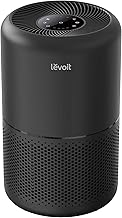


 Purivortex Air Purifiers for Bedroom
- Cleaner Air In Minutes: Purivortex is proven to…
- Breathe Easier with 99.97% Filtration: Purivortex HEPA air…
- Bigger Filter, Better Purification: Purivortex goes beyond the…


As an Amazon Associate we earn from qualifying purchases at no extra cost to you.
By Daniel Foster
Specifications come from manufacturer documentation and long-term owner feedback rather than lab testing. Nothing here is medical advice; for persistent respiratory symptoms, speak with a physician.
🛒 Best Price Today on Amazon
Prime members get fast, free shipping on everything above, plus member-only deals. New members get a 30-day free trial — cancel anytime.
Start 30-Day Prime Free Trial →See Today’s Amazon DealsMatching a Purifier to a Room You Sleep In
A best air purifier bedroom choice faces constraints a living room unit does not: it runs at night, close to your head, for eight hours at a time. Four specifications follow from that.
CADR, Room Coverage and Air Changes Per Hour
CADR is the decisive number, measured in cubic feet per minute for smoke, dust and pollen. Coverage claims in square feet are often quoted at a single air change per hour, which is far too slow for allergy relief; four to five air changes per hour is the useful target.
A practical rule: divide a manufacturer’s headline coverage figure by four or five to get the area the unit genuinely services at a meaningful rate. A 150 cfm CADR machine suits a bedroom of roughly 200 to 230 sq ft (19 to 21 m2) at that standard, which covers most bedrooms.
Noise on the Lowest Setting
Noise is the specification that decides whether a best air purifier bedroom purchase actually gets used. Sleep or night modes on good units sit around 24 to 28 dB, which is quieter than a whisper and blends into a room. Mid settings typically reach 40 to 50 dB, and top settings resemble a hairdryer.
The trap is that CADR figures are measured at maximum speed while you will run the unit at minimum. Size up deliberately: a larger purifier ticking over quietly cleans more air than a small one straining at full speed beside your pillow.
Where the Unit Fits in a Bedroom
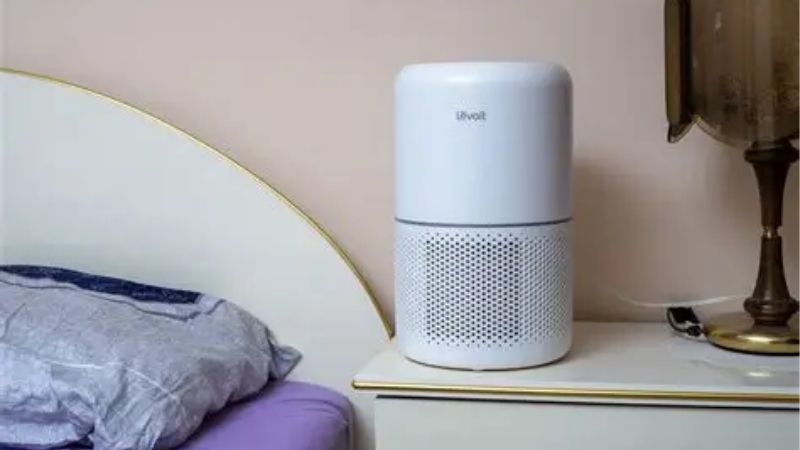
Purifiers need clearance to draw and discharge air, usually 12 in (30 cm) or more from walls and furniture, and units with 360-degree intakes need it on all sides. Placing one in a corner behind a chair defeats the airflow design entirely.
Measure the floor space you can spare and the height available if it sits beside a bedside table, since tower models run 20 to 26 in (51 to 66 cm) tall. Position it a few feet from the bed rather than directly beside your head, so airflow is not blowing across your face all night.
Filters, Replacement Cost and Certification
True HEPA filters capture 99.97 percent of particles at 0.3 microns, which covers dust, pollen and pet dander. Activated carbon handles odours and is a separate consumable that saturates faster than the HEPA layer does.
Replacement filters typically run every 6 to 12 months and cost a meaningful fraction of the machine annually, so check pricing and availability before buying. Look for UL or ETL marks, and be cautious with ionisers: several models include one that can be switched off, and switching it off avoids ozone concerns entirely.
Six Purifiers Sized for Bedrooms
Every best air purifier bedroom candidate here was chosen for quiet operation and bedroom-scale coverage rather than maximum throughput. Each entry lists a genuine drawback.
| Model | Approx CADR | Sleep mode | Best for |
|---|---|---|---|
| Levoit Core 300S | Around 141 cfm | About 24 dB | Small bedrooms |
| Coway AP-1512HH Mighty | Around 240 cfm | Low twenties dB | Overall balance |
| Winix 5500-2 | Around 240 cfm | Around 28 dB | Odours and value |
| Blueair Blue Pure 511 | Bedroom scale | Very quiet | Simplicity |
| Levoit Vital 200S | Higher throughput | Quiet mode | Larger bedrooms |
| Honeywell HPA100 | Around 100 cfm | Audible even low | Small rooms, low cost |
Levoit Core 300S: The Bedroom Default
A compact cylinder with a three-stage filter and a sleep mode measured at roughly 24 dB, which is genuinely inaudible under normal bedroom conditions. CADR around 141 cfm suits a room up to roughly 220 sq ft (20 m2) at a useful air change rate.
The 360-degree intake needs clearance all round, so it cannot be tucked against a wall. Filters are proprietary and the carbon layer is thin, so heavy odours saturate it faster than the HEPA layer wears out.
Coway AP-1512HH Mighty: The Long-Running Favourite
CADR around 240 cfm across dust, pollen and smoke, a true HEPA layer, activated carbon, and a low setting quiet enough for sleeping. It also has an air quality indicator and an eco mode that stops the fan when the air is clean.
The ioniser is on by default on some units and should be switched off if ozone concerns matter to you. The auto mode can also cycle the fan up and down audibly, which light sleepers notice; running it on a fixed low speed avoids that.
Winix 5500-2: Carbon Capacity for Odours
Similar CADR to the Coway with a notably thicker carbon filter, which is why it appears so often in recommendations for cooking smells, smoke and pet odours. Low speed sits around 28 dB, at the edge of noticeable in a silent room.
PlasmaWave is an ionising function and should be turned off if you would rather avoid it entirely; the unit works well as a plain HEPA and carbon machine. Filter replacements are moderately priced but the carbon pre-filters are an additional recurring item.
Blueair Blue Pure 511: One Button, Very Quiet
A simple three-speed machine with a washable fabric pre-filter sleeve over a combined particle and carbon filter. It is among the quietest units in this class at low speed and among the easiest to live with, since there is nothing to configure.
There is no air quality sensor, no auto mode and no timer, so it runs at whatever speed you set. Coverage is bedroom-scale only, and pushing it into a larger open-plan space is beyond its design.
Levoit Vital 200S: When the Bedroom Is Large
Higher throughput than the Core line with a wider intake designed to handle pet hair, plus app control and scheduling. For a master bedroom over roughly 350 sq ft (33 m2), this is the size that reaches a useful air change rate on a quiet setting.
It is physically larger and needs floor space rather than a bedside position. App-dependent features also age with the app, and some owners prefer the simpler models precisely because there is nothing to update.
Honeywell HPA100: Small Room, Low Outlay
CADR around 100 cfm with a true HEPA filter and a carbon pre-filter, sized for a small bedroom or a nursery of roughly 150 sq ft (14 m2). Filters are widely stocked, which keeps ownership straightforward.
Even the lowest setting is audible, closer to a soft fan than silence, so light sleepers should look elsewhere. The pre-filter also needs replacing several times a year, which narrows the running-cost advantage over pricier machines.
Filters, Placement and Running It Every Night
Purifiers are consumable-driven appliances, so the best air purifier bedroom setup on paper degrades quietly if filters are ignored. Three ownership realities decide whether one keeps working as intended.
Filter Life and What It Actually Costs
HEPA filters typically last 6 to 12 months of continuous use and carbon layers saturate sooner, often within three to six months in a kitchen-adjacent or pet-heavy home. A clogged filter reduces airflow, so a neglected machine quietly stops delivering its rated CADR.
Price the filters before buying the machine and check whether the manufacturer sells them reliably. Third-party filters vary in media quality and fit, and a poorly sealed filter lets air bypass the media entirely, which is the worst possible outcome.
Placement, Doors and Realistic Expectations
A purifier cleans the room it is in. With the bedroom door open it is fighting the whole house, so closing the door at night is the single most effective free improvement to its performance.
It also cannot address moisture-driven problems. Damp, condensation and mould growth need ventilation and humidity control; filtering spores from the air does not stop them being produced. Address the source and treat the purifier as a supplement.
Seasonal Demand and Timing
Interest in this category climbs through autumn as windows close and heating starts, and again during respiratory virus season. That demand overlaps with the electronics discount calendar, so the Amazon deal event in early October and the late November promotional window are when filters and machines both get attention.
Stocking a spare filter set when they are discounted is more useful than upgrading the machine. Prices move constantly, so verify at the point of purchase rather than relying on any expected discount.
Frequently Asked Questions
Three questions come up in nearly every message from readers choosing a best air purifier bedroom option.
Should I run it all night or all day?
Continuous operation on a low setting is more effective than intermittent high-speed bursts, because particle levels rebuild whenever the unit is off. Low speed is also where the noise figure you can live with sits, which is why sizing up matters.
Do I need an ioniser or UV feature?
No. HEPA plus activated carbon covers what a bedroom purifier is asked to do. Ionisers can generate ozone as a by-product and most models let you disable them; UV lamps in consumer units have very short contact times and add little.
Will it help with dust in the room?
It reduces airborne dust, which cuts what settles on surfaces over time. It does nothing for dust already on the floor or bedding, so it works alongside vacuuming and washing bedding rather than replacing either.
See More:
- Best low price dash cam
- Projector screens at Best Buy
- Best buy projector screens
- Best projector for games
- Best projector for gaming
Final Thoughts on Purifying a Bedroom
The best air purifier bedroom setup is one sized generously enough to run quietly rather than one running flat out beside your head. Check CADR against your room area at four to five air changes per hour, then check the decibel figure on the lowest setting.
Measure the floor space and leave clearance around the intake before ordering, and price a year of filters as part of the purchase. Whichever best air purifier bedroom option you choose, close the door at night and change filters on schedule, because both do more for the result than the badge on the front.
Write Your Review
No reviews yet. Be the first to share your experience!