
Projector screens at Best Buy tend to be a narrow in-store selection, which is why most buyers end up comparing the same handful of models online. This guide ranks seven screens available on Amazon by gain, diagonal, material and frame type, so the surface you choose actually matches the projector and the room you already own.
As an Amazon Associate we earn from qualifying purchases.
Our top picks


As an Amazon Associate we earn from qualifying purchases at no extra cost to you.
By Daniel Foster
How to Choose a Screen Before You Compare Brands
Anyone comparing projector screens at Best Buy soon learns that a screen is not a passive white rectangle. Its gain, its material and its frame all change the image more than most buyers expect, and the wrong combination can undo the money spent on the projector itself. These are the decisions to settle first.
Gain, Diagonal and Throw Distance: The Numbers That Decide It
Gain describes how much light the surface reflects back compared with a reference white board. Standard matte white sits near 1.0 to 1.1 and gives the widest viewing angle. Higher gain concentrates light toward the centre seat and dims for anyone off to the side, which suits narrow rooms and dim projectors.
Diagonal is set by throw distance, not by preference. Divide your projector distance by its throw ratio to get the image width, then work back to a diagonal. A standard throw unit at roughly 10 feet typically lands somewhere near 100 to 120 inches; a short-throw unit reaches the same size from a third of the distance.
Ambient light is the third variable. If you cannot control the windows, an ambient light rejecting surface with a gain below 1.0 will hold contrast better than a bright matte white one, because it reflects the projector beam while absorbing light arriving from above and the sides.
Space and Fit: Wall Room, Ceiling Height and Seating
Measure the wall before choosing a diagonal. A 120 inch 16:9 screen needs roughly 105 inches of clear width and 59 inches of height, plus frame border and enough ceiling clearance that the bottom edge sits above furniture and the top clears any crown moulding.
Seating distance sets the practical ceiling on size. Sitting closer than about 1.2 times the screen width makes pixel structure and compression artefacts visible, and a screen that fills the wall but forces the front row into the front three feet of the room is the wrong purchase.
Frame Type: Fixed, Motorised, Manual or Portable
Fixed frame screens give the flattest surface and the best long-term image because the material is tensioned permanently. They also occupy the wall full time, which rules them out for a shared living room where the television lives in the same place.
Motorised and manual pull-down screens hide when not in use but bring wave and curl at the edges, particularly on cheaper non-tensioned models. Portable folding screens travel and store easily and are the honest choice for occasional outdoor use, though creasing is a permanent risk.
Seven Screens Worth Comparing Right Now
The picks below cover the installation types that projector screens at Best Buy shoppers usually weigh, rather than ranking by price alone. Each entry notes one real limitation, because every frame type trades something away. Figures come from manufacturer specifications and pooled owner reports over time.
1. Elite Screens Sable Frame B2 — The Default Fixed Frame
The Sable Frame B2 pairs a CineWhite surface near 1.1 gain with a black velvet aluminium frame that absorbs overshoot from the projector edges. Assembly is a wrap-and-clip process that takes two people about an hour, and the finished surface stays flat for years.
It needs permanent wall space and it is not ambient-light rejecting, so a room with untreated windows will still wash out during the day. Buyers with a bright multipurpose room should look at the ALR entries below instead.
2. Silver Ticket STR Series — Value Fixed Frame
Silver Ticket offers essentially the same construction concept at a lower outlay, with a choice of white or grey material and diagonals reaching well past 150 inches. For a dedicated basement room the value per square inch is hard to beat.
Frame finish is the compromise; the velvet is thinner and the corners require careful alignment during assembly. Larger sizes are also heavy and awkward for a single installer to hang alone.
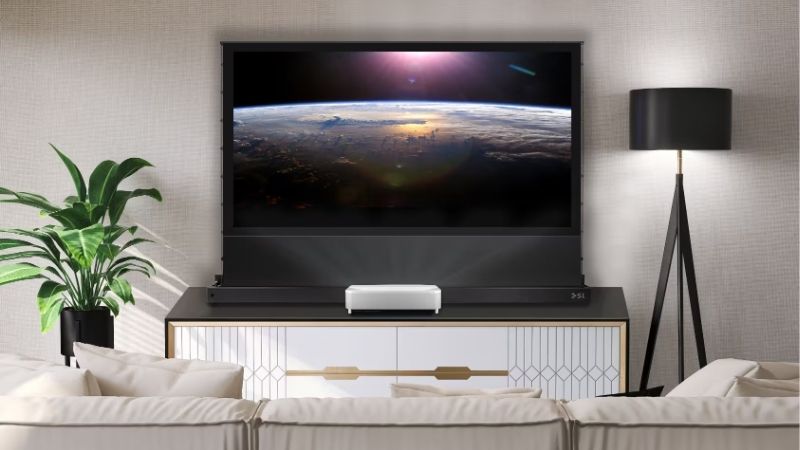
3. Elite Screens Aeon CLR 3 — Ambient Light Rejecting for Ultra Short Throw
The CLR 3 uses a lenticular surface engineered to accept light from below and reject light from above, which is exactly the geometry an ultra short throw projector creates. In a room with lamps on, the contrast difference against matte white is immediately obvious.
It only works properly with ultra short throw units placed directly beneath it. Pairing it with a ceiling-mounted standard throw projector produces a dim, uneven image, so confirm your projector type before ordering.
4. Elite Screens Spectrum Electric — Motorised Convenience
A motorised tab-free screen that drops from a ceiling or wall housing on a wireless remote, the Spectrum suits a living room where the screen must disappear when guests arrive. Installation needs a power outlet near the housing and two anchored mounting points.
Non-tensioned material means slight waves along the edges, visible mainly on bright full-screen content. Anyone chasing a perfectly flat surface should accept a fixed frame or step up to a tab-tensioned model.
5. Elite Screens Yard Master 2 — The Outdoor Frame
Built for backyard use, the Yard Master 2 assembles from snap-together aluminium tubes with a wrinkle-resistant surface and comes with ground stakes and guy lines. It goes up in about twenty minutes and packs into a carry bag afterwards.
Wind is its enemy: anything beyond a light breeze bows the frame and moves the image. Storage also requires a dry space, since the material holds moisture and can mildew if packed damp.
6. Akia Screens Motorised Tab-Tensioned — Flat Surface, Hidden Housing
Tab tensioning uses side cords to pull the material taut across its width, which removes the waves that plague standard roll-down screens. The result approaches fixed-frame flatness while still retracting into a slim ceiling housing.
The mechanism adds cost and weight, and it must be mounted into structure rather than drywall alone. Retraction is also slower, which matters only to the impatient but is worth knowing.
7. Mdbebbron Foldable Portable Screen — The Occasional-Use Option
A polyester sheet with grommets and rope, this is the cheapest way to get a large image on a garage wall or a fence for a movie night. It weighs almost nothing and stores in a drawer.
Creases from folding never fully disappear, and the surface has no black backing, so light passes through and reflects off whatever is behind it. Treat it as a temporary solution, not a permanent install.
| Screen | Type | Gain | Best room | Main drawback |
|---|---|---|---|---|
| Elite Sable Frame B2 | Fixed frame | About 1.1 | Dedicated dark room | Permanent wall use |
| Silver Ticket STR | Fixed frame | About 1.1 | Basement theatre | Thinner frame finish |
| Elite Aeon CLR 3 | Fixed ALR | Below 1.0 | Bright living room | Ultra short throw only |
| Elite Spectrum Electric | Motorised | About 1.1 | Shared living space | Edge waves |
| Elite Yard Master 2 | Portable frame | About 1.1 | Backyard | Wind sensitivity |
| Akia Tab-Tensioned | Motorised | About 1.1 | Multipurpose room | Needs structural mount |
| Mdbebbron Foldable | Portable sheet | Unrated | Occasional outdoor | Permanent creasing |
Availability and pricing shift regularly across retailers, so verify both at the moment of purchase rather than relying on figures quoted anywhere online.
Installation, Longevity and What It Costs to Live With
Screens rarely break outright. They degrade slowly in ways that are easy to prevent, and the difference between a surface that looks right after five years and one that does not comes down to how it was installed and cleaned.
What Goes Wrong Over Time
Non-tensioned roll-down material develops permanent waves as the coating relaxes, usually within two to three years of daily use. Fixed frames avoid this but can sag at the corners if the tensioning springs were unevenly seated during assembly.
Surface contamination is the quieter problem. Dust and cooking residue dull a matte white coating and shift colour balance slightly warm. Ambient light rejecting surfaces are more delicate still, since their optical structure is easily scratched by aggressive wiping.
Mounting, Wiring and the Hidden Labour
A large fixed frame is a two-person job with a level, a stud finder and about ninety minutes. Motorised units add electrical work, since the housing needs a nearby outlet or a switched circuit, and running that cleanly often means opening drywall.
Factor in the projector mount too. Screen and projector must share a centre line, and correcting a misaligned pair with digital keystone reduces resolution. Measuring twice costs nothing; remounting a 120 inch frame costs an afternoon.
Buying Windows and Seasonal Demand
Home theatre gear follows a predictable rhythm. Interest climbs through October as evenings shorten and sports viewing moves indoors, then peaks around Black Friday and Cyber Monday at the end of November when projector and screen bundles are most heavily promoted.
Outdoor screens invert that pattern, selling through spring and early summer and clearing at the end of the warm season. Anyone shopping projector screens at Best Buy or online in late summer will generally find better outdoor stock than indoor promotions.
Frequently Asked Questions
The questions below come up constantly from first-time buyers weighing projector screens at Best Buy against online alternatives, and the answers change how much you need to spend.
Is a real screen better than a painted white wall?
Yes, in most rooms. A proper surface has consistent reflectivity, a black backing that stops light bleeding through, and a black border that raises perceived contrast. A wall is flat but rarely uniform, and its texture scatters detail.
Should I choose a grey screen?
Grey material raises perceived black level in rooms with some ambient light, at the cost of overall brightness, and it is why grey options appear on nearly every list of projector screens at Best Buy. With a bright modern projector in a partly lit room it can help; in a fully dark room a white surface generally looks better.
What size should I actually buy?
Work from throw distance first and seating distance second. Confirm your projector can produce your target diagonal from its mounting position, then check that the nearest seat sits at least 1.2 times the screen width away.
Can one screen work for both a projector and a television?
Not in the same wall position. A retractable or motorised screen mounted above the television is the usual compromise, which is why buyers comparing projector screens at Best Buy so often end up choosing a roll-down model over a fixed frame.
See More:
- Best low price dash cam
- Best buy projector screens
- Best projector for games
- Best projector for gaming
Final Thoughts on Choosing Your Screen
The right surface follows from three measurements: throw distance, wall space and how much ambient light you cannot eliminate. Settle those and the shortlist narrows to two or three models, whether you are browsing projector screens at Best Buy in person or comparing the same categories on Amazon.
Measure the wall and the projector distance before ordering anything, and confirm the screen type matches your projector geometry, especially if an ultra short throw unit is involved. That single check separates a satisfying purchase from an expensive return. A correctly matched inexpensive screen outperforms an expensive mismatched one every time.


Write Your Review
No reviews yet. Be the first to share your experience!