
Best buy Samsung soundbar comparisons get confusing fast, because the lineup runs from simple two-channel bars to eleven-channel systems with wireless rear speakers. This guide ranks seven models by channel count, subwoofer arrangement, Atmos capability and connectivity, so the tier you choose matches the room and the television you already own.
As an Amazon Associate we earn from qualifying purchases.
Our top picks
 Samsung B-Series Soundbar HW B400F 2.0 ch
- FULL, BALANCED SOUND WITH A SUBWOOFER INCLUDED: Immerse…
- ONE REMOTE
- Experience immersive sound that fills the room


As an Amazon Associate we earn from qualifying purchases at no extra cost to you.
By Daniel Foster
How the Samsung Lineup Is Actually Structured
Samsung names its soundbars by series letter and number, and the pattern behind any best buy Samsung soundbar comparison is more logical than it first appears. Understanding the three variables behind those names removes most of the confusion before you compare individual models.
Channels, Power and Connections: The Numbers That Decide It
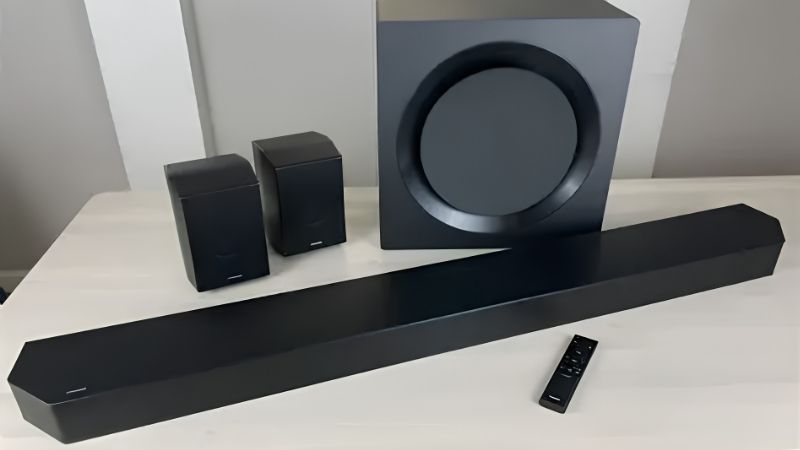
Channel notation reads as three figures. The first is horizontal channels, the second is subwoofers, the third is upward-firing height drivers for Dolby Atmos. A 3.1.2 bar therefore has left, centre and right channels, one subwoofer and two height drivers.
More channels genuinely change what you hear, but only if the room supports them. Height effects rely on reflection from a flat ceiling roughly eight to ten feet high; a vaulted or sloped ceiling scatters them and reduces an expensive Atmos bar to an ordinary one.
Connectivity is where mistakes happen. HDMI eARC carries full-resolution Atmos from the television to the bar over a single cable, while plain ARC and optical connections compress or limit the signal. Confirm your television has an eARC-labelled port before paying for the top tiers.
Space and Fit: Bar Width, Height and Subwoofer Placement
Measure the television stand before ordering. A bar wider than the stand overhangs awkwardly, and one taller than the gap beneath the screen blocks the infrared receiver on some sets. Slim profiles around two inches high clear most pedestal stands.
Subwoofers need a plan too. A wireless subwoofer still needs a mains outlet and roughly a foot of clearance from walls to avoid boom, and corner placement exaggerates low frequencies noticeably. In an apartment, an all-in-one bar without a separate subwoofer is often the more considerate choice.
Q-Symphony, SpaceFit and the Samsung Television Advantage
Q-Symphony lets a Samsung television use its own speakers alongside the soundbar rather than muting them, which widens the front stage. It only works with compatible Samsung televisions, and it is the main reason to keep a soundbar in the same brand family.
Wireless connection standards matter for the same reason. Recent bars pair over Wi-Fi as well as Bluetooth, which supports higher quality streaming and multiroom grouping, while Bluetooth-only models compress the signal. Check which the model offers if music matters as much as film.
SpaceFit Sound uses a microphone to measure the room and adjust output, correcting for hard floors or heavy curtains. The correction is modest rather than transformative, but it is automatic and requires nothing from the owner.
Seven Samsung Soundbars by Tier
Any best buy Samsung soundbar shortlist runs from entry level to flagship, and the models below cover that whole span. Each entry names a genuine limitation, since every tier gives something up. Specifications come from manufacturer documentation and pooled owner reports rather than measurement performed here.
1. Samsung HW-B450 — The Entry Two-Channel Bar
A 2.1 system with a wireless subwoofer, aimed squarely at replacing thin television speakers without complication. Dialogue clarity improves immediately, which is the single biggest gain most households notice.
There is no Atmos, no height channel and no HDMI input, so connection runs through optical or basic ARC. Treat it as a clarity upgrade rather than a cinema system.
2. Samsung HW-B650 — Adding a Centre Channel
Stepping to 3.1 adds a dedicated centre channel, which anchors dialogue to the screen and separates speech from effects far more convincingly than a stereo bar can manage.
Still no height channels, and the subwoofer is modest in output. For rooms above roughly 300 square feet the bass runs out before the rest of the system does.
3. Samsung HW-Q600C — Entry Atmos
A 3.1.2 configuration introduces upward-firing drivers and genuine Atmos decoding at the accessible end of the range. In a room with a flat ceiling the added height cues are audible on well-mixed content.
Height effects depend entirely on ceiling geometry, and the bar cannot compensate for a sloped one. Rear presence is simulated rather than real.
4. Samsung HW-S60D — All-in-One Without a Subwoofer
A 5.0 channel bar with no separate subwoofer, designed for apartments, bedrooms and anywhere a thumping box would cause friction. Fabric-wrapped and compact, it suits a room where appearance matters.
Low frequency extension is limited by physics, so action films lack weight. An optional subwoofer can be added later, which changes the value calculation.
5. Samsung HW-Q800D — The Sensible Sweet Spot
A 5.1.2 system with a capable wireless subwoofer, full Atmos support and eARC connectivity. For most living rooms this is where the price-to-performance curve flattens, and stepping higher delivers diminishing returns without adding rear speakers.
Rear channels remain virtual unless a separate wireless surround kit is purchased. The subwoofer is large enough to need real placement thought.
6. Samsung HW-Q930D — Rear Speakers Included
Adding wireless rear speakers with their own height drivers produces genuine surround rather than a simulation. In a closed rectangular room the difference over a front-only bar is immediately obvious.
Two additional units need two additional outlets behind the seating position, which often means visible cabling or an extension. Setup is more involved than a single bar.
7. Samsung HW-Q990D — The Flagship
An 11.1.4 configuration with subwoofer and rear speakers, representing the most complete package Samsung offers without moving to separate components. Height and surround placement are convincing in a suitable room.
It is expensive, physically substantial and wasted in a small or acoustically awkward space. Households without a flat ceiling should spend the difference elsewhere.
| Model | Channels | Subwoofer | Atmos | Suits |
|---|---|---|---|---|
| HW-B450 | 2.1 | Wireless | No | Basic clarity upgrade |
| HW-B650 | 3.1 | Wireless | No | Dialogue-focused rooms |
| HW-Q600C | 3.1.2 | Wireless | Yes | Entry Atmos, flat ceiling |
| HW-S60D | 5.0 | None | Virtual | Apartments and bedrooms |
| HW-Q800D | 5.1.2 | Wireless | Yes | Most living rooms |
| HW-Q930D | 9.1.4 | Wireless | Yes | Real surround, closed room |
| HW-Q990D | 11.1.4 | Wireless | Yes | Large dedicated spaces |
Model availability rotates annually and pricing moves constantly, so confirm the current generation and figure at the time of purchase.
Setup, Longevity and What It Costs to Live With
A best buy Samsung soundbar is a simple device that fails in predictable ways, and most long-term complaints trace to connection choices made during the first hour rather than to hardware quality.
Cabling and the eARC Question
Use the HDMI port labelled eARC on the television and a cable rated for the bandwidth, not whatever cable came with an older device. Optical connections cannot carry lossless Atmos, which is the most common reason a new bar sounds no better than expected.
Enable the relevant passthrough settings on the television and switch its internal speakers to the external output. Several tiers of performance are routinely lost to a menu left on default, particularly on sets that ship with an automatic sound mode enabled.
What Fails Over Time
Wireless subwoofer pairing is the most frequently reported issue, usually resolved by re-pairing but occasionally recurring after firmware updates. Interference from crowded 5GHz networks contributes in dense apartment buildings.
Firmware itself is the second variable. Updates occasionally change behaviour on features such as automatic volume levelling or Atmos handling, and support windows end after several years. A bar still receiving updates is a meaningfully safer purchase than one quietly retired from the schedule.
Drivers themselves rarely fail. Surrounds age slowly over many years, and the practical lifespan is usually decided by HDMI standards moving on rather than by anything breaking. Warranty terms typically cover a year on the bar and the same on wireless components, sold separately thereafter.
Seasonal Demand and When Models Change
Samsung refreshes the lineup annually, which means the previous generation becomes markedly better value once the new letter arrives. Watching for that transition is more useful than watching individual promotions.
Beyond that, home audio sees its heaviest promotion during Prime Big Deal Days in early October and across Black Friday and Cyber Monday at the end of November, when television and soundbar bundles are most common. Anyone comparing a best buy Samsung soundbar in late summer is generally shopping the quietest part of the year.
Frequently Asked Questions
These are the questions that come up most often from readers weighing a best buy Samsung soundbar against other brands.
Do I need a Samsung television to use one?
No. Any soundbar works with any television over HDMI ARC or optical. A Samsung television unlocks Q-Symphony and simplified setup, but the core performance does not depend on brand matching.
Is Atmos worth paying for?
Only with a flat ceiling in the eight to ten foot range and content that actually uses it. In a room with sloped ceilings or open beams, money spent on a better subwoofer or real rear speakers delivers more, and the entry Atmos tiers become poor value.
Can I add rear speakers later?
On many models, yes, through Samsung wireless surround kits designed for specific series. Confirm compatibility with your exact model before assuming, since the kits are not universal across generations.
Where should the subwoofer go?
On any best buy Samsung soundbar with a wireless sub, along the same wall as the television, roughly a foot clear of the wall and out of a corner, then adjusted by ear. Corner placement adds volume but muddies definition, which is the most common complaint from new owners.
See More:
- Best low price dash cam
- Projector screens at Best Buy
- Best buy projector screens
- Best projector for games
- Best projector for gaming
Final Thoughts on Choosing a Samsung Soundbar
Selecting the best buy Samsung soundbar for a given home comes down to ceiling geometry, room size and whether your television supports eARC and Q-Symphony. Those three answers point at a tier, and within a tier the differences are small.
Measure the television stand and the space where a subwoofer would sit before ordering, check the HDMI port labels on your set, and decide honestly whether rear speakers will ever be cabled. Buying the right tier beats buying the highest one.



Write Your Review
No reviews yet. Be the first to share your experience!