
Soundbar for TV Best Buy displays put a dozen brands side by side with no way to judge which suits your room, which is where most buyers go wrong. This guide compares seven models across brands by channel count, connectivity and the room size each genuinely fits, so the bar you choose matches the space rather than the demo.
As an Amazon Associate we earn from qualifying purchases.
Our top picks
 Samsung B-Series Soundbar HW B400F 2.0 ch
- FULL, BALANCED SOUND WITH A SUBWOOFER INCLUDED: Immerse…
- ONE REMOTE
- Experience immersive sound that fills the room


 Sound Bar for Smart TV
- 【𝐈𝐦𝐩𝐚𝐜𝐭𝐟𝐮𝐥 𝐕𝐨𝐥𝐮𝐦𝐞 𝐁𝐨𝐨𝐬𝐭】: Elevate faint sounds to vibrant…
- 【𝐄𝐩𝐢𝐜 𝐂𝐢𝐧𝐞𝐦𝐚 𝐀𝐮𝐝𝐢𝐨】: Powered by 4 high-performance drivers,…
- 【𝐓𝐚𝐢𝐥𝐨𝐫𝐞𝐝 𝐒𝐨𝐮𝐧𝐝】: Fine-tune your listening experience with 3…


 ULTIMEA 5.1CH Surround Sound Bar System with
- Simplified 5.1ch Dolby Atmos Setup: Enjoy immersive 4D…
- Voice Clarity Enhancement: VoiceMX technology uses advanced DSP…
- 300W Output with 6-Driver System: Featuring five precision-tuned…
As an Amazon Associate we earn from qualifying purchases at no extra cost to you.
By Daniel Foster
What Separates One Soundbar From Another
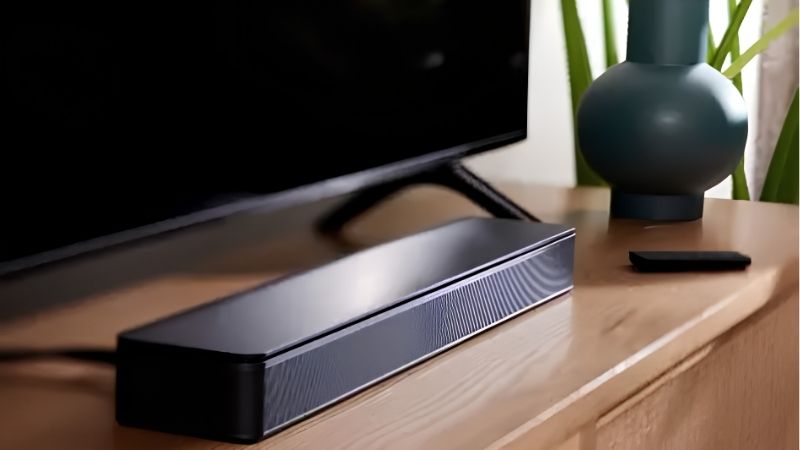
Any soundbar for TV Best Buy stocks differs less by brand than by three underlying variables: how many channels the bar drives, whether it has a separate subwoofer, and how it connects to your television. Everything else is refinement on top of those.
Channels, Subwoofer and Connection: The Numbers That Decide It
Channel notation reads as three figures. The first is horizontal channels, the second is subwoofers and the third is upward-firing height drivers for Dolby Atmos. A 3.1.2 bar therefore has left, centre and right channels, one subwoofer and two height drivers.
A dedicated centre channel is the most audible upgrade for most households, because it anchors dialogue to the screen and separates speech from effects. Going from 2.0 to 3.1 changes more in daily viewing than adding height channels does.
Total system wattage is the least useful figure on the box. Manufacturers measure it inconsistently and a well-tuned lower-wattage bar routinely outperforms a louder one, so treat channel layout and subwoofer presence as the meaningful comparison instead.
Connection determines what the bar can actually receive. HDMI eARC carries full-resolution Atmos over one cable, plain ARC compresses it, and optical cannot carry it at all. Check the port labels on your television before paying for the higher tiers.
Space and Fit: Stand Width, Bar Height and Subwoofer Placement
Measure the television stand edge to edge and the gap between the screen bottom and the surface. A bar taller than that gap can block the infrared receiver, and one wider than the stand overhangs awkwardly and risks being knocked.
Wireless subwoofers still need a mains outlet and roughly a foot of clearance from walls to avoid boom. Corner placement exaggerates low frequencies noticeably, and in an apartment with neighbours below, an all-in-one bar without a separate subwoofer is often the more considerate choice.
Room Size Sets the Tier
Under about 200 square feet, a compact all-in-one bar is sufficient and a large subwoofer becomes a liability. Between 200 and 400, a 3.1 or 5.1.2 arrangement with a modest subwoofer suits most furniture layouts comfortably.
Above 400 square feet or in an open plan sharing space with a kitchen, channel count and subwoofer capability both need to rise or dialogue gets lost to distance. Ceiling height matters too, since Atmos height effects need a flat ceiling roughly eight to ten feet up.
Seven Models Across Brands and Tiers
The soundbar for TV Best Buy shoppers should consider spans compact units to flagship systems from several manufacturers. Each entry names a genuine drawback. Figures reflect manufacturer specifications and pooled long-term owner reports rather than testing conducted by this site.
1. Roku Streambar — Smallest Room, Smallest Budget
A compact bar with streaming built in, aimed at a bedroom or a small apartment where the television speakers are the actual problem. Dialogue clarity improves immediately and setup takes minutes.
There is no separate subwoofer and low frequency extension is limited by size. Sound quality is a clear step up from a television but not from a real system.
2. Vizio V-Series 2.1 — Value With a Subwoofer
An affordable 2.1 arrangement with a wireless subwoofer that adds genuine low end without complication. For a first soundbar in a medium room, the value is difficult to beat.
There is no centre channel, so dialogue separation is limited, and build quality is basic. Connectivity is functional rather than generous.
3. Yamaha SR-B40A — Dialogue-Focused Middle Ground
Yamaha applies decades of audio engineering to a bar with clear voice reproduction and a wireless subwoofer, plus a dedicated clear voice mode that helps considerably with mumbled film dialogue.
Atmos performance is virtual rather than delivered by upward-firing drivers, and the app is basic. It is a sensible bar rather than an exciting one.
4. Polk Signa S4 — Entry Atmos With Real Height Drivers
A 3.1.2 configuration with actual upward-firing drivers at an accessible price, which is unusual at this tier. With a flat ceiling the height effects are audible on well-mixed content.
The subwoofer is modest for larger rooms, and height performance collapses under sloped or beamed ceilings. Build is plain.
5. Sonos Beam Gen 2 — Compact and Well Integrated
A small all-in-one bar with strong dialogue handling, eARC connectivity and a multiroom platform that suits households already using it for music. Physically compact for what it delivers.
There is no separate subwoofer in the box, and adding one substantially raises the total. The platform works best when you commit to it.
6. Sony HT-S2000 — Balanced Living Room Choice
A 3.1 arrangement with virtual height processing and Sony sound tuning, sized for a standard living room without demanding rear speakers or a large subwoofer footprint.
Virtual height is less convincing than physical drivers, and low end runs out in large rooms. An optional subwoofer is sold separately.
7. JBL Bar 1300X — Detachable Rear Speakers
Rear speakers detach from the bar, charge in place and run wirelessly, which solves the rear cabling problem that stops most people fitting real surround. Output is substantial.
It is expensive, physically large and unnecessary in a small room. The detachable batteries are a component that will eventually need replacing.
| Model | Channels | Subwoofer | Atmos | Room size |
|---|---|---|---|---|
| Roku Streambar | 2.0 | None | No | Small bedroom |
| Vizio V-Series 2.1 | 2.1 | Wireless | No | Medium room |
| Yamaha SR-B40A | 2.1 | Wireless | Virtual | Medium room |
| Polk Signa S4 | 3.1.2 | Wireless | Yes | Medium, flat ceiling |
| Sonos Beam Gen 2 | 5.0 | Optional | Virtual | Small to medium |
| Sony HT-S2000 | 3.1 | Optional | Virtual | Standard living room |
| JBL Bar 1300X | 11.1.4 | Wireless | Yes | Large or open plan |
Model generations rotate annually and pricing moves constantly, so confirm both at the moment of purchase.
Setup, Longevity and Living With It
A soundbar for TV Best Buy sells is mechanically simple, and most long-term complaints trace to decisions made in the first hour rather than to hardware quality. Getting the connection right is most of the job.
The First Hour Matters Most
Connect to the HDMI port labelled eARC with a cable rated for the bandwidth, then switch the television audio output away from its internal speakers. Several tiers of performance are routinely lost to a menu left on a default setting.
Run automatic room calibration if the model offers it, with the room quiet and empty. The correction is modest rather than transformative, but it compensates for hard floors and bare walls that would otherwise sharpen the treble unpleasantly.
What Goes Wrong Later
Wireless subwoofer dropouts are the most frequently reported issue, usually resolved by re-pairing and occasionally recurring after firmware updates. Congested wireless networks in apartment buildings contribute.
Lip sync drift is the other recurring annoyance, appearing when the television and bar process audio at different speeds. Most sets and bars expose an audio delay adjustment in milliseconds, and correcting it once usually solves it permanently.
Actual hardware failure is rare, since drivers age slowly and most systems are retired because HDMI standards move on. Warranty terms typically cover the bar for a year with wireless components warranted separately, and firmware support ends after a few years.
Generations, Bundles and Buying Windows
Manufacturers refresh soundbar lineups annually, and the outgoing generation becomes the strongest value once the new one arrives. Watching for that transition usually beats waiting for a specific promotion.
Beyond that, home audio is promoted heavily during Prime Big Deal Days in early October and across Black Friday and Cyber Monday at the end of November, when television and soundbar bundles are most common. Anyone comparing a soundbar for TV Best Buy stock in late summer is shopping the quietest part of the year.
Frequently Asked Questions
These are the questions readers ask most when weighing a soundbar for TV Best Buy carries against ordering online.
Do brands need to match my television?
No. Any soundbar works with any television over HDMI ARC or optical. Same-brand pairings unlock convenience features such as using the television speakers alongside the bar, but core performance does not depend on it.
Is a subwoofer essential?
For films and action content, it makes the largest single difference. For dialogue-heavy viewing in a small room, a good all-in-one bar without one is often the better choice and causes fewer problems with neighbours.
How high should the bar sit?
Position any soundbar for TV Best Buy carries roughly level with or just below the screen, aimed toward the seating position. Placing it inside a cabinet with a closed front muffles output considerably and undoes much of what you paid for.
Are height channels worth the premium?
Only with a flat ceiling around eight to ten feet and content mixed for Atmos. In rooms with sloped ceilings or open beams, money spent on a better subwoofer or real rear speakers delivers more.
See More:
- Best low price dash cam
- Projector screens at Best Buy
- Best buy projector screens
- Best projector for games
- Best projector for gaming
Final Thoughts on Choosing a Soundbar
Anyone comparing a soundbar for TV Best Buy displays or online listings should start from room size, ceiling geometry and the HDMI ports on their television. Those three answers point at a tier, and within a tier the brand differences are small.
Measure the stand width, the gap under the screen and the space a subwoofer would occupy before ordering. Check the port labels on your set, and be honest about whether rear speakers will ever actually be positioned and powered.





Write Your Review
No reviews yet. Be the first to share your experience!