
Best buy projector screens searches usually start in a retail aisle and end with a question no shelf tag answers: how much light does the room have? This guide sorts seven widely available screens by room condition rather than by brand, covering bright living rooms, dedicated dark spaces, outdoor setups and rooms that must serve two purposes.
As an Amazon Associate we earn from qualifying purchases.
Our top picks


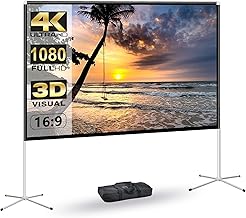
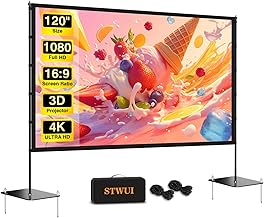
As an Amazon Associate we earn from qualifying purchases at no extra cost to you.
By Daniel Foster
Start With the Room, Not the Product Page
Most best buy projector screens comparisons go wrong when the surface is chosen before the room is assessed. Light control, projector geometry and available wall space determine which of the four screen families will work, and only then does model selection matter.
Light Rejection, Gain and Throw: The Numbers That Decide It
Two figures do most of the work. Gain describes reflected brightness relative to a reference board, with matte white near 1.0 to 1.1 and ambient light rejecting surfaces usually between 0.4 and 0.8. Lower gain sounds worse but preserves black levels when lamps are on.
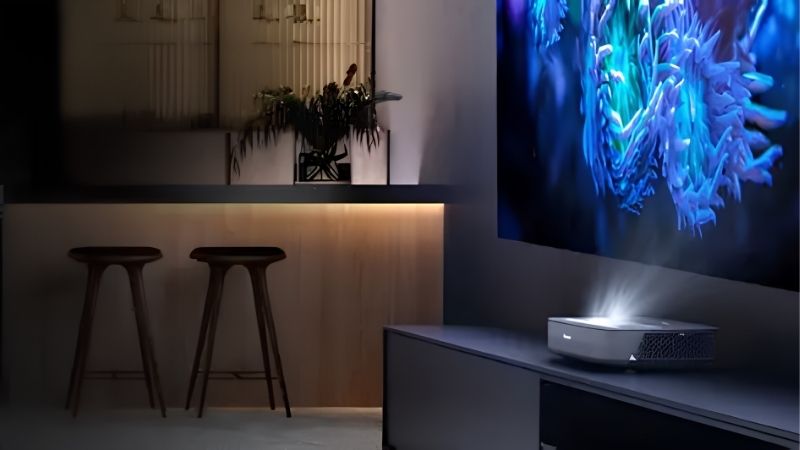
Throw ratio decides the diagonal you can achieve. Multiply the ratio by your projector distance to get image width, then convert to a 16:9 diagonal. A unit rated near 1.2 placed 10 feet back produces roughly a 110 inch image; an ultra short throw model reaches similar size from under 20 inches.
Match the two deliberately. Ambient light rejecting material is engineered around a specific light angle, so a lenticular ultra short throw surface used with a ceiling projector loses brightness dramatically. Confirm the pairing before choosing a size.
Space and Fit: What the Wall Can Actually Hold
Screens are larger than buyers imagine. A 120 inch 16:9 surface spans about 105 inches wide and 59 inches tall before the frame border, which means a standard 12 foot wall with a doorway at one end often cannot take it without compromise.
Vertical placement matters as much as width. The bottom edge should clear a media console and any seated head heights, while the top needs clearance from crown moulding or a sloped ceiling. Mark the outline in painter tape and live with it for a day before committing.
Aspect Ratio and Material Choice
Most buyers should stay with 16:9, which matches streaming content, consoles and broadcast sport. A 2.35:1 cinemascope surface suits film-first rooms but leaves letterboxing or requires lens memory functions that budget projectors do not offer.
Material choice follows light control. Matte white for dark rooms, grey or ambient light rejecting for lit rooms, and woven acoustically transparent material only when speakers sit directly behind the surface, since weave costs a small amount of brightness and detail.
Check the stated 4K or 8K rating too, though it means less than it sounds. It describes surface texture fine enough that the weave does not interfere with small pixels, which matters at short seating distances and is largely irrelevant beyond about twelve feet.
Seven Screens Sorted by Room Condition
These best buy projector screens alternatives cover the realistic situations buyers describe, from a fully controlled basement to a backyard fence. Every entry lists one genuine weakness. Specifications come from manufacturer documentation and aggregated long-term owner feedback rather than testing performed here.
1. Bright Living Room: Elite Screens Aeon CLR 3
Designed for ultra short throw projectors, the lenticular surface accepts light rising from below while rejecting overhead room lighting. In a lamp-lit family room the contrast advantage over matte white is not subtle, and it is the single most effective fix for a bright space.
The constraint is strict: it needs an ultra short throw projector directly beneath it, correctly aligned. Any other projector geometry produces a dim and uneven image, and alignment tolerance during installation is measured in millimetres.
2. Bright Room, Standard Projector: Elite ezFrame CineGrey 5D
This angular reflective surface pairs with a ceiling-mounted standard throw projector and rejects a useful portion of off-axis light. It is the answer for people who want ambient light performance without replacing the projector they already own.
The viewing cone is narrower than matte white, so seats far to the side see reduced brightness. Room layouts with a long sofa perpendicular to the screen will notice the falloff.
3. Dedicated Dark Room: Silver Ticket STR Series
In a controlled room, the cheapest of the best buy projector screens alternatives delivers most of what an expensive one does, provided it uses a standard white surface on a rigid frame. Silver Ticket offers large diagonals with a black velvet frame and a straightforward tensioning system.
Assembly demands patience and a second person, particularly above 120 inches, and the frame finish is less refined than premium alternatives. Wall space is committed permanently.
4. Shared Living Space: Elite Screens Spectrum Electric
When the screen must vanish, a motorised drop-down housing mounted above the television solves the conflict. Remote operation makes it practical for daily use and the housing is slim enough to sit unobtrusively near the ceiling.
Non-tensioned material shows gentle waves at the edges under bright scenes, and installation requires nearby power. It is a convenience purchase rather than an image-quality one.
5. Outdoors: Elite Screens Yard Master 2
Snap-together aluminium tubes and a wrinkle-resistant surface make this a twenty-minute setup for a backyard screening, complete with stakes and guy lines for stability on grass.
Any real wind moves the frame and the image with it, and the material must be stored dry to avoid mildew. Repeated seasonal use eventually loosens the tube joints.
6. Flat Surface Without Permanence: Akia Motorised Tab-Tensioned
Side tensioning cords pull the material taut, producing near fixed-frame flatness from a retractable screen. For a multipurpose room that hosts both film nights and family life, this is the best compromise available.
It costs more than an untensioned equivalent, weighs enough to demand structural mounting points, and retracts slowly. The mechanism is also the part most likely to need service years later.
7. Occasional and Portable: Elite Screens Tripod Series
A self-supporting tripod screen sets up anywhere in under five minutes and folds into a case, which suits presentations, classrooms and irregular use where nothing can be mounted.
Sizes stay modest, the surface shows fold-related irregularities over time, and the tripod occupies floor space in front of the wall. Image quality is adequate rather than impressive.
| Room condition | Recommended screen | Material approach | Install effort |
|---|---|---|---|
| Bright, ultra short throw | Elite Aeon CLR 3 | Lenticular ALR | High precision |
| Bright, ceiling projector | Elite ezFrame CineGrey 5D | Angular reflective | Moderate |
| Dark dedicated room | Silver Ticket STR | Matte white | Two people, one hour |
| Shared living room | Elite Spectrum Electric | Matte white, motorised | Needs power |
| Backyard | Elite Yard Master 2 | Portable frame | Twenty minutes |
| Multipurpose room | Akia Tab-Tensioned | Tensioned matte white | Structural mount |
| Temporary or travelling | Elite Tripod Series | Freestanding | Five minutes |
Stock and pricing vary widely between retailers and change often, so confirm both at the time of purchase.
Longevity, Maintenance and Total Cost
Screens outlive most projectors, which makes their long-term behaviour worth understanding. Failure here is gradual, and the pattern differs sharply between fixed and retractable designs.
How Each Type Ages
Fixed frames hold their shape but can develop corner sag if the tension springs were seated unevenly during assembly. Correcting that later means partially dismantling the frame, which is tedious rather than difficult.
Retractable screens are the ones that age visibly. The coating relaxes with repeated rolling, producing waves that catch the eye on bright scenes, and motor assemblies eventually slow or stick. Tab-tensioned models delay this but do not eliminate it.
Portable outdoor surfaces age fastest of all. Each fold sets a crease line, moisture invites mildew if the material is packed damp, and ultraviolet exposure gradually yellows the coating. Two or three seasons of regular use is a realistic expectation rather than a defect.
Cleaning Without Damaging the Surface
Use a dry microfibre cloth and light pressure, working from the centre outward. Matte white tolerates a slightly damp cloth with plain water; ambient light rejecting surfaces should be treated as optical components and cleaned as rarely as possible.
Never use household cleaners, alcohol or abrasive pads. The coating is thin, and a scratch across a lenticular surface is permanent and clearly visible during bright scenes.
Where the Money Actually Goes
The screen is often the smaller half of the project. Mounting hardware, a projector mount, cabling and any wall repair add up, and an ambient light rejecting surface can cost several times what a plain matte white one does at the same diagonal.
On timing, home theatre bundles are promoted most aggressively during the Black Friday and Cyber Monday window at the end of November, with a smaller wave during Prime Big Deal Days in early October. Outdoor screens instead clear stock as summer ends.
Frequently Asked Questions
These are the recurring questions from people comparing best buy projector screens against online alternatives.
Does an ambient light rejecting screen replace blackout curtains?
It reduces the problem substantially but does not eliminate it. Direct sunlight falling on the surface still overwhelms any projector, so the combination of light rejection and basic window covering remains the strongest setup.
How much does frame colour matter?
More than expected. A black velvet border absorbs projector overshoot and gives the eye a hard reference edge, which raises perceived contrast noticeably compared with a bare or reflective frame.
Can I mount a fixed frame on drywall alone?
Small sizes can use heavy-duty anchors, but anything over roughly 100 inches should reach at least two studs. The frame itself is light; the risk is leverage from the wall bracket over years.
Is a higher gain screen a shortcut to a brighter image?
Only for the centre seats. Gain concentrates light along the projection axis at the expense of viewing angle and can introduce hotspotting, so it solves brightness in narrow rooms and creates problems in wide ones.
See More:
- Best low price dash cam
- Projector screens at Best Buy
- Best projector for games
- Best projector for gaming
Final Thoughts on Best Buy Projector Screens
Anyone comparing best buy projector screens should let the room decide first: measure the light, the throw distance and the wall, then pick the family of screen that suits those conditions. Model selection within that family is comparatively easy, and most best buy projector screens shortlists collapse to two or three real candidates at that point.
Tape the outline on the wall, confirm the projector can hit that diagonal from where it will actually sit, and check that the material type matches your projector geometry before ordering. Getting those three right matters more than any brand badge.


Write Your Review
No reviews yet. Be the first to share your experience!