
Best screen for a projector depends far more on the light in your room than on the price of the material. A white wall works in the dark; a room with windows needs a screen designed to reject ambient light. This guide compares seven options on gain, material type, size and mounting.
As an Amazon Associate we earn from qualifying purchases.
By Daniel Foster
🛒 Best Price Today on Amazon
Prime members get fast, free shipping on everything above, plus member-only deals. New members get a 30-day free trial — cancel anytime.
Match the Screen to the Room, Not the Projector
The best screen for a projector is decided by how much light you can control and where the projector sits. A high-gain screen in a bright room and a matte white screen in a dark one solve completely different problems.
Gain, Material Type and Size: The Deciding Numbers
Three specifications decide the best screen for a projector shortlist: gain, material type, and diagonal size with aspect ratio. Gain of 1.0 reflects light evenly; above 1.0 concentrates it toward the center seats; below 1.0 widens the viewing angle at the cost of brightness.
Material type splits into matte white for dark rooms, ambient light rejecting for rooms with some light, and ceiling light rejecting for ultra short throw projectors sitting below the screen. The last two are not interchangeable.
Size follows viewing distance. A common guideline places seating at roughly 1.2 to 1.5 times the screen width for cinema viewing, so a 100 in diagonal 16:9 screen suits seating around 8.5 to 11 ft (2.6 to 3.4 m) away.
Space and Fit: Wall Width, Mounting and Viewing Angle
Measure the flat wall available for the best screen for a projector and subtract room for the frame, typically 1.5 to 3 in (4 to 8 cm) per side. Fixed frame screens need a genuinely flat wall and studs or solid anchors to carry the weight.
Check the half-gain angle if seating is spread wide. High-gain and ambient light rejecting screens dim noticeably off-axis, so a wide sofa arrangement is usually better served by a screen with gain near 1.0.
Screen Types and Where Each Belongs
Fixed frame screens give the flattest surface and the best image, and they never need retracting. Motorised and manual pull-down screens suit rooms that double as living space, at the cost of occasional waves in the material.
Portable screens serve outdoor and temporary use. Ultra short throw setups need a ceiling light rejecting surface specifically, since standard ALR material is designed to reject light from a different angle.
Materials, Acoustics and Longevity
Acoustically transparent screens allow speakers to sit behind the image, at a small cost in brightness and a risk of moire with some projectors. Most home setups do not need them.
Black borders matter more than most buyers expect. A velvet-wrapped frame absorbs overspill and sharpens the perceived edge of the image, which is why framed screens look cleaner than bare material of the same gain.
Vinyl surfaces can crease permanently if folded, which is why rolled shipping matters. Wipeable materials are worth prioritising in rooms with pets or children, since screen surfaces mark easily and cannot be scrubbed hard.
Best Screen for a Projector: Seven Options Compared
The list runs from a budget fixed frame to ambient light rejecting and portable options. Specifications are manufacturer-stated and combined with recurring themes in owner reports rather than testing carried out by us.
Silver Ticket STR Series Fixed Frame
The value benchmark: a fixed frame screen with a 1.1 gain matte white surface, black velvet frame and sizes from 100 to 150 in diagonal, sold at a fraction of premium brand pricing.
Assembly takes time and requires care to tension evenly. In a light-controlled room, it delivers most of what expensive screens do.
Elite Screens Sable Frame B2
A fixed frame screen with a 1.1 gain white surface, a 2.4 in aluminium frame wrapped in black velvet and a wide range of sizes, with a well-documented assembly process.
It costs more than budget equivalents for similar material. Frame rigidity and finish are the differences you pay for.
Elite Screens Aeon CLR3
A ceiling light rejecting screen designed specifically for ultra short throw projectors, using a serrated optical surface that rejects light from above while accepting it from below.
It is expensive and only works with UST projectors. With one, it transforms daytime viewing in a room that cannot be darkened.
Elite Screens Yard Master 2
A portable outdoor screen on a snap-together aluminium frame, with a wipeable surface and sizes suited to garden film nights, packing into a carry bag.
It needs staking or weighting in wind and is not intended as a permanent indoor screen. Setup takes minutes rather than an afternoon.
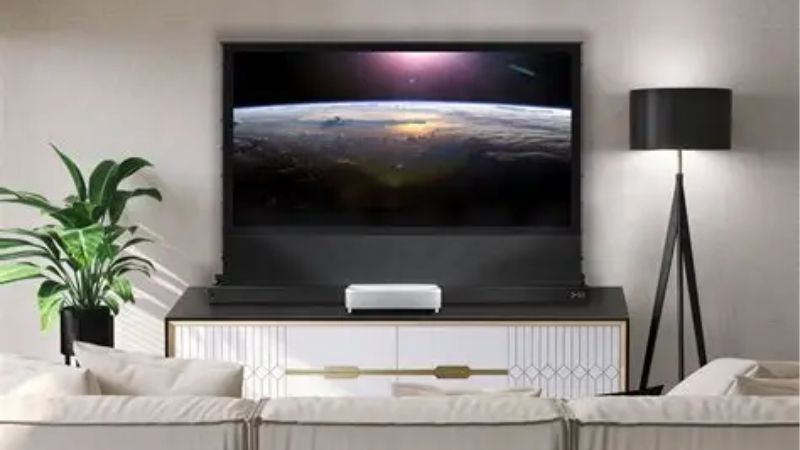
Vividstorm S Pro Floor Rising ALR
A motorised screen that rises from a floor cabinet, using ambient light rejecting material, for rooms where nothing can be mounted on the wall or ceiling.
It is among the most expensive options and the cabinet occupies floor space. For rented rooms or glass walls, it may be the only workable answer.
Elite Screens Manual B
A pull-down manual screen with a slow-retract mechanism, matte white material and wall or ceiling mounting, for rooms used for more than watching films.
Material waves are common for the first weeks and sometimes permanently. Price and the ability to hide the screen are the appeal.
Paint On Screen S1 Ultimate
Projector screen paint applied directly to a prepared wall, giving a completely flat surface at any size with no frame and no shipping crease risk.
Surface preparation determines the result entirely, and a poorly finished wall shows every flaw. It suits large custom sizes where a frame would be impractical.
| Screen | Type | Gain | Best room | Main trade-off |
|---|---|---|---|---|
| Silver Ticket STR | Fixed frame | ~1.1 | Dark room | Careful assembly needed |
| Elite Sable Frame B2 | Fixed frame | ~1.1 | Dark room | Costs more for same gain |
| Elite Aeon CLR3 | Ceiling light rejecting | ~0.6 | Bright room, UST only | UST projectors only |
| Elite Yard Master 2 | Portable frame | ~1.1 | Outdoors | Wind, not permanent |
| Vividstorm S Pro | Floor rising ALR | ALR surface | No-mount rooms | Price, floor space |
| Elite Manual B | Pull-down | ~1.1 | Multi-use rooms | Material waves |
| Paint On Screen S1 | Screen paint | ~1.4 | Custom sizes | Wall prep decides result |
Screen pricing varies widely by size and material on Amazon, so confirm the exact diagonal, aspect ratio and gain of the version listed before ordering.
Installation, Care and Timing
Choosing the best screen for a projector is straightforward once the room is assessed; installing it well is what determines whether the image looks professional.
Getting the Installation Right
Mount the best screen for a projector so the bottom of the image sits roughly 24 to 36 in (61 to 91 cm) above the floor for seated viewing, adjusting for sightlines over furniture. Screens mounted too high cause neck strain in long sessions.
Check the projector’s vertical offset before drilling. Fixed-offset models place the image a set distance above or below the lens, and mounting the screen first sometimes forces keystone correction that a few inches of adjustment would have avoided.
Fixed frames need level mounting and solid anchors; a screen tilted by half a degree is visible against a ceiling line. Tension the material evenly during assembly, working opposite corners rather than around the perimeter.
Ambient Light and Room Treatment
Dark, matte surrounding walls and ceiling improve perceived contrast more than any material upgrade. Light bouncing off a white ceiling back onto the screen washes out black levels regardless of what you paid.
Blackout curtains often deliver more improvement than an ambient light rejecting screen and cost less. Treat the room first, then decide whether specialised material is still needed.
Buying Timing
Screens follow the projector promotional calendar. Amazon runs Prime Big Deal Days in early October, with Black Friday and Cyber Monday in late November as the deeper window for home theatre gear.
Bundles pairing a projector with a screen appear frequently, though the included screen is often a basic pull-down. Discounts vary by model and size and cannot be promised in advance.
Frequently Asked Questions
Questions people ask before buying a screen.
Is a screen better than a white wall?
Yes, meaningfully. Screens provide a uniform, correctly reflective surface with a black border that improves perceived contrast, while walls have texture and colour cast.
What gain should I choose?
Around 1.0 to 1.2 for most rooms. Higher gain brightens central seating at the cost of off-axis viewing, and lower gain widens the viewing angle.
Do I need an ambient light rejecting screen?
Only if you cannot darken the room. Blackout curtains plus a standard screen usually outperform an ALR screen in a room you can control.
Can I use an ALR screen with a ceiling-mounted projector?
Standard ALR material is designed for front projection angles, while CLR material is designed for ultra short throw. Match the material to where the projector actually sits.
See More:
- Best low price dash cam
- Projector screens at Best Buy
- Best buy projector screens
- Best projector for games
- Best projector for gaming
Choosing the Right Surface
The best screen for a projector is decided by light control first, seating layout second and budget third. Dark rooms are served perfectly well by the Silver Ticket STR or Elite Sable Frame B2 at a modest price.
Ultra short throw setups in bright rooms need CLR material like the Aeon CLR3, and rooms that cannot be drilled may justify a floor-rising screen. Treat the room with dark walls and blackout curtains before spending on specialised material.
Our top picks


As an Amazon Associate we earn from qualifying purchases at no extra cost to you.




Write Your Review
No reviews yet. Be the first to share your experience!