
Best projector for golf simulator decisions look different depending on whether the bay is a weekend project or a room you will use daily for years. This guide organizes seven models by budget tier and compares them on lamp versus laser running cost, aspect ratio matching and total install spend.
As an Amazon Associate we earn from qualifying purchases.
By Daniel Foster
🛒 Best Price Today on Amazon
Prime members get fast, free shipping on everything above, plus member-only deals. New members get a 30-day free trial — cancel anytime.
Budget Tiers and What Each One Buys
The best projector for golf simulator market splits into three tiers: an entry build using a lamp projector, a mid build adding resolution or brightness, and a permanent install using a laser light source. The right tier depends on hours of use, not on ambition.
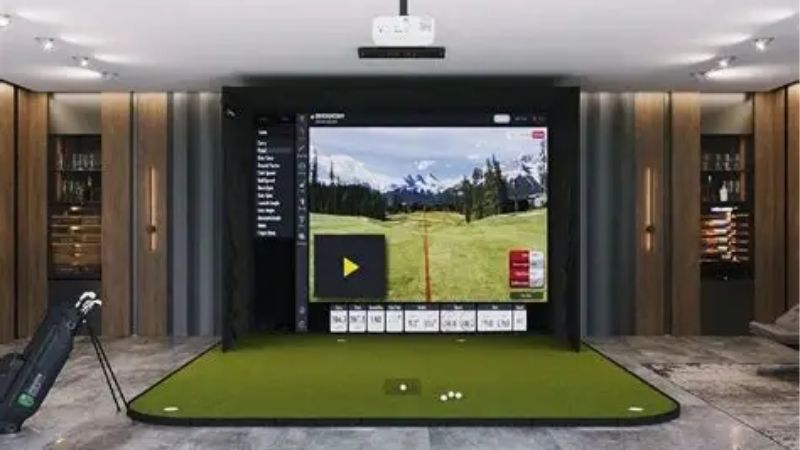
Light Source, Aspect Ratio and Total Cost: The Deciding Numbers
Four figures decide which best projector for golf simulator tier suits you: light source type and rated hours, native aspect ratio, brightness in ANSI lumens, and total installed cost including mount, cables and any lamp replacements over five years.
Lamps are rated between 4,000 and 15,000 hours depending on mode, and lamps cost money each time. Laser sources are rated at 20,000 to 30,000 hours with no consumables, which changes the arithmetic for anyone hitting several hours a week.
Aspect ratio is the specification builders most often overlook. Most projectors are 16:9, while many impact screens are closer to 16:10 or 4:3 in usable area, so part of the image lands off-screen unless the throw and mount are planned around it.
Space and Fit: Screen Size, Room Depth and Mounting
Plan any best projector for golf simulator install from the impact screen, usually 8 to 12 ft (2.4 to 3.7 m) wide, then work back through throw ratio to find the mount distance. A 0.8:1 lens needs roughly 8 ft of distance for a 10 ft image; a 1.5:1 lens needs 15 ft.
Ceiling height governs everything else. Bays generally need 9 to 10 ft (2.7 to 3 m) of clearance for a full swing, and the projector plus mount typically consumes 8 to 14 in (20 to 36 cm) below the ceiling.
Matching Brightness to the Room
Impact screen material absorbs a meaningful share of projected light, and a bay in a garage rarely has full light control. Around 3,000 ANSI lumens works in a dark room; 4,000 or more is safer in mixed light.
Brightness beyond what the room needs is wasted and can produce a washed-out image with crushed detail. Dark surrounding walls and ceiling improve perceived contrast more than an extra thousand lumens.
The Costs Beyond the Projector
Budget for a ceiling mount, a long HDMI cable rated for the resolution you are running, cable management and possibly an electrician for a ceiling socket. Those often add a significant fraction of the projector price.
A surge protector is worth adding as well. Bays frequently share a circuit with garage equipment, and projectors are among the more expensive items to lose to a power event.
Lamp replacements are the recurring cost on entry builds. Over five years of regular use, two or three lamps can approach the price gap between a lamp model and a laser one, which is worth calculating before choosing a tier.
Best Projector for Golf Simulator Picks by Tier
Models are grouped by build tier rather than ranked. Specifications are manufacturer-stated and combined with recurring themes in owner reports rather than testing performed by us.
Optoma GT1090HDRx
An entry short throw lamp projector with roughly 4,200 ANSI lumens and a very short throw ratio, designed for tight rooms where mount distance is the binding constraint.
Resolution is 1080p and lamp replacement is an ongoing cost. Brightness and throw for the price make it a common first sim projector.
BenQ LH720
A 1080p laser projector with high brightness and a long-life light source, offering laser economics without moving to 4K pricing.
Resolution limits sharpness on a wide screen. For a bay used several hours weekly, the absence of lamp replacements is the argument.
Optoma ZH450ST
A short throw 1080p laser with around 4,200 ANSI lumens, a compact body and a rated life that suits permanent ceiling installation.
It sits in the mid tier on price and does not offer 4K. Short throw plus laser life is an unusual combination at this level.
ViewSonic LS610HDH
A 1080p laser projector with high brightness and low maintenance requirements, aimed at installations where the unit will be difficult to access once mounted.
The throw ratio is longer than dedicated short throw units, so room depth matters. Sealed optics reduce dust problems in garage environments.
BenQ LK935ST
A 4K laser short throw model with very high brightness, aimed at premium and light-commercial bays where image quality and uptime both matter.
It is one of the most expensive options available for a home bay. Resolution, brightness and laser life together justify it only for heavy use.
Epson EpiqVision Ultra LS800
An ultra short throw laser projector that sits close to the screen, useful in rooms where a ceiling mount is impossible or where cabling overhead is impractical.
Ultra short throw placement conflicts with the hitting area in many bays, so it suits specific layouts rather than typical ones. Where it fits, it removes ceiling work entirely.
Optoma UHD35STx
A 4K short throw lamp projector with strong brightness and low input lag, offering 4K resolution at a lower price than laser equivalents.
Lamp replacement returns as a cost, and fan noise is noticeable in a hard-surfaced bay. It is the value route to a 4K image on a wide screen.
| Model | Tier | Light source | Resolution | Main trade-off |
|---|---|---|---|---|
| Optoma GT1090HDRx | Entry | Lamp | 1080p | Lamp replacements |
| BenQ LH720 | Mid | Laser | 1080p | Not 4K |
| Optoma ZH450ST | Mid | Laser, short throw | 1080p | Resolution limit |
| ViewSonic LS610HDH | Mid | Laser | 1080p | Longer throw |
| BenQ LK935ST | Premium | Laser, short throw | 4K | Highest cost |
| Epson LS800 | Specialist | Laser, ultra short throw | 4K PRO-UHD | Placement conflicts |
| Optoma UHD35STx | Mid | Lamp, short throw | 4K | Fan noise, lamps |
Model availability and pricing shift often on Amazon, so confirm the current generation and throw specification against your measurements before ordering.
Planning the Build and Timing the Purchase
A best projector for golf simulator purchase should come after the screen and room decisions, not before, because those constrain which projectors are usable at all.
Order of Operations for a Build
Decide the impact screen size first, then the hitting position, then the mount location. Only then does throw ratio narrow the projector list to a handful of usable models.
Run cabling before mounting. A projector installed and then wired is far harder to work with, and long HDMI runs above 25 ft (7.6 m) generally need an active or fiber cable to carry 4K reliably.
Maintenance in a Bay Environment
A best projector for golf simulator install faces more dust than a living room does, thanks to mats, turf fibers and shoes. Clean intake filters every few months and check them monthly in a garage installation.
Vacuum the bay floor rather than sweeping it, since sweeping lifts fine turf fiber straight into the intake path. A few minutes of that habit does more for projector life than any setting in the menu.
Overheating from blocked filters shortens lamp and laser life and triggers shutdowns mid-session. Sealed optical engines resist dust better, which is worth prioritizing in a garage or basement.
Buying Timing
Projectors follow the wider electronics promotional calendar. Amazon runs Prime Big Deal Days in early October, with Black Friday and Cyber Monday in late November as the deeper discount window.
Winter is also when indoor sim building peaks, so popular short throw models can go out of stock in late autumn. Buying before that rush is often more reliable than waiting for a specific price.
Frequently Asked Questions
Questions builders ask when planning a bay.
Laser or lamp for a home bay?
Laser for several hours of use per week, lamp for occasional use. Calculate lamp replacements over five years before assuming lamp is cheaper.
Does aspect ratio really matter?
Yes. A 16:9 projector on a taller impact screen leaves unused screen or projects past the edges, so plan the image size around the screen’s usable area.
Can I use a regular home theatre projector?
Only if room depth allows its longer throw and brightness suits the room. Most standard-throw models need more distance than a bay provides.
How long should the HDMI run be?
Keep it as short as practical. Beyond roughly 25 ft, use an active or fiber HDMI cable rated for the resolution and refresh rate you are running.
See More:
- Best low price dash cam
- Projector screens at Best Buy
- Best buy projector screens
- Best projector for games
- Best projector for gaming
Choosing a Tier and Committing
The best projector for golf simulator use is decided by hours per week and room geometry. Occasional use is well served by the Optoma GT1090HDRx; regular use justifies a laser model like the ZH450ST or LH720.
Daily or commercial bays justify the BenQ LK935ST. Measure the screen and room first, price the mount and cabling alongside the projector, and clean the filters regularly in a dusty bay.
Our top picks


As an Amazon Associate we earn from qualifying purchases at no extra cost to you.

Write Your Review
No reviews yet. Be the first to share your experience!