
Best projector for home movie theater decisions are settled by three numbers: ANSI lumens for the light you cannot control, throw distance for the room you actually have, and native resolution rather than the one a projector accepts as input.
As an Amazon Associate we earn from qualifying purchases.
Our top picks
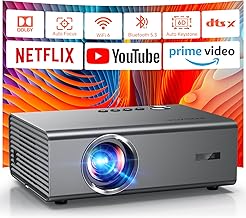
![[Built-in Apps/4K Support] Smart Outdoor Projector with WiFi and Bluetooth, Movie Projector, DoIby Audio with Dual Speaker, Auto Focus w/ YouTube&PrimeVideo Proyector, Upgrad P62 Pro](https://m.media-amazon.com/images/I/71dnuLKAfoL._AC_UY218_.jpg)


![Outdoor-Projector-4K [VIDAA Live TV/40W Dolby/920 ISO] with WiFi6 and Bluetooth Compatible with Netflix, Smart Projector, AI Voice Control & Auto Focus, HDR10, Movie Proyector for Ceiling Home Theater](https://m.media-amazon.com/images/I/81pt3e8j0JL._AC_UY218_.jpg)


As an Amazon Associate we earn from qualifying purchases at no extra cost to you.
By Daniel Foster
🛒 Best Price Today on Amazon
Prime members get fast, free shipping on everything above, plus member-only deals. New members get a 30-day free trial — cancel anytime.
Start 30-Day Prime Free Trial →See Today’s Amazon DealsSpecifying the Best Projector for Home Movie Theater Use
The best projector for home movie theater use differs between a dedicated room and a shared living room, and the difference is mostly about ambient light. Deciding which situation you are in first eliminates most of the market before any brand comparison begins.
ANSI Lumens, Throw Distance and Native Resolution
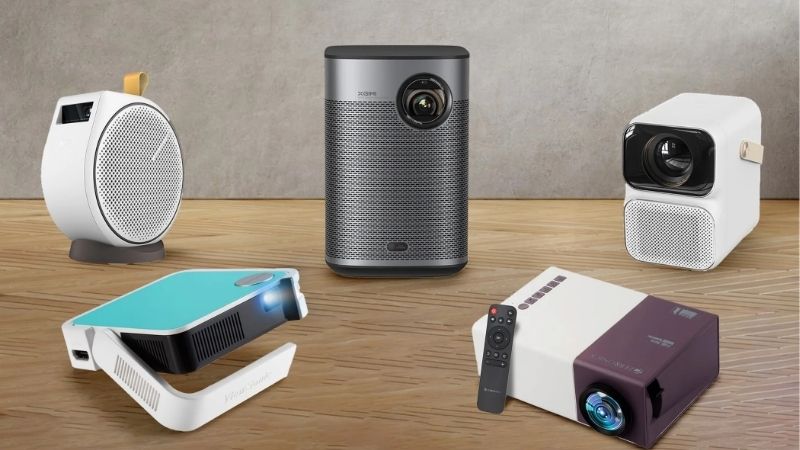
Brightness must be quoted in ANSI lumens to be comparable. A properly darkened room works well from about 1,500 ANSI lumens, a living room with some light control wants 2,000-3,000, and anything advertised in LED or peak lumens is not directly comparable. Where only LED lumens are quoted, assume the ANSI equivalent is roughly half.
Throw ratio is distance divided by image width. A standard long-throw projector at 1.5:1 needs roughly 11 ft (3.4 m) for a 100 in image, while an ultra short throw unit sits inches from the wall. Native 4K resolves detail that pixel-shifted 4K approximates. At normal seating distance that difference is subtle rather than dramatic.
Space and Fit: Room Depth, Screen Size and Mounting
Measure from the intended projector position to the screen wall before anything else. A room with 12-14 ft (3.7-4.3 m) of depth suits a ceiling-mounted long throw projector at 100-120 in, while a room without that depth needs an ultra short throw model. Measuring the room first prevents buying the wrong format entirely.
Ceiling mounting requires a bracket, an image flip setting and a planned cable run for power and HDMI. Ultra short throw units sit on furniture directly below the screen, which removes the cabling problem entirely but demands a very flat wall or a proper screen. Textured walls defeat ultra short throw geometry completely.
Contrast, Screens and Light Control
Contrast ratio determines how deep black looks, and it collapses in a room with ambient light regardless of the number quoted. Manufacturer contrast figures are measured in conditions no home matches. Blackout curtains and dark wall paint do more for perceived picture quality than a step up in projector tier.
A matte white screen suits a dark room; a grey or ambient light rejecting screen suits a living room, and ultra short throw units need an ALR screen designed specifically for their angle. Budget for the screen rather than treating it as optional. A good screen with a modest projector beats the reverse arrangement.
Light Source, Sound and Ownership Costs
Lamp projectors need bulb replacement every 3,000-5,000 hours at real cost, while laser and LED sources run 20,000-30,000 hours and dim gradually instead. Over a decade that difference usually outweighs the higher purchase price of a laser unit. Lamp costs are easy to overlook and add up quickly with daily use.
Built-in speakers on home cinema projectors are adequate for casual viewing and no substitute for a soundbar or a receiver. Check for HDMI eARC if the projector will pass audio through, since not all models support it. An external receiver avoids the question altogether.
Top Picks: Six Projectors for a Home Cinema
The list covers long throw and ultra short throw designs across the price range, with a genuine drawback for each. Which best projector for home movie theater use fits depends on room depth before anything else. Specifications are manufacturer figures combined with aggregated owner reports rather than testing of our own, and claims should be verified on the listing.
| Model | Type | Rated brightness | Resolution | Light source |
|---|---|---|---|---|
| Epson Home Cinema 3800 | Long throw | Around 3,000 ANSI lumens | 4K PRO-UHD | Lamp |
| Optoma UHD38 | Long throw | Around 4,000 ANSI lumens | 4K UHD | Lamp |
| BenQ HT2060 | Long throw | Around 2,300 ANSI lumens | 1080p | LED |
| Anker Nebula Cosmos Laser 4K | Long throw | Around 2,200 ANSI lumens | 4K | Laser |
| Hisense PX3-PRO | Ultra short throw | Around 3,000 ANSI lumens | 4K | Triple laser |
| Formovie Theater | Ultra short throw | Around 2,800 ANSI lumens | 4K | Triple laser |
Epson Home Cinema 3800 – Bright and Well Supported
Around 3,000 ANSI lumens with 4K PRO-UHD processing and lens shift, which makes placement far more forgiving than digital keystone correction. Lens shift moves the image without distortion, so the projector does not have to sit dead centre. Lens shift is the feature most worth paying for in a fixed install.
It uses a lamp, so budget for a replacement bulb every few thousand hours as a running cost. The 4K here is achieved through pixel shifting rather than a native 4K panel, which is visible on fine detail against true native units.
Optoma UHD38 – Highest Brightness Here
Around 4,000 ANSI lumens makes this the option most likely to work in a living room where light cannot be fully controlled, with low input lag that also suits gaming. Brightness is the specification that decides usability in a shared room.
High brightness comes with fan noise that is audible in quiet scenes, and lamp replacement is again an ongoing cost. Black levels are weaker than the laser units here, which is most noticeable in a properly dark room. In a living room that weakness matters far less.
BenQ HT2060 – 1080p Done Properly
An LED light source with accurate colour and lens shift at 1080p rather than 4K, which is a deliberate trade. For a 100 in screen at normal seating distance, well-implemented 1080p often looks better than poorly implemented 4K.
It is not a 4K projector, which will matter to some buyers regardless of the picture quality argument. Brightness of around 2,300 ANSI lumens is adequate rather than generous, so decent light control is still required. It suits a dedicated room rather than a bright lounge.
Anker Nebula Cosmos Laser 4K – Laser Without Lamp Costs
A laser light source rated around 20,000 hours removes bulb replacement from the ownership equation entirely, with 4K resolution and automatic setup features. For a best projector for home movie theater build that will run for years, the light source matters more than most specifications.
Automatic keystone correction crops and rescales the image, so physical placement is still preferable. The smart platform’s streaming app support changes over time, so an external streaming device is worth planning for. An HDMI stick also outlasts most built-in platforms.
Hisense PX3-PRO – Ultra Short Throw Flexibility
A triple laser ultra short throw unit that sits inches from the wall, producing a 100-120 in image without ceiling mounting or a cable run across the room. For a living room where a mounted projector is impractical, this is the format that works.
It requires an ALR screen designed for ultra short throw geometry, which adds significant cost and cannot be substituted with a plain white wall. Placement is also fussy, since a few millimetres of misalignment shows as a skewed image. Marking the furniture position once aligned saves repeating that.
Formovie Theater – Ultra Short Throw With Strong Black Levels
A triple laser ultra short throw with notably good contrast for the format and a full smart platform. Black levels are the usual weakness of ultra short throw units, and this is one of the better performers in that respect.
As with any ultra short throw, an ALR screen is effectively mandatory and the total cost rises accordingly. Ultra short throw units are also heavy and awkward to align precisely, so setup takes longer than a ceiling-mounted alternative. Once aligned, they stay put and need no cable run at all.
Building the Room Around the Projector
Projector choice is perhaps half of picture quality, and the best projector for home movie theater setups still disappoints in an uncontrolled room. Light control, screen choice and placement account for the rest, and they are usually cheaper to get right than moving up a projector tier would be.
Light Control Before Anything Else
Blackout curtains, dark wall paint near the screen and removing reflective surfaces all improve perceived contrast more than extra lumens do. A 1,500 lumen projector in a dark room outperforms a 3,000 lumen one in a bright one on every measure except peak brightness.
Where the room cannot be darkened, choose brightness and an ambient light rejecting screen together rather than one alone. Neither compensates fully for the other, and buying only the projector is the more common mistake. Screen and curtains together cost less than a tier upgrade.
Screens, Placement and Geometry
Calculate image size from the throw ratio rather than estimating, and use lens shift where available rather than digital keystone correction, which crops and rescales the image. Ceiling mounts need the cable run planned before anything is drilled.
Seating distance should suit the screen size: roughly 1.5 times the screen width is a common starting point for a comfortable viewing angle. A larger image is not automatically better if the front row ends up too close to take it in. Comfort matters more than maximum size in a small room.
Maintenance, Sound and Buying Timing
Vents collect dust, which raises operating temperature and increases fan noise, so clearing filters and intakes periodically is worthwhile. Lamp units dim measurably before failing, and laser units decline slowly enough that the change is invisible day to day.
Home cinema interest rises from September as evenings shorten, and projector discounts cluster around Prime Big Deal Days in early October and the late November sales period. Buying outside those windows usually means paying close to list price. Stock on the popular models also thins during those weeks.
See More:
- Best low price dash cam
- Projector screens at Best Buy
- Best buy projector screens
- Best projector for games
- Best projector for gaming
Final Thoughts on the Best Projector for Home Movie Theater Setups
Measure the room first, set brightness against the light you cannot control, then decide between long throw and ultra short throw based on the depth available. Resolution and brand preference should only break ties between models that already fit.
The best projector for home movie theater use is the one matched to your room rather than the brightest or the highest resolution. Measure the throw distance and budget for a screen before ordering, and confirm brightness units and native resolution on the listing at purchase.


Write Your Review
No reviews yet. Be the first to share your experience!