
Best projector outdoor setups are decided by one specification above all others: brightness in ANSI lumens, because a garden after sunset still has far more ambient light than a dark living room. Throw distance and native resolution decide the rest.
As an Amazon Associate we earn from qualifying purchases.
Our top picks


![[Built-in Apps/4K Support] Smart Outdoor Projector with WiFi and Bluetooth, Movie Projector, DoIby Audio with Dual Speaker, Auto Focus w/ YouTube&PrimeVideo Proyector, Upgrad P62 Pro](https://m.media-amazon.com/images/I/71dnuLKAfoL._AC_UY218_.jpg)


![[Officially-Licensed App & Auto Focus]White Smart Mini Projector with WiFi and Bluetooth, XuanPad 4K Support Movie Projector, Portable Native 1080P Outdoor Projector with 360° Stand](https://m.media-amazon.com/images/I/71eMQlH6EgL._AC_UY218_.jpg)

As an Amazon Associate we earn from qualifying purchases at no extra cost to you.
By Daniel Foster
Specifications come from manufacturer documentation and long-term owner feedback rather than lab testing. Brightness claims vary by measurement standard, so ANSI or ISO figures are used where the manufacturer states them.
🛒 Best Price Today on Amazon
Prime members get fast, free shipping on everything above, plus member-only deals. New members get a 30-day free trial — cancel anytime.
Start 30-Day Prime Free Trial →See Today’s Amazon DealsThe Three Numbers That Decide an Outdoor Picture
Indoor projectors flatter themselves in a dark room. Outside, the same machine looks washed out, which is why a best projector outdoor shortlist looks nothing like a living room one. Four specifications explain the difference.
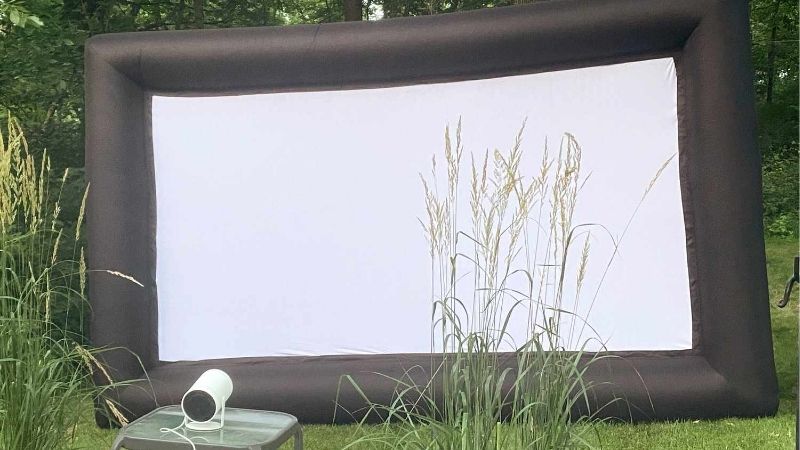
ANSI Lumens, Throw Distance and Native Resolution
Brightness is the decisive figure for any best projector outdoor purchase. Roughly 500 ANSI lumens works only in genuine darkness on a small screen; 1000 to 1500 ANSI lumens handles a dark garden at a moderate size; 2500 ANSI lumens and above holds up with streetlights, porch lights or an early start before full dark.
Throw distance sets how far back the projector must sit for a given image width. A standard throw model typically needs 10 to 13 ft (3 to 4 m) to fill a 100 in (254 cm) screen. Native resolution matters more than supported resolution: a unit that accepts 4K but displays 1080p is a 1080p projector.
Screen Size, Throw Distance and Where It All Fits
Measure the garden before choosing anything. You need a flat run from the projector position to the screen, free of the path people walk, plus somewhere stable to place the unit at roughly screen-centre height. A table at 30 in (76 cm) is usually easier than a tripod for a family setup.
Screen size follows from distance, not desire. A 100 in (254 cm) image needs about 87 in (221 cm) of width, so check the wall, fence or screen frame you plan to use. Keystone correction fixes geometry but costs sharpness, so aim to place the projector squarely rather than relying on it.
Contrast, Screen Surface and Ambient Light
Outdoors there are no walls or ceiling to bounce light back, which is why images look dimmer than the same projector indoors. A proper screen with a white or grey surface returns significantly more light to viewers than a bedsheet or a fence panel.
Contrast ratios quoted in marketing are effectively meaningless outdoors, because ambient light lifts black levels regardless. Blocking stray light from a porch lamp or neighbouring window does more for perceived contrast than any specification on the box.
Sound, Connections and Power
Built-in speakers on projectors are small and struggle against open air and background noise. A Bluetooth speaker of any decent size transforms the experience more cheaply than upgrading the projector.
Plan power before purchase: an extension lead rated for outdoor use, or a battery model if no socket is reachable. Check inputs too, since a streaming stick needs an HDMI port and a USB port for power, and not every compact model provides both.
Six Projectors Bright Enough for a Garden
Any best projector outdoor candidate has to be bright first, so these are mains-powered models chosen for output rather than portability. That is the right priority when the screen is large and the sky is not fully dark. Each entry lists a drawback.
| Model | Brightness | Native resolution | Best for |
|---|---|---|---|
| BenQ TH685P | About 3500 lumens | 1080p | Bright gardens, gaming |
| Epson Home Cinema 880 | About 3300 lumens | 1080p | Colour accuracy |
| Optoma HD146X | About 3600 lumens | 1080p | Budget brightness |
| ViewSonic PX701-4K | About 3200 lumens | 4K UHD | Detail at large sizes |
| Anker Nebula Cosmos Laser 4K | About 2400 ANSI lumens | 4K UHD | Laser light source |
| Epson EpiqVision Mini EF12 | About 1000 lumens | 1080p | Compact laser setup |
BenQ TH685P: Brightness With Low Input Lag
Around 3500 lumens at 1080p native, with a low input lag mode that makes it usable for console gaming on a big screen. That combination is why it appears on so many garden setups: it stays watchable earlier in the evening than dimmer models.
Lamp-based light sources dim gradually over their rated life and the replacement lamp is a real future cost. Fan noise is also noticeable in a quiet garden, though outdoor ambient noise masks it more than indoors.
Epson Home Cinema 880: Colour That Holds Up
About 3300 lumens with three-chip LCD technology, which means colour brightness matches white brightness rather than falling behind it. On a large outdoor image that shows as richer colour rather than a bright but pale picture.
It is physically larger than most competitors and there is no built-in streaming platform, so a stick or console is required. The lamp cost applies here as well, and it does not offer the very low input lag gamers look for.
Optoma HD146X: Maximum Brightness Per Pound
Roughly 3600 lumens at 1080p makes this one of the brightest options at its price, which matters more outdoors than any other feature. Setup is simple and it accepts 4K signals even though it displays 1080p.
Single-chip DLP designs can show a colour flash effect that a minority of viewers notice, and the built-in speaker is weak even by projector standards. Plan on external audio from the start.
ViewSonic PX701-4K: Detail on a Big Screen
Around 3200 lumens with 4K UHD output, so at image sizes over 100 in (254 cm) the extra detail is genuinely visible when the source material supports it. It is a sensible middle ground between brightness and resolution.
4K adds nothing if your content is streamed at lower bitrates or the screen is small, and the extra resolution does not improve a washed-out image. Lamp replacement remains a future expense.
Anker Nebula Cosmos Laser 4K: No Lamp to Replace
About 2400 ANSI lumens from a laser light source with 4K output and built-in Android TV, so streaming works without extra hardware. Laser sources hold brightness far longer than lamps and turn on at full output immediately.
It is the most expensive unit here and 2400 ANSI lumens, while genuinely bright, is measured on a stricter standard than the lamp figures above, so compare carefully. Built-in streaming platforms also age faster than the hardware they run on.
Epson EpiqVision Mini EF12: Small, Laser, Portable Enough
About 1000 lumens from a laser source in a compact body with built-in audio designed by a hi-fi brand, which is unusually decent for the size. For a small screen in a fully dark garden it is a tidy, quick setup.
It is the dimmest option here and will disappoint on a 120 in (305 cm) screen or before full darkness. Treat it as a 60 to 80 in (152 to 203 cm) machine and it performs well; push it larger and it does not.
Setup, Weather and Long-Term Ownership
The best projector outdoor performance depends on care as much as specification, because garden use is harder on hardware than a living room shelf. The failure modes are specific and avoidable.
Damp, Insects and Storage
None of these projectors is weatherproof. Dew forms on cool surfaces after sunset, and insects are drawn to the light and the vents. Bring the unit indoors the same evening rather than leaving it out overnight, and let it cool before packing it away.
Dust and insect debris in the optical path is the most common cause of visible spots on the image. Clean filters where the model has them, and store the projector in a case rather than under a garden table.
Light Source Life and Brightness Decline
Lamp-based models lose brightness gradually across their rated hours, and outdoor use is the setting where that decline is noticed first because there is no darkness to compensate. Laser and LED sources decline far more slowly and have no consumable to replace.
Fan noise usually rises before failure, and running a projector in a hot enclosed box or bag while it cools is the fastest route to shortening its life. Check for UL or ETL marks on any mains-powered unit and use an outdoor-rated extension lead.
Timing a Purchase
Projectors follow the electronics discount calendar, and demand rises as evenings darken through autumn. The Amazon deal event in early October and the Black Friday to Cyber Monday window at the end of November are when this category gets the most attention, partly because projectors sell heavily as gifts.
If your plan is summer garden viewing, buying in that autumn window and storing the unit is a rational sequence. Prices move constantly and no discount is worth accepting a projector too dim for your screen size.
Frequently Asked Questions
Three questions come up in nearly every message from readers assembling a best projector outdoor setup for the first time.
How many lumens do I actually need outside?
In full darkness on a 100 in (254 cm) screen, 1000 ANSI lumens is workable. With any streetlight, porch light or residual dusk, 2000 ANSI lumens and up is the honest requirement. Brightness is the specification least worth economising on outdoors.
Can I project onto a wall or a sheet?
Yes, but you lose light and sharpness. A painted wall scatters light in all directions and a sheet ripples in the slightest breeze. A basic screen with a taut surface is the cheapest meaningful upgrade to any outdoor setup.
Do I need 4K?
Only if your source is genuinely 4K and the screen is large enough for the difference to be visible, usually beyond 100 in (254 cm) at normal seating distance. Below that, spend the money on brightness instead.
See More:
- Best low price dash cam
- Projector screens at Best Buy
- Best buy projector screens
- Best projector for games
- Best projector for gaming
Final Thoughts on Garden Projection
The best projector outdoor viewing demands is the bright one, not the sharp one. Match ANSI lumens to how dark your garden really gets, confirm the throw distance fits the space you have, and treat native resolution as a secondary concern below 100 in (254 cm).
Measure the run from projector position to screen before ordering, and budget for a screen and a separate speaker in the same purchase. Whichever best projector outdoor setup you assemble, plan the power route and bring the unit indoors after each session, because damp does more damage than use.

Write Your Review
No reviews yet. Be the first to share your experience!