
Best air purifier for cat allergy is a CADR question before it is a brand question. Cat allergen particles are small and stay airborne for hours, so the machine needs high clean air delivery for the room size, sealed HEPA filtration and carbon for litter odour.
As an Amazon Associate we earn from qualifying purchases.
By Daniel Foster
Why Cat Allergen Is Harder Than Ordinary Dust
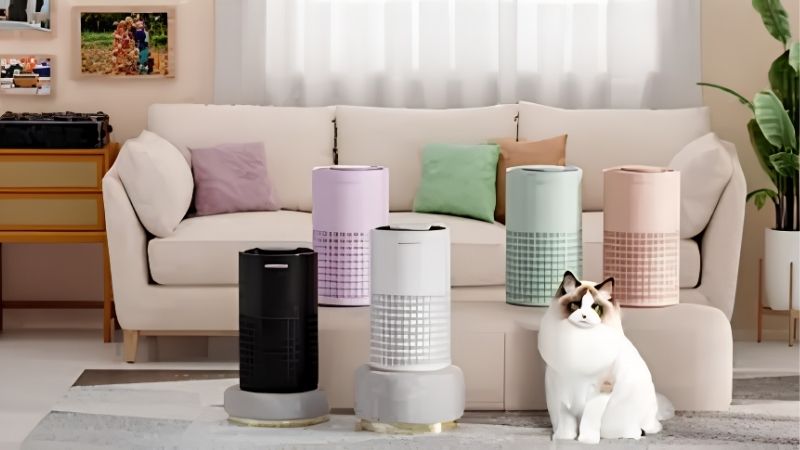
Anyone shopping for the best air purifier for cat allergy is really solving a fine-particle problem. The primary cat allergen, Fel d 1, is carried on very small particles that remain suspended far longer than pollen or heavier dust. That single property changes the specification you should shop on, because a purifier that settles a room slowly will not keep up.
The Decisive Numbers: CADR and Coverage Area
Clean Air Delivery Rate is the number that matters, quoted in cfm for smoke, dust and pollen. The best air purifier for cat allergy generally means a smoke CADR of at least 200 cfm for a typical bedroom and 300 cfm or more for an open living space, because smoke CADR tracks fine-particle performance.
Coverage claims are the same figure dressed differently. A manufacturer quoting 1,500 sq ft (139 m2) is usually assuming one air change per hour, which is far too slow for allergens. Divide that number by four or five to get the room size at 4-5 air changes per hour, which is the target for allergy use.
Filtration type sets the ceiling. True HEPA captures 99.97 percent of particles at 0.3 microns, and a sealed housing prevents air from bypassing the filter through body gaps. An unsealed purifier with an excellent filter performs worse than a sealed one with an ordinary filter, which is why the best air purifier for cat allergy is always a sealed design.
Space and Fit: Where the Unit Actually Goes
Purifiers need clearance to breathe. Most tower and cylinder designs pull air from the sides or base and exhaust upward, needing 6-12 in (15-30 cm) of space around them, so pushing one into a corner behind furniture cuts its effective output substantially.
Footprints run from about 10 in (25 cm) square for a bedroom unit up to 15 x 10 in (38 x 25 cm) for a large-room machine, with heights of 18-28 in (46-71 cm). Measure the intended floor space and check that a socket is within cable reach, since extension leads are best avoided for continuously running appliances.
Filter Costs and What Fails First
The purifier is the cheap part. HEPA filters typically need replacing every 6-12 months and carbon pre-filters every 3-6 months in a home with cats, and annual filter cost ranges from modest to more than a third of the machine’s purchase price depending on brand.
Washable pre-filters extend HEPA life considerably by catching fur before it reaches the pleats, and in a cat household that pre-filter needs vacuuming every couple of weeks. Fan bearings and the sensor module are the other wear points, with sensors drifting and needing occasional cleaning to stop the auto mode misreading the room.
7 Purifiers That Handle Cat Allergen and Litter Odour
The best air purifier for cat allergy varies with room size, so read the coverage column against your own space. The picks below are chosen on published CADR, sealed filtration and carbon capacity rather than marketing claims. Prices on Amazon change frequently, so the tiers are indicative.
| Model | CADR / coverage (listed) | Carbon | Price tier |
|---|---|---|---|
| Coway Airmega AP-1512HH | ~240 cfm smoke, 361 sq ft | Yes | Mid |
| Winix 5500-2 | ~232-246 cfm, 360 sq ft | Large pellet carbon | Budget-mid |
| Levoit Vital 200S | ~240 cfm class, pet mode | Yes | Mid |
| Alen BreatheSmart 45i | Listed to 800 sq ft at 2 ACH | Pet filter option | Premium |
| Rabbit Air MinusA2 | Listed to 815 sq ft at 2 ACH | Pet allergy filter | Premium |
| Blueair Blue Pure 211i Max | ~350 cfm class, large room | Yes | Mid |
| Honeywell HPA300 | ~300-320 cfm, 465 sq ft | Pre-filter carbon | Mid |
Coway Airmega AP-1512HH: The Bedroom Default
For a single room this is the default recommendation for the best air purifier for cat allergy at a sensible price: roughly 240 cfm smoke CADR in a compact body makes this the standard recommendation for a bedroom up to about 360 sq ft (33 m2) at the manufacturer’s rating. It is quiet on its lower speeds, which matters if the cat sleeps in the same room.
The washable pre-filter helps with fur, but the carbon layer is thin compared with dedicated odour machines, so a litter tray in the same room will still register. The ioniser can be switched off, which is the sensible default.
Winix 5500-2: Carbon Volume for Litter
The reason this model persists in pet recommendations is the granular carbon filter, which holds far more adsorbent material than the thin carbon sheets typical at this price. For litter odour specifically it outperforms machines with higher particle CADR.
The PlasmaWave function generates ions and should be turned off if you would rather avoid any ionisation; the unit works normally without it. Filter replacements are the ongoing cost, and the carbon element is the one you will change most often.
Levoit Vital 200S: Pet Mode and Wide Intake
A three-sided intake and a dedicated pet mode that runs the fan harder while a washable pre-filter catches fur make this a practical choice for a room the cat actually lives in. App scheduling and auto mode work reliably.
It is physically larger than its CADR suggests, and on higher speeds it is noticeably audible. Replacement filters are proprietary, and while reasonably priced, third-party alternatives vary considerably in quality.
Alen BreatheSmart 45i: Filter Chosen for the Problem
Alen sells different filter types for the same body, including a pet-specific option with extra carbon, which lets you match the machine to the actual complaint rather than accepting a generic filter. Coverage is listed to 800 sq ft (74 m2) at two air changes per hour.
It is expensive, and the meaningful coverage figure for allergy purposes is roughly half the headline number once you target four to five air changes. Filters are premium-priced, so calculate the annual running cost before committing.
Rabbit Air MinusA2: Customisable and Wall-Mountable
The customised filter layer, available in a pet allergy configuration, plus the option to hang the unit on a wall makes this the choice where floor space is scarce. Wall mounting also keeps it away from a curious cat.
It is among the most expensive options here and the six-stage filter assembly is costly to replace. Airflow at the quietest setting is modest, so it works best sized generously relative to the room rather than run flat out.
Blueair Blue Pure 211i Max: High Output, Low Complexity
Blueair’s approach combines electrostatic charging with a less dense filter, producing high airflow at low noise, which suits a large open living area where a cat roams. Setup is essentially unpacking it and plugging it in.
The fabric pre-filter needs washing regularly in a cat home or it clogs with fur, and carbon capacity is moderate. There is no auto sensor on the simplest variants, so it runs at whatever speed you set.
Honeywell HPA300: Big Airflow, Basic Features
Around 300 cfm across the CADR measures at a mid-market price makes this the value pick for a larger room. It is plain, mechanical and has no app, which for many buyers is a benefit rather than a shortcoming.
It is loud on its top setting, closer to a box fan than a bedroom appliance, and the carbon is a thin pre-filter rather than a substantial layer. Filters are inexpensive but need changing on schedule to maintain airflow.
Getting Real-World Results in a Cat Household
The best air purifier for cat allergy is one part of managing allergen, and how it is run matters as much as which one you buy.
Placement and Runtime
Run the machine continuously on a moderate setting rather than intermittently on high. Allergen is generated constantly, and a purifier switched on for an hour a day never reaches steady state. Continuous operation on speed two is usually quieter and more effective than bursts at speed four.
Place it in the room where you spend the most time, typically the bedroom, and keep the door closed so the machine is working on a defined volume rather than the whole house. Keeping windows shut while it runs stops it fighting an unlimited supply of outside air.
What a Purifier Cannot Do
Airborne capture does not remove allergen that has settled into carpet, upholstery and bedding, which is where a large proportion of it ends up. Vacuuming with sealed HEPA filtration and washing bedding weekly address that reservoir; the purifier handles what is in the air.
Nothing here is medical guidance. Allergy symptoms vary enormously between individuals and a purifier is an environmental measure rather than a treatment, so persistent symptoms are a conversation for a doctor or an allergist rather than a product decision.
Seasonal Demand and When to Buy
Air purifiers follow the electronics and home-appliance calendar, with Prime Big Deal Days in early October and the Black Friday and Cyber Monday window in late November as the next two periods when discounts are most common across the category.
Demand also spikes with air quality events. Wildfire smoke episodes and periods of elevated AQI clear stock quickly and push prices up, and the same happens as respiratory virus season begins in autumn. Buying ahead of those windows is generally easier than buying during them.
Frequently Asked Questions
These are the questions that come up once best air purifier for cat allergy research moves past brand names and into specifications.
How big a purifier do I need for a bedroom?
For a 200 sq ft (19 m2) bedroom at four to five air changes per hour, look for a smoke CADR around 130-160 cfm or higher. Buying a machine rated well above the room size lets you run it on a quieter setting and still hit the target.
Does an ioniser help with cat allergen?
Mechanical HEPA filtration does the work; ionisers are a secondary feature and some generate small amounts of ozone. Most units allow the function to be disabled, and running with it off is the straightforward choice if you are uncertain.
How often do filters need changing with cats?
Faster than the manual suggests. Fur loads the pre-filter quickly, so vacuum it every two weeks, expect carbon to need replacing every three to six months, and plan on HEPA every six to twelve months depending on runtime.
See More:
- Best noise cancelling headphones Bose
- Best deal on air fryer
- Best buy Bella air fryer
- Best deals air fryer
- Best blender bottle
Final Thoughts on Purifiers for Cat Allergy
The best air purifier for cat allergy is the one whose CADR comfortably exceeds your room size at four to five air changes per hour, with sealed HEPA and enough carbon to handle the litter tray. Measure the room and check the socket position before ordering, run the machine continuously rather than in bursts, and treat filter replacement as part of the purchase price rather than a surprise.
Our top picks


 LEVOIT Air Purifier for Home Allergies and
- Power Source: Corded Electric
- Control Method: Touch
- Filter Type: 3 in 1 Filtration
Covers up to 1073 square feet on one unit
Operates as quiet as 24 decibels in sleep mode
Captures 99.97 percent of particles down to 0.1 microns
Requires genuine Levoit replacement filters for proper performance
Corded electric design needs a nearby wall outlet
 MOOKA Air Purifier for Home Bedroom Large
- 𝐇𝐢𝐠𝐡𝐞𝐫 𝐀𝐢𝐫 𝐈𝐧𝐭𝐚𝐤𝐞 & 𝐋𝐚𝐫𝐠𝐞𝐫 𝐂𝐨𝐯𝐞𝐫𝐚𝐠𝐞 𝐟𝐨𝐫 𝐏𝐞𝐭…
- 𝐒𝐦𝐚𝐫𝐭 𝐏𝐌𝟐.𝟓 𝐀𝐐𝐈 𝐃𝐢𝐬𝐩𝐥𝐚𝐲 & 𝐀𝐮𝐭𝐨 𝐌𝐨𝐝𝐞: Built-in…
- 𝐖𝐚𝐬𝐡𝐚𝐛𝐥𝐞 𝐏𝐫𝐞-𝐅𝐢𝐥𝐭𝐞𝐫 & 𝟑-𝐒𝐭𝐚𝐠𝐞 𝐃𝐞𝐬𝐢𝐠𝐧: Equipped with a…


As an Amazon Associate we earn from qualifying purchases at no extra cost to you.






Write Your Review
No reviews yet. Be the first to share your experience!