Key takeaways
- The panel is mostly sound steel or properly prepared old finish.
- The repair is shallow to moderate and has a firm metal foundation.
- You want the easiest balance of spreadability, shaping, and sanding.
- You are restoring several panels and need a general-purpose material.
The best automotive body filler for car restoration is usually a premium lightweight polyester filler such as Evercoat Rage Ultra or 3M Platinum Plus for shallow-to-moderate repairs, while epoxy-based filler, reinforced filler, or finishing glaze is better when the substrate, repair depth, or moisture exposure demands it.
There is no single filler that suits every restoration job. The right choice depends on whether you are repairing bare steel, galvanized metal, aluminum, fiberglass, or an old painted panel; how deeply the panel is damaged; how much time you need to shape the material; and whether the repair will be exposed to moisture before primer and paint. The comparison below focuses on those decisions rather than simply ranking products.
Our top picks
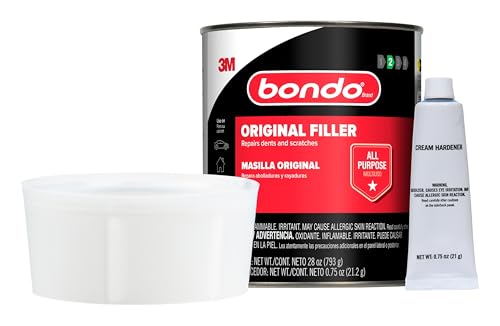
 Bondo Body Filler
- Original formula for repairing dents, dings, holes, large…
- Two-part lightweight compound mixes easily and spreads smoothly
- Spread easy and cures in only 20 minutes…
 Bondo Body Filler
- ORIGINAL FORMULA for repairing dents, dings, holes, large…
- TWO-PART lightweight compound mixes easily and spreads smoothly
- SPREAD EASY and cures in only 20 minutes…
As an Amazon Associate we earn from qualifying purchases at no extra cost to you.
Quick comparison: which filler fits the repair?
| Filler type | Typical working time | Practical maximum per application | Sanding effort | Moisture resistance | Best use |
|---|---|---|---|---|---|
| Lightweight polyester filler | 3–6 minutes at 21°C | About 6 mm | Low to moderate | Fair after sealing; poor if left exposed | General steel-panel dents and contouring |
| Aluminum-filled polyester filler | 3–5 minutes | About 6 mm | Moderate | Better than standard filler | Metal panels needing improved heat and moisture stability |
| Fiberglass-reinforced filler | 4–8 minutes | About 10–12 mm, in multiple lifts | High | Good when fully sealed | Pinholes, perforations, deep low areas, and bridging repairs |
| Epoxy filler or epoxy fairing compound | 20–60 minutes | Usually 3–6 mm per coat | Moderate to high | Very good | Aluminum, blasted steel, marine-prone areas, and moisture-sensitive repairs |
| Polyester finishing glaze | 3–5 minutes | About 1–3 mm | Low | Fair only after primer | Pinholes, sanding scratches, and final surface correction |
These figures are working ranges, not universal specifications. Temperature, hardener ratio, panel temperature, humidity, and the manufacturer’s technical sheet can change curing and application limits. Never use a thick layer of ordinary filler as a substitute for metal repair.
Best overall: lightweight premium polyester filler
A quality lightweight polyester filler is the most versatile choice for a typical steel-bodied restoration. Evercoat Rage Ultra, Evercoat Rage Gold, and 3M Platinum Plus are examples of this category. They spread smoothly, feather well, and usually sand more easily than economy fillers.
Use this type after removing rust and straightening the panel as closely as possible. It is intended to refine a surface, not replace missing metal. A practical application is a dent reduced to roughly 3–6 mm at its deepest point, followed by one or more thin coats. Most products become workable within several minutes and can often be sanded after roughly 15–25 minutes at room temperature.
The main trade-off is moisture sensitivity. Polyester filler is not a waterproof repair system. If it sits overnight in damp air, absorbs water during wet sanding, or is applied over untreated rust, later bubbling and adhesion failure become more likely. Seal it with the recommended epoxy or 2K primer system before prolonged exposure.
Choose this when:
- The panel is mostly sound steel or properly prepared old finish.
- The repair is shallow to moderate and has a firm metal foundation.
- You want the easiest balance of spreadability, shaping, and sanding.
- You are restoring several panels and need a general-purpose material.
Best for deep or damaged areas: fiberglass-reinforced filler
Fiberglass-reinforced polyester filler, often sold as “kitty hair” or short-strand filler, contains chopped glass fibers that add bridging strength. It is useful over small perforations, rough welded areas, and deeper low spots after structural metalwork is complete.
Its strength is not a license to fill large rust holes. Cut out weakened metal, weld in a patch, grind the welds, and use reinforced filler only to level irregularities. Apply it in lifts rather than one heavy mound. A 10–12 mm repair may require two or three applications, allowing each layer to cure and cool.
This material is harder to spread and sand than lightweight filler. Start with approximately 40-grit abrasive, then cover it with standard filler or glazing putty before moving through 80, 120, and 180 grit. If you use it for an entire panel, the extra sanding can erase its time advantage.
Best for aluminum and moisture exposure: epoxy filler
Epoxy filler or epoxy fairing compound is the safer choice when adhesion and moisture resistance matter more than rapid sanding. It bonds well to correctly prepared aluminum and blasted steel, and it generally has a longer open time than polyester filler. That gives beginners more opportunity to spread and shape a large repair before the material begins to drag.
Its disadvantages are cost, slower cure, and more demanding surface preparation. Epoxy products may remain rubbery or clog paper if sanded too soon. They also require accurate mixing by weight or by the supplied ratio. Some epoxy systems require a recoat window; others must be scuffed after full cure. Follow the technical sheet rather than assuming that every epoxy behaves alike.
For a vehicle that will be stored in a humid garage, driven in wet weather, or repaired around aluminum panels, the added protection can justify the higher material cost. Epoxy does not eliminate corrosion: contamination, trapped moisture, and poor edge sealing can still cause failure.
Best for final imperfections: finishing glaze
Finishing glaze is designed for shallow defects, not panel shaping. Products such as Evercoat Metal Glaze are commonly used to fill pinholes, sanding scratches, tiny low areas, and minor waviness after the main filler has been blocked.
Because it is soft and easy to sand, glaze can save time at the final stage. Keep applications thin—generally 1–3 mm or less—and do not use it over loose paint, active rust, or a flexible plastic part unless the product specifically supports that substrate. A glaze that looks perfect before primer can reveal shrinkage or pinholes after the surface is sealed, so inspect under a guide coat.
Substrate compatibility matters more than brand
- Bare mild steel: Remove rust, oil, mill scale, and oxide. Polyester filler works for normal contouring, but epoxy primer beneath or over the repair provides a better corrosion-control strategy when the system allows it.
- Aluminum: Degrease, abrade with a suitable pad or abrasive, remove residue, and use a product rated for aluminum. Epoxy filler or a manufacturer-approved aluminum-compatible polyester filler is preferable to an unverified general filler.
- Galvanized steel: Avoid aggressive heat and prepare the coating according to the paint system’s instructions. Adhesion problems can occur if the zinc surface is polished smooth or contaminated.
- Fiberglass and SMC: Use a filler labeled for composites and remove wax, mold-release residue, and damaged fibers. Ordinary metal-panel filler may crack if the panel flexes.
- Old paint: Feather sound, firmly bonded coating and test compatibility. Do not bury lifting lacquer, silicone contamination, or unknown unstable layers beneath filler.
Decision matrix for restoration situations
| Your situation | Recommended material | Why | What to avoid |
|---|---|---|---|
| First restoration, one or two shallow dents | 1.5–2 kg lightweight polyester filler | Easy to shape and enough material for several attempts | Buying a large pail of reinforced filler |
| Multiple steel panels and regular workshop use | Lightweight filler plus separate finishing glaze | Efficient general filler with a cleaner final stage | Using glaze for deep contouring |
| Aluminum hood or moisture-prone storage | Epoxy filler or aluminum-rated system | Better adhesion and moisture tolerance | Unsealed polyester filler left overnight |
| Welded patch with pinholes or rough transitions | Fiberglass-reinforced filler, then lightweight filler | Bridges irregularities before fine surfacing | Filling a structurally weak rust hole |
| Final pinholes and 180-grit scratches | Finishing glaze | Fast application and low sanding effort | Building thick layers |
How much filler should you buy?
A rough planning calculation helps prevent buying only by container size. Suppose a door repair averages 0.25 m² and the intended average filler thickness is 2 mm. The theoretical volume is:
0.25 m² × 0.002 m = 0.0005 m³, or 500 cm³.
Because filler is mixed, spread, sanded away, and lost on boards and tools, a practical allowance is roughly 1.5–2 times that volume. A 1.5 kg container is therefore usually more realistic than a small 500 g container for one substantial door repair, while a 3 kg container makes sense for several panels. Actual coverage varies with density and repair shape.
Ownership realities and common mistakes
Filler itself is only part of the cost. Expect to use mixing boards, spreaders, disposable gloves, sanding discs or blocks, guide coat, solvent-approved cleaning materials, and primer. Abrasive paper is often the first consumable to run out. Cured filler quickly clogs worn paper, so replace it instead of applying excessive pressure.
- Mix small batches that can be applied within the stated working time.
- Use the specified hardener amount; extra hardener does not create a stronger repair and can cause color or curing problems.
- Keep filler and panel temperature near the product’s recommended range. Cold material cures slowly; excessive heat shortens working time sharply.
- Block-sand with a firm board on broad panels to avoid making waves.
- Do not wet-sand uncured or moisture-sensitive polyester filler.
- Clean tools before the material hardens, and keep the container rim free of cured crumbs.
- Prime promptly after final sanding, especially in a humid workspace.
Final verdict
For most classic-car steel-panel repairs, choose a premium lightweight polyester filler and pair it with a separate finishing glaze. Add fiberglass-reinforced filler only where a properly repaired metal area needs bridging or leveling. Choose epoxy filler for aluminum, high moisture exposure, or situations where adhesion and longer working time outweigh easy sanding. Matching the filler to the substrate and repair depth will produce a more durable restoration than choosing the hardest or most expensive product by default.