Our Short List of 3
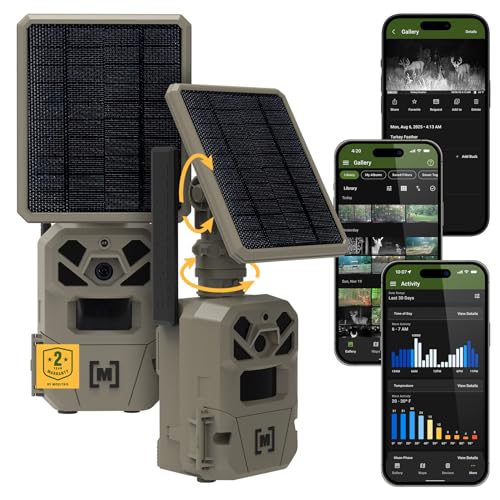
- Best for: Two locations watched all season by someone who wants to stop buying and swapping AA cells.
- Photo resolution: 40MP
- Video: 1080p FHD with audio
- Power: Integrated adjustable solar panel with built-in rechargeable Li-ion battery pack, no AA batteries required
- Connectivity: Multi-carrier LTE, auto-connects to the strongest signal

- Best for: A sunny, out-of-the-way post you plan to visit once or twice a season and never want to find dead.
- Photo resolution: 40MP
- Video: 1080p with sound
- Trigger speed: 0.3 seconds
- Flash and detection range: 100 feet, no-glow LEDs

- Best for: Gates, yards and lease roads where you want to look in live and have GPS working against theft.
- Connectivity: 4G LTE, this listing is the AT&T version in Spartan Areus camo
- Live streaming: Up to 30 FPS, with on-demand image and video capture
- Battery: Internal rechargeable 5300mAh lithium battery, solar panel connects directly
- Field of view: 96-degree wide-angle lens
All 4 Picks at a Glance
| Product | Specs | Action |
|---|---|---|
| Moultrie Edge Solar Cellular Trail Camera, 2-Pack |
| Check price on Amazon |
| SPYPOINT Flex-S-Dark Solar Cellular Trail Camera |
| Check price on Amazon |
| Spartan GoLive2 4G LTE Trail Camera |
| Check price on Amazon |
 GardePro X60 Pro Max Cellular Trail Camera |
| Check price on Amazon |
Key takeaways
- Four cellular trail cameras that run on rechargeable battery packs instead of AA cells, compared on solar charging, battery capacity, carrier fit and storage, with specs from their Amazon listings.
The real decision in a cellular trail camera is not the megapixel number. It is how the camera stays alive. A cellular camera on disposable AA cells sends photos happily for a few weeks, then goes silent in the middle of the season, and you find out on your next visit instead of on your phone. A rechargeable battery pack changes that routine: the camera tops itself up from a solar panel or a cable, and the maintenance trip mostly disappears. What separates the models below is how each pack recharges, how much reserve it holds for cloudy weeks, and what still needs buying separately.
This guide is for hunters running stands they cannot visit weekly, landowners watching a gate, feeder or ranch road from town, and anyone keeping a security post where swapping batteries means disturbing the very spot under watch. Every pick was chosen because its Amazon listing describes a rechargeable battery pack as the camera’s power source, and the specifications in each entry come from that listing.
Quick Picks
As an Amazon Associate we earn from qualifying purchases.
| Product | Best for | Key spec from title |
|---|---|---|
| Moultrie Edge Solar 2-Pack | Covering two spots with no battery swaps at all | Integrated solar panel, rechargeable pack, 40MP |
| SPYPOINT Flex-S-Dark | A sunny post visited once or twice a season | Built-in solar panel and internal battery, 40MP |
| Spartan GoLive2 | Checking the feed live and tracking a stolen camera | Internal 5300mAh lithium battery, live stream, GPS |
| GardePro X60 Pro Max | Shaded sets where storage should be built in | Built-in 8000mAh battery, 32GB built-in memory |
How to Choose
Start with how the battery gets recharged
Three different systems hide behind the word rechargeable. An integrated solar panel, as on the Moultrie and the SPYPOINT below, trickle-charges the pack whenever daylight reaches the camera, which suits open field edges and south-facing fence lines. A sealed internal pack with a charging cable, like the Spartan’s, asks you to charge before deployment or add a panel later. A camera such as the GardePro charges over USB and accepts an add-on solar panel. Match the system to the site: a panel buried under canopy earns almost nothing, while a cable-charged pack on a shaded trail can outlast a solar camera that never sees the sun.
Read battery capacity as reserve, not as a promise
Manufacturers quote runtime in months, but the honest number on a listing is the pack capacity in milliamp hours and what the camera does with it. Live streaming, on-demand video requests and frequent photo uploads all draw far more power than a camera that sends a few stills a day. Cold weather cuts capacity further, and a busy feeder can drain in weeks a pack that would idle for a season on a quiet trail. Treat the stated autonomy as a best case for a low-traffic post, and favour a larger pack or a solar top-up when the camera will work hard or sit far from home.
Check the carrier fit before the camera features
A rechargeable battery is wasted on a camera that cannot connect. Every cellular trail camera needs an active data plan with its own maker, and the models differ in how they find a network. Multi-carrier designs, including the Moultrie here, connect automatically to the strongest signal at the post. Dual-SIM cameras such as the SPYPOINT switch between two networks. The Spartan is sold in carrier-specific versions, so the version on the listing has to match the network with real coverage where the camera will hang. Check coverage at the exact tree, not at the road or the house, before choosing.
Decide how photos are stored and retrieved
Power is only half of the no-visit promise; the other half is storage. Built-in memory, fitted to the Moultrie and the GardePro below, removes the card entirely, so nothing fills up unnoticed and there is no card to pull. A microSD slot, as on the SPYPOINT and the Spartan, gives you a local copy of full-resolution files but adds a card to buy and manage. Also check how retrieval works in the app: on-demand photo and video requests and live view are convenient, yet each request is another transmission that draws on both the plan and the battery.
The 4 Best Options
Moultrie Edge Solar Cellular Trail Camera, 2-Pack
- Best for: Two locations watched all season by someone who wants to stop buying and swapping AA cells.
- Photo resolution: 40MP
- Video: 1080p FHD with audio
- Power: Integrated adjustable solar panel with built-in rechargeable Li-ion battery pack, no AA batteries required
- Connectivity: Multi-carrier LTE, auto-connects to the strongest signal
Two locations watched all season by someone who wants to stop buying and swapping AA cells.
A Moultrie data plan is required for each camera and is sold separately, and the solar panel needs genuine daylight, so a deeply shaded stand will not keep the pack full.
Two cameras, one purchase, and no AA cells anywhere in the routine. Each Edge Solar carries an integrated, adjustable solar panel over a built-in rechargeable lithium-ion pack, so a pair of stands, a feeder and a gate, or both ends of a ranch road can run a full season with the panel doing the work. The 40MP photos and 1080p video with audio are sent over a multi-carrier LTE connection that picks the strongest signal on its own, and built-in memory removes the memory card from the setup entirely.
SPYPOINT Flex-S-Dark Solar Cellular Trail Camera
- Best for: A sunny, out-of-the-way post you plan to visit once or twice a season and never want to find dead.
- Photo resolution: 40MP
- Video: 1080p with sound
- Trigger speed: 0.3 seconds
- Flash and detection range: 100 feet, no-glow LEDs
A sunny, out-of-the-way post you plan to visit once or twice a season and never want to find dead.
The listing separates the essentials: a microSD card and either the LIT-22 rechargeable lithium pack or 8 AA batteries are sold separately, and deep shade cuts the solar advantage sharply.
The Flex-S-Dark is built around the same idea taken further: a solar panel moulded into the top of the housing feeds an internal battery that the listing says replaces up to 1,000 standard AA batteries, with power lasting up to 11 months at a time in suitable conditions. Around that power system sits a capable camera, with 40MP photos, 1080p video with sound and a 0.3-second trigger. The no-glow flash emits no visible light, which suits shy game and posts you would rather nobody noticed, and dual-SIM LTE lets the camera pick the stronger network.
Spartan GoLive2 4G LTE Trail Camera
- Best for: Gates, yards and lease roads where you want to look in live and have GPS working against theft.
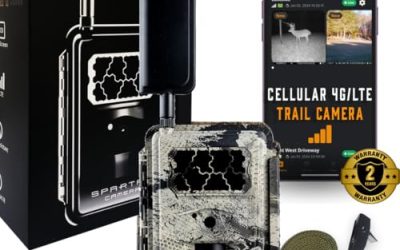
- Connectivity: 4G LTE, this listing is the AT&T version in Spartan Areus camo
- Live streaming: Up to 30 FPS, with on-demand image and video capture
- Battery: Internal rechargeable 5300mAh lithium battery, solar panel connects directly
- Field of view: 96-degree wide-angle lens
Gates, yards and lease roads where you want to look in live and have GPS working against theft.
Carrier versions are specific, so confirm this AT&T listing matches coverage at your post before ordering; the product information also lists 12 AA batteries in connection with external power options, so read the power section of the listing carefully.
Most rechargeable cellular cameras still work in stills and short clips; the GoLive2 adds a live stream you can open from the app, plus on-demand photo and video requests, which makes it the pick when a post needs checking rather than just recording. Its internal 5300mAh lithium battery is rechargeable and ready for a direct solar panel hookup, and the wide 96-degree lens covers a gate, crossing or equipment yard in one frame. Anti-theft GPS is the other headline: if the camera is taken, its position travels with it, which matters on accessible land.
GardePro X60 Pro Max Cellular Trail Camera
- Best for: Shaded trails and crossings where solar charging is unrealistic and built-in storage removes a chore.
- Battery: Built-in 8000mAh lithium rechargeable battery pack, pre-installed
- Memory: 32GB built-in memory
- Connectivity: Cellular SIM pre-installed, compatible with Verizon, AT&T and T-Mobile
- Live view: Live streaming with instant alerts through the app
Shaded trails and crossings where solar charging is unrealistic and built-in storage removes a chore.
There is no solar panel in the box, so runtime depends on the charge you start with and how often you use live view; the SP300 panel that extends it is a separate purchase.
The X60 Pro Max skips the solar panel and puts the money into the pack and the storage instead: an 8000mAh lithium rechargeable battery comes pre-installed, and 32GB of memory is built into the camera, so there is no card to buy, format or fill unnoticed. It streams a live view, sends instant alerts, and its pre-installed SIM works across Verizon, AT&T and T-Mobile on a shared data plan. For a shaded woodland set where a panel would earn little, charging the pack over the included Type-C cable before deployment is the more honest arrangement.
Which One Fits Your Situation
You run two stands and are tired of feeding them batteries
Take the Moultrie Edge Solar 2-Pack. Two cameras arrive with their panels and rechargeable packs already integrated, the multi-carrier connection removes SIM guesswork at each site, and built-in memory means neither camera can be silenced by a full card. Hang one on the feeder and one on the travel corridor, aim the panels at open sky, and the pair should need you for hunting rather than for maintenance.
Your best post is an hour away and gets full sun
Choose the SPYPOINT Flex-S-Dark. Its whole design assumes absence: a solar-fed internal battery rated in months, a no-glow flash that does not advertise the camera, and a free monthly photo allowance that covers a quiet post. It is the camera in this group most comfortable being ignored, provided the site gives the panel real daylight and you budget for the card and any plan upgrade a busy month demands.
The camera guards a gate, a yard or leased equipment
Pick the Spartan GoLive2. Live streaming and on-demand requests turn it from a recorder into something closer to a lookout, and anti-theft GPS answers the obvious risk of an expensive camera on an accessible post. Order the carrier version that matches the signal at that gate, charge the internal pack fully before mounting, and add a solar panel if the mount catches decent sun.
Your set sits under canopy where panels barely charge
Go with the GardePro X60 Pro Max. Under trees, a big sealed pack charged at home beats a small one waiting on weak light, and the built-in memory means a long deployment cannot end with a full card. Use live view sparingly, since streaming is the fastest drain on the pack, and consider the add-on solar panel only if a nearby clearing gives it an honest shot at the sky.
Common Mistakes
- Mounting a solar-fed camera in deep shade and blaming the battery when the panel never receives enough daylight to replace what the camera uses.
- Comparing headline battery life in months without checking how that figure assumes light traffic, mild weather and few video uploads.
- Ordering a carrier-specific camera, such as a single-network Spartan version, before confirming that network’s signal at the exact mounting tree.
- Forgetting that every cellular camera here needs its maker’s data plan, and that live view and on-demand requests consume both data and battery.
- Assuming built-in memory and a memory card behave the same, then discovering a card-based camera stopped recording weeks ago on a full card.
Frequently Asked Questions
Do rechargeable cellular trail cameras still need a data plan?
Yes. The rechargeable battery replaces AA cells, not the cellular service. Each camera transmits through its maker’s app and plan, and the plan is sold separately on top of the camera. One exception in this group is the SPYPOINT, whose listing includes a free plan covering 100 photos per month, which can be enough for a quiet post before any paid tier is needed.
Will a solar panel keep a trail camera running through winter?
It depends on the site more than the season. Short days, low sun and snow sitting on the panel all reduce charging, and cold reduces what the pack can deliver. A camera on an open field edge usually keeps up; one under canopy may not. Angling the panel toward the midday sun, clearing snow after storms and starting winter with a full charge make the difference.
Is a rechargeable pack better than lithium AA batteries?
For a camera you rarely visit, usually yes. A rechargeable pack, especially one fed by a solar panel, removes the swap trip and the recurring cost of cells, and the camera reports its charge in the app. Lithium AAs still suit card-only cameras and very cold posts. The weakness of a sealed pack is that when it finally wears out, replacement means the maker’s part rather than a shop shelf.
How often will I still need to visit a rechargeable cellular camera?
Far less often, but not never. Plan on occasional trips to clean the lens and sensor window, clear brush from the detection zone, check the mount after storms and confirm the panel is unobstructed. A camera that sends a daily check-in photo lets you spot a fading battery or a blocked view early, so most visits become quick confirmations instead of rescue missions.
FAQ
Do rechargeable cellular trail cameras still need a data plan?
Will a solar panel keep a trail camera running through winter?
Is a rechargeable pack better than lithium AA batteries?
How often will I still need to visit a rechargeable cellular camera?
More from Amazon
Programs that pair well with the guide above. Offers and eligibility are set by Amazon and may change.
Free shipping on eligible items, Prime Video and more. Eligible new members can start with a free trial.
Start a Prime free trialAudiobooks and podcasts to listen to on the go. Eligible new members can start with a free trial.
Try Audible freeAd-free music streaming. Eligible new subscribers can start with a free trial.
Try Music Unlimited freeA free business account with business pricing and bulk-buying tools for work, shop or home office.
Create a business accountAs an Amazon Associate we earn from qualifying purchases.