Key takeaways
- Required width: 10 feet of furniture + 2 feet of side margin = approximately 12 feet.
- Required depth: about 7 feet from the front of the sofa to the coffee table zone + 2 feet of front and rear allowance = approximately 9 feet.
- Best standard match: an 9 × 12-foot rug, rotated so the 12-foot side follows the seating group.
Best Large Area Rugs for Living Rooms
The best large area rugs for living rooms are usually low- to medium-pile rugs that extend beneath the front legs of every major seat, with a size chosen for the room rather than the coffee table alone.
Quick picks by living-room situation
| Living-room situation | Best size to start with | Recommended construction | Why it fits |
|---|---|---|---|
| Small room or apartment, about 10 × 12 feet | 5 × 8 or compact 6 × 9 feet | Low-pile polypropylene, wool blend, or washable synthetic | Defines the seating area without blocking walkways or making the room feel crowded |
| Medium living room, about 12 × 15 feet | 8 × 10 feet | Low- or medium-pile wool, nylon, polyester, or polypropylene | Usually allows the sofa and chairs to sit partly or fully on the rug |
| Large or open-plan room | 9 × 12 or 10 × 14 feet | Dense low-pile wool or durable synthetic | Creates a visual zone and keeps a large seating arrangement connected |
| Pets, children, or frequent entertaining | 6 × 9, 8 × 10, or larger as space permits | Low-pile, stain-resistant synthetic with a stable backing | More forgiving of spills, vacuuming, tracked-in dirt, and repeated traffic |
These are starting points, not fixed rules. Measure the furniture footprint and the clearance around it before buying. A rug that is technically large but leaves sofa legs floating just outside its edge can make the arrangement look accidental.
Our top picks


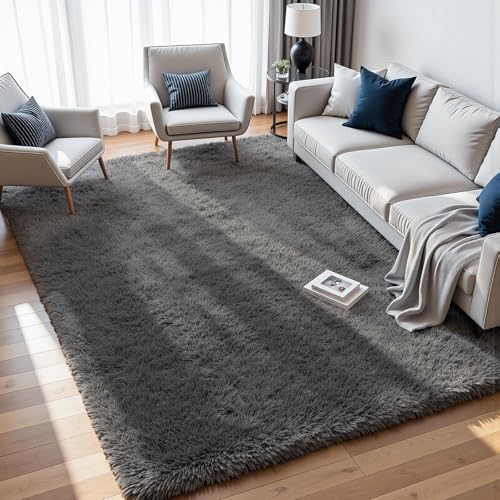

As an Amazon Associate we earn from qualifying purchases at no extra cost to you. Ratings are shown as listed on Amazon.
How to choose the right rug size
Small living rooms
In a small room, a 5 × 8-foot rug often works with the long side parallel to the sofa. Place the front legs of the sofa on the rug, or position the rug entirely in front of it if the room is too narrow. Leave approximately 12 to 24 inches of visible flooring around the rug where possible; forcing a 9 × 12-foot rug into a compact room can make doors, vents, and pathways difficult to use.
For a small apartment with a sofa, accent chair, and coffee table, a 6 × 9-foot rug may be the better compromise. It gives the coffee table a stable center while allowing at least the sofa’s front legs to overlap the rug.
Medium living rooms
An 8 × 10-foot rug is the most versatile size for a conventional seating group. The sofa should either sit fully on the rug or have both front legs on it. Chairs should also touch the rug rather than sit several inches away. This arrangement visually links the furniture and reduces the “floating island” effect.
Check the rug’s actual finished dimensions. A nominal 8 × 10-foot rug can vary by a few inches, and thick borders or irregular handwoven edges can reduce the usable central area.
Open-plan living rooms
In an open-plan space, the rug’s job is to define the living zone without becoming a trip hazard between the seating area, dining area, and kitchen. A 9 × 12-foot rug generally suits a larger sofa and two chairs; a 10 × 14-foot rug may be appropriate for a broad sectional and several occasional seats.
Keep the rug large enough that the seating arrangement appears intentional, but do not use one rug to cover unrelated zones. A separate rug under the dining table can clarify the boundary between living and dining areas.
Material, pile, and backing compared
| Material or construction | Typical pile | Strengths | Ownership trade-offs |
|---|---|---|---|
| Wool | Low to medium | Resilient, naturally springy, comfortable, and often repairable | Commonly costs about $300–$2,000+ at large sizes; may shed initially and needs prompt spot cleaning |
| Polypropylene | Low to medium | Affordable, colorfast, and generally resistant to many household stains | Can flatten or show wear sooner in heavy traffic; heat and strong solvents may damage fibers |
| Polyester | Low to medium | Soft feel, broad color range, and often lower cost | Oil-based stains can be difficult to remove, and plush surfaces may compress unevenly |
| Nylon | Low to medium | Good abrasion resistance and useful for busy households | May cost more than basic polypropylene and can develop visible traffic patterns |
| Flatweave | Usually under 0.25 inch | Easy to vacuum, good under doors and furniture, and practical for dining-adjacent areas | Offers less cushioning and can shift without a suitable pad |
| Shag or high pile | About 1 to 2 inches or more | Soft, warm, and visually substantial | Harder to vacuum, more likely to trap crumbs, and more prone to crushing under furniture |
For most living rooms, low pile means roughly 0.25 to 0.5 inch, while medium pile is approximately 0.5 to 0.75 inch. Low pile is the safer choice when a robot vacuum, wheeled furniture, mobility aid, or frequently opened door must cross the rug.
Backing and rug pads matter more than they appear
Backing determines how a rug behaves on the floor, but it should not replace a separate rug pad. Latex- or rubber-backed rugs can grip well, yet some backing materials may discolor or stick to delicate flooring over time. Always follow the flooring manufacturer’s guidance, especially with finished wood, vinyl, or heated floors.
A quality pad should be slightly smaller than the rug—typically 1 to 2 inches shorter on every side—so it does not show. For a 8 × 10-foot rug, a pad around 7 feet 10 inches by 9 feet 10 inches is a practical target. Dense felt gives cushioning and insulation; rubber or latex adds grip. A felt-and-rubber combination is often the most balanced option for a living room.
Do not use a thick pad beneath a thick shag rug unless the furniture and doors can accommodate the extra height. The combined thickness can exceed 2 inches and create an abrupt edge at the room entrance.
Decision matrix: match the rug to the household
| Priority | Choose | Avoid or reconsider |
|---|---|---|
| Lowest initial cost | Low-pile polypropylene or polyester, usually about $80–$350 for large sizes | Hand-knotted wool and delicate viscose constructions |
| Long-term resilience | Dense wool, nylon, or tightly woven polypropylene | Loose loops in the main pet-scratching area |
| Frequent spills | Low-pile synthetic with a non-absorbent or stain-resistant treatment | High-pile fibers and absorbent decorative fibers marketed mainly for appearance |
| Maximum softness | Medium-pile wool or polyester, with a firm supportive pad | Flatweaves if comfort underfoot is the main goal |
| Easy vacuuming | Flatweave or low-pile rug with a firm edge | Shag, thick fringe, and loose loops |
| Rental or temporary home | Lightweight synthetic rug with a removable pad | Heavy rug systems that may be difficult to move through narrow stairs |
Stain resistance: what it can and cannot do
“Stain-resistant” usually means the fibers resist absorbing or holding a stain; it does not mean the rug is spill-proof. Milk, wine, muddy water, pet accidents, and oily food should be addressed quickly. Blot liquid with white cloths, lift solids with a spoon, and use only a cleaning product approved for that material. Rubbing can push the spill deeper or distort the pile.
Color and pattern also affect perceived cleanliness. A heathered, multitone, or subtly patterned rug can hide everyday dust better than a solid cream rug. That is a practical advantage, but it should not replace regular cleaning.
Worked sizing calculation
Suppose a seating area measures 11 feet wide by 13 feet deep, with a sofa 7 feet long and two chairs that extend the group to 10 feet wide. To keep the front legs of all seating on the rug while preserving a visual margin, allow about 12 inches beyond each side of the furniture:
- Required width: 10 feet of furniture + 2 feet of side margin = approximately 12 feet.
- Required depth: about 7 feet from the front of the sofa to the coffee table zone + 2 feet of front and rear allowance = approximately 9 feet.
- Best standard match: an 9 × 12-foot rug, rotated so the 12-foot side follows the seating group.
An 8 × 10-foot rug would still work if only the front legs sit on it, but it would leave less side-to-side connection between the chairs and sofa.
Durability and maintenance realities
- Vacuum high-traffic areas once or twice weekly, using a height setting suitable for the pile.
- Rotate the rug 180 degrees every three to six months to distribute fading and compression.
- Use furniture cups under heavy tables or sofas, but move furniture periodically so the pile can recover.
- Trim loose fibers with scissors; do not pull them, because pulling can unravel a woven structure.
- Expect some shedding from wool during the first weeks or months. Empty the vacuum more often rather than repeatedly using aggressive suction.
- Have large or delicate rugs professionally cleaned when the care label requires it. Saturating a rug at home can cause dye transfer, backing damage, or slow drying.
The parts most likely to show wear first are the entry edges, sofa pathways, and areas where chairs pivot. A rug pad reduces sliding and edge stress, while a low-pile, dense construction generally outlasts a loosely tufted high-pile design in these locations.
Final recommendation
For the broadest combination of comfort, maintenance, and layout flexibility, choose a low-pile 8 × 10-foot rug for a medium room, a 5 × 8 or 6 × 9-foot rug for a small room, and a 9 × 12-foot rug for most open-plan seating areas. Select wool when long service life and texture justify the price; choose polypropylene or nylon when stain resistance, budget, and easy cleaning matter more. In every case, confirm the furniture placement, measure door clearances, and pair the rug with a correctly sized nonslip pad.