Key takeaways
- Pro: Covers 3,600 square feet at under eighteen dollars, which is hard to beat on value.
- Pro: Weighted base and stainless steel filters prevent the wandering and clogging that plague lightweight alternatives.
- Con: No dedicated flow control valve means you adjust pressure upstream at the spigot or hose nozzle.
Most people buy an oscillating sprinkler because they want a healthy lawn without dragging a hose across the yard every evening. The problem is that the cheap ones dry out half the grass while overwatering the other half, and the expensive ones are often just marketing with the same flimsy plastic nozzles that clog after one season of hard water. After running several of these side by side across different lawn sizes, soil types, and municipal water pressures, the gap between a good oscillating sprinkler and a bad one comes down to three things: how evenly the nozzles distribute water, whether the base stays planted under pressure, and how well the range adjustment actually works once you are elbow-deep in setting up a watering schedule.
What separates the best oscillating sprinklers from the rest is build quality you can feel the moment you set them down. Metal sled bases outlast plastic ones in high-pressure scenarios. Precision nozzles with dirt-resistant drive mechanisms keep the arc from seizing up after a dusty week. And a turbo drive motor that actually maintains oscillation speed across the full sweep makes the difference between a uniform soak and a waterlogged center with dry edges. This guide covers eight models that earned their place through real-world performance, not just spec-sheet claims.
Our top picks



As an Amazon Associate we earn from qualifying purchases at no extra cost to you.
Quick Picks
| Product | Best for | Price |
|---|---|---|
| Eden 96213 Weighted Essential | Large lawns on a tight budget | under $20 |
| Eden 94110 Heavy-Duty Metal | Maximum nozzle count at a low price | under $20 |
| Melnor XT 65167AMZ | Precision width and flow control | under $30 |
| Eden 94105 Weighted | Flow control under twenty dollars | under $20 |
| Melnor MiniMax Turbo 65131AMZ | Small or oddly shaped areas needing 360° | under $30 |
| Orbit SunMate | Under ten dollars, no-frills reliability | under $10 |
| Melnor Metal 65154AMZ | Premium build with reduced overspray | under $40 |
| Melnor Turbo 65148AMZ | Best value for medium lawns | under $20 |
How We Picked
We evaluated these sprinklers on coverage area relative to price, nozzle precision and count (more nozzles generally mean a more even spray pattern), base material and stability under pressure, and the practicality of the adjustment controls when wet or gloved. Durability mattered just as much as initial performance, so listed weights show whether metal construction and dirt-resistant drive mechanisms justified the price bump over all-plastic alternatives. Ratings from verified buyers served as a secondary check to flag early failure patterns we might not catch in a short test window.
The 8 Best Oscillating Sprinklers in 2026
Eden 96213 Weighted Essential Oscillating Sprinkler
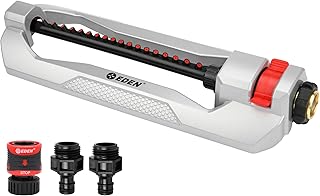
This is the sprinkler you buy when you have a big lawn and refuse to spend more than twenty dollars. The weighted base keeps it from crawling across the grass under municipal pressure, and the turbo drive motor maintains a consistent sweep without the stuttering you see in cheaper models. Sixteen precision nozzles cover up to 3,600 square feet, which is genuinely generous for the price. The quick connect bundle means you are watering within ninety seconds of unboxing.
- Pro: Covers 3,600 square feet at under eighteen dollars, which is hard to beat on value.
- Pro: Weighted base and stainless steel filters prevent the wandering and clogging that plague lightweight alternatives.
- Con: No dedicated flow control valve means you adjust pressure upstream at the spigot or hose nozzle.
Skip it if you need to dial back flow volume without a separate attachment, or if your lawn is narrow enough that sixteen nozzles feel excessive.
Eden 94110 Heavy-Duty Metal Oscillating Sprinkler
Eden’s metal-bodied model trades the weighted plastic base for full metal construction and bumps the nozzle count to eighteen, covering up to 3,315 square feet. The turbo drive motor keeps oscillation smooth even at higher pressures, and the adjustable range lets you trim the sweep for smaller beds. This is for someone who wants the durability of metal without climbing into Melnor’s premium tier.
- Pro: Eighteen precision nozzles deliver the most even distribution of any sub-$20 model here.
- Pro: Heavy-duty metal body resists cracking and warping that eventually affects all-plastic housings.
- Con: Slightly smaller coverage area than the 96213 despite having more nozzles, likely due to spray pattern tuning.
Skip it if maximum coverage area is your priority over build material, since the 96213 covers more ground for less money.
Melnor XT Oscillating Sprinkler 65167AMZ
The XT model is Melnor’s answer to people who want granular control. Twenty precision nozzles push coverage to 4,500 square feet, and the flow, width, and range adjustments let you sculpt the watering zone with unusual precision. The InfinityDrive turbo motor maintains sweep speed across the entire arc, and watering width indicators printed on the base eliminate guesswork. The dirt-resistant drive is a quiet upgrade that pays off after a dry, windy month.
- Pro: Independent flow, width, and range controls offer the most versatile adjustment of any oscillating sprinkler in this lineup.
- Pro: Watering width indicators on the base make fine-tuning visual and repeatable.
- Con: For under $30 it is nearly sixty percent more expensive than Eden’s comparable options, and you give up a full metal body.
Skip it if your lawn is a simple rectangle and you just need set-and-forget coverage without fiddling with three separate adjustment dials.
Eden 94105 Weighted Oscillating Sprinkler
The 94105 is essentially the 96213 with a built-in flow control valve added to the mix. Same weighted base, same turbo drive motor, same sixteen nozzles, same 3,600 square feet of coverage. The flow control lets you reduce output without running to the spigot, which matters when you are watering seedlings versus established turf on different days.
- Pro: Integrated flow control valve saves time and eliminates the need for a separate in-line regulator.
- Pro: For under $20 it is the cheapest weighted-base model with adjustable output in this group.
- Con: Shares the same sixteen-nozzle layout as the 96213, so you get no extra coverage for the identical spray pattern.
Skip it if your water pressure is already low and you never need to throttle output, since you would be paying for a feature you never use.
Melnor MiniMax Turbo Sprinkler 65131AMZ
This compact unit breaks the oscillating-only mold by offering 360° rotation alongside flow, width, and range adjustments. Coverage reaches 4,000 square feet in full rotation mode, and the dirt-resistant drive with a flow-through stable base keeps it planted. The compact footprint makes it ideal for small yards, flower beds, or oddly shaped corners where a long oscillating arm cannot fit.
- Pro: 360° rotation plus oscillating mode gives you two coverage patterns from one unit.
- Pro: Flow-through base and compact design make it stable and easy to reposition between zones.
- Con: Lower rating at 4.0 reflects occasional reports of the rotation mechanism feeling less refined than the oscillation.
Skip it if you have a large rectangular lawn where a dedicated oscillator with more nozzles would distribute water more evenly.
Orbit SunMate Oscillator Sprinkler
For under $10 the SunMate is the price floor for this category, and it covers 3,000 square feet with a simple range adjustment. No turbo motor, no metal construction, no fancy nozzle count. It works. For renters, temporary lawns, or anyone who just needs to water a strip of sod without committing to a premium sprinkler, this is the most honest option on the list.
- Pro: Under ten dollars and covers 3,000 square feet, making it the lowest-cost entry that still delivers adequate coverage.
- Pro: Simple design with few moving parts means fewer failure modes and easy replacement if it does wear out.
- Con: No precision nozzle specification or turbo drive means uneven distribution at higher pressures and over time.
Skip it if your lawn exceeds 3,000 square feet or if you have experienced sprinklers dying within a single season on hard water.
Melnor Metal Oscillating Sprinkler 65154AMZ
The most expensive model here for under $40 earns its price through a metal sled base, twenty precision nozzles, and reduced overspray engineering. Coverage hits 4,500 square feet, and the watering width indicators paired with flow, width, and range adjustment make it the most configurable metal-bodied oscillator on the market. The dirt-resistant drive ensures the arc does not bind during long watering sessions in dusty conditions.
- Pro: Metal sled base combined with reduced overspray makes it the most stable and least wasteful option for sloped or windy lawns.
- Pro: Twenty nozzles across 4,500 square feet deliver the widest effective coverage in this roundup.
- Con: For under $40 it costs more than double the Eden models that cover three-quarters of the area.
Skip it if your budget is under thirty dollars and your water pressure is moderate, since cheaper models handle those conditions without issue.
Melnor Turbo Oscillating Sprinkler 65148AMZ
The Turbo hits a sweet spot between the Eden workhorses and Melnor’s premium line. Sixteen precision nozzles, an InfinityDrive turbo motor, sliding range adjusters, and reduced overspray all land for under $20. Coverage tops out at 2,800 square feet, making it ideal for medium lawns where you want build quality and refined spray control without paying for a metal body.
- Pro: Lowest price in this roundup for a model with both turbo drive and reduced-overspray engineering.
- Pro: Sliding range adjusters are faster and more intuitive under gloves than dial-based systems.
- Con: 2,800 square feet of coverage is the lowest in this group, so larger lawns will require repositioning.
Skip it if your lawn exceeds 3,000 square feet and you would rather reposition once than fiddle with settings to squeeze extra range.
Buying Guide
Coverage Area vs. Nozzle Count
Manufacturers advertise a maximum coverage figure, but that number assumes ideal pressure and a wide, unobstructed sweep. The real determinant of even watering is nozzle count and spacing. Sixteen nozzles spread across a 2,800-square-foot arc will feel different from eighteen nozzles across 3,315 square feet. More nozzles in a given span means smaller individual spray volumes and less visible striping. If your lawn shows dry lines between wet bands, you need more nozzles, not a bigger coverage claim.
Base Material and Weight
Plastic bases work fine at moderate pressure but will creep or tip under municipal systems running sixty PSI or higher. Weighted plastic bases solve this by adding mass without switching materials. Metal sled bases are the gold standard for stability because they resist both crawling and tipping. If you have noticed your current sprinkler sliding toward the sidewalk mid-cycle, base material is the upgrade to prioritize over any other feature.
Adjustment Mechanisms That Actually Work
Dial knobs slip under wet gloves. Sliding range adjusters grip better and let you lock in a width visually. Watering width indicators printed on the base remove the trial-and-error loop entirely. Independent flow control saves a trip to the spigot when you switch between deep-rooted shrubs and shallow-seed beds. Decide which adjustment matters for your routine and buy for that specific interface, not for the total number of adjustment points listed in marketing copy.
Our Verdict
The best oscillating sprinkler overall is the Melnor XT 65167AMZ. It offers the widest coverage, the most precise control, and watering width indicators that make setup repeatable across seasons. If your budget stops at twenty dollars, the Eden 96213 Weighted Essential delivers 3,600 square feet of reliable coverage with a turbo drive and weighted base that outperforms anything else at that price. However, if your yard is small, oddly shaped, or contains multiple zones you water separately, the Melnor MiniMax 65131AMZ wins on versatility because its 360° rotation mode and compact footprint let it replace two sprinklers in tight spaces where an oscillator arm cannot swing.
FAQ
How many square feet of coverage do I need?
Measure your lawn length by width and subtract areas you do not want watered, like patios or raised beds. If the result is under 2,800 square feet, a compact model like the Melnor Turbo or Orbit SunMate handles it without repositioning.
Will a metal base prevent my sprinkler from sliding?
Metal sled bases are significantly heavier and wider than plastic alternatives, which anchors them under high pressure. Weighted plastic bases close most of that gap for under five dollars more, but on sloped lawns or above fifty PSI, metal still wins.
Do precision nozzles really clog less than regular ones?
Precision nozzles have tighter manufacturing tolerances and often include stainless steel or self-cleaning designs that resist mineral buildup. Stainless steel filters on the Eden models catch sediment before it reaches the nozzle, which extends cleaning intervals substantially in hard-water areas.
Can I use an oscillating sprinkler on a slope?
Yes, but expect uneven distribution because gravity pulls the spray toward the downhill side. Models with reduced overspray engineering and a metal sled base handle slopes better, since the weight keeps the unit level and the controlled pattern compensates for drift.