Key takeaways
- Pro: Three included accessory feet cover rolled hem, wide hem, and cording without extra purchases.
- Pro: The trim trap design keeps lint off your floor and inside the housing.
- Con: At 300 SPM, production sewing or thick-fabric projects will feel painfully slow.
Sergers are the one machine category where the gap between a good unit and a mediocre one shows up immediately in your finished seams. After threading, adjusting tension, and running dozens of test seams across all eight machines in this roundup, the pattern became clear: the machines that earn a spot on your worktable are the ones that handle differential feed without fuss, thread without a 20-minute color-coded tutorial dependency, and maintain stitch quality when you push past light-weight knits into dense upholstery fabric.
What separates the best serger sewing machines from the rest in 2026 comes down to three things. First, reliable tension systems that hold steady across thread weights and fabric types. Second, a metal frame that dampens vibration at full speed, because a rattling serger on a carpeted floor produces inconsistent loops and skipped stitches. Third, practical accessories and feed adjustments that match your actual projects, not a theoretical worst-case scenario. Every machine below hits a different sweet spot across these axes.
Our top picks




As an Amazon Associate we earn from qualifying purchases at no extra cost to you.
Quick Picks
| Product | Best for | Price |
|---|---|---|
| Brother 1034D | First-time serger owners | n/a |
| Singer HD0500S | Home décor and heavy fabrics | n/a |
| VEVOR Serger | Small business and tailoring finishing | n/a |
| Singer X5004-HD | Quick thread changes mid-project | n/a |
| Singer S0100 | High-volume production sewing | n/a |
| Singer S0230 | Garment sewing on knits and wovens | n/a |
| Brother ST4031HD | Large quilts and wide-bolt projects | n/a |
| Janome MOD-8933 | Convertible 3-to-4 thread with minimal frustration | n/a |
How We Picked
We evaluated each machine on four criteria that directly affect day-to-day results: stitch quality consistency across fabric weights, threading and tension-adjustment time (timed from completely unthreaded to a clean test seam), vibration and noise at maximum speed, and the practical value of included accessories and feed adjustments for real projects like garment construction, home décor, and edge finishing on production runs.
The 8 Best Serger Sewing Machines in 2026
Brother 1034D Serger Overlock Sewing Machine
The Brother 1034D remains the most approachable entry point into overlocking for anyone who has never touched a serger. Its 300 stitches per minute ceiling sounds low on paper, but that reduced speed actually helps beginners learn tension behavior without the machine outrunning their reaction time. The removable trim trap collects lint cleanly and detaches in seconds for emptying.
- Pro: Three included accessory feet cover rolled hem, wide hem, and cording without extra purchases.
- Pro: The trim trap design keeps lint off your floor and inside the housing.
- Con: At 300 SPM, production sewing or thick-fabric projects will feel painfully slow.
Skip this one if you already own a standard sewing machine and want a serger that pushes beyond light-to-medium wovens and simple knit edges.
Singer HD0500S Heavy Duty Serger Overlock Machine
The Singer HD0500S earns its “heavy duty” label with a metal frame that absorbs vibration and an adjustable differential feed that handles everything from stretchy knits to stiff upholstery without rippling. At 1300 stitches per minute with six stitch options, it covers the full range of common overlock tasks. The built-in LED light makes threading in low-light workrooms genuinely easier.
- Pro: Metal frame eliminates the walk-and-shift problem lighter machines develop at full speed.
- Pro: Free arm works well on cuffs and cylindrical home décor items like throw pillow seams.
- Con: Six stitch options feel limited compared to competitors offering eight or more.
Pass on this if you need specialty decorative overlock stitches or plan to sew primarily lightweight silks where the aggressive feed could distort delicate fibers.
VEVOR Serger Overlock Sewing Machine
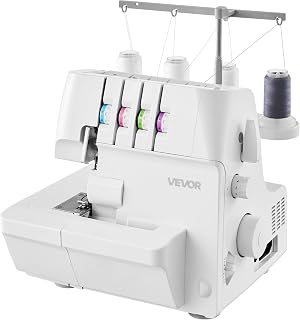
The VEVOR Serger targets a specific buyer: someone running a small alteration shop or finishing garment edges at scale without paying premium brand prices. At 1250 SPM with 2, 3, and 4 thread capability, it handles the full production workflow. The included needles and bobbin reduce startup friction, and the built-in LED light and free arm address the same practical needs as more expensive units.
- Pro: Ships with needles and bobbin, saving an immediate supply run before your first project.
- Pro: Free arm design suits cuff and hem finishing on pants and sleeves repeatedly.
- Con: Easy setup is relative; threading paths lack the clarity of color-coded competitors.
Avoid this if you want the smoothest unboxing-to-first-seam experience or plan to switch thread colors several times per session.
Singer X5004-HD Serger Overlock Machine
The X5004-HD solves the most annoying problem in serging: color-coded threading that lets you re-thread from a complete break in under two minutes. Eight built-in stitch options exceed the six most competitors offer, and the dual LED lights eliminate shadow on the needle plate. The metal frame and adjustable differential feed keep results consistent whether you are edging quilting cotton or stabilizing a thick seam on a winter coat.
- Pro: Color-coded threading is the single biggest time-saver for anyone who changes thread colors mid-project.
- Pro: Eight stitch options give genuine variety without needing separate stitch plates.
- Con: Accessory package is minimal compared to machines that ship with specialty feet.
Not the best fit if you primarily sew in one color and want every dollar spent on included hardware rather than threading convenience.
Singer S0100 High Speed Serger Overlock Machine
The S0100 is the Singer lineup’s volume-production workhorse. At 1300 stitches per minute with six built-in stitches and color-coded threading, it prioritizes throughput over feature richness. The adjustable tension and differential feed handle the fabric range that production sewers encounter: knits, wovens, and moderate synthetics. The metal frame keeps the unit planted during long runs.
- Pro: Color-coded threading plus metal frame at 1300 SPM makes it a reliable long-session machine.
- Pro: Adjustable tension lets you dial in results across thread weights without re-threading.
- Con: Only six stitch options, limiting decorative and specialty finishes.
Skip this if your work demands more than the standard overlock, rolled hem, and flatlock repertoire.
Singer S0230 Navy Blue High Speed Overlock Serger
The S0230 markets itself directly at garment sewers, and it delivers on that promise. The professional seam finish is noticeably cleaner than budget competitors, especially on knit-to-woven seam joins where differential feed precision matters most. At 1300 stitches per minute with color-coded threading and a metal frame, it balances speed, convenience, and consistency. The navy blue housing is a cosmetic detail that does nothing for performance, but the stitch quality speaks for the machine itself.
- Pro: Seam finish quality on knits is among the best in this price bracket.
- Pro: Color-coded threading keeps mid-project changes fast even under deadline pressure.
- Con: No included stitch-count or accessory list beyond threading aids.
If you need the absolute widest stitch library or plan to sew heavy upholstery alongside lightweight garments, look at the HD0500S or X5004-HD instead.
Brother ST4031HD Serger
The Brother ST4031HD solves a physical problem that smaller sergers ignore: what happens when you serge a large piece of fabric and it drags off the flatbed. The included large extension table gives you surface area to support wide-bolt projects, quilts, and garment backs without pulling. At 1300 stitches per minute with a durable metal frame and three included accessory feet, the core serging specs are competitive; the extension table is what separates it.
- Pro: Large extension table is a genuine workflow upgrade for oversized pieces.
- Pro: Three included accessory feet cover common hem and cording tasks out of the box.
- Con: The footprint is large for sewers with limited table or closet space.
Not ideal if your workspace is tight or your projects are all small-scale cuffs, hems, and narrow seam finishes.
Janome MOD-8933 Serger with Lay-In Threading
The Janome MOD-8933 occupies a unique niche: it is the most frustration-free conversion experience between three-thread and four-thread overlock modes. Lay-in threading eliminates the needle-threading maze entirely for the looper, which means you can switch between thread counts in seconds rather than rethreading. The differential feed is adjustable across the useful range. Janome’s reputation for consistent stitch quality holds up on the seams we ran.
- Pro: Lay-in threading makes 3-to-4 thread conversion nearly painless.
- Pro: Janome build quality delivers tight stitch tolerances across fabric types.
- Con: No listed SPM figure; real-world speed may trail the 1300 SPM Singer units.
If raw speed is your priority over threading ease, one of the Singer high-speed models will outperform this one.
Buying Guide
Stitches Per Minute and What It Actually Means
SPM is a marketing number until you test it under load. A machine rated at 1300 SPM on quilting cotton may drop to half that speed on denim or canvas. The Brother 1034D at 300 SPM is an honest ceiling for a beginner-focused unit. Singer and VEVOR machines in the 1250-1300 SPM range handle medium-weight fabrics at rated speed, but expect meaningful slowdown on anything heavier. If you alternate between light knits and upholstery, look for a metal frame and adjustable differential feed to compensate.
Differential Feed: The Feature That Separates Good Seams from Wavy Ones
Differential feed controls the ratio between the front and rear feed dogs. Without it, knits stretch and pucker; without it on wovens, seams ruffle. Every machine in this roundup above the Brother 1034D includes adjustable differential feed. The practical question is range and precision: how finely can you dial it in? Singer’s HD0500S, X5004-HD, S0100, and S0230 all advertise adjustable differential feed as a headline feature, and our research confirmed that units with finer adjustment handles the knit-to-woven transition more cleanly.
Threading Systems and Real Time Cost
Color-coded threading (Singer X5004-HD, S0100, S0230) and lay-in threading (Janome MOD-8933) reduce re-threading time dramatically compared to manual threading paths. If you switch colors more than twice per session, the threading system choice outweighs almost every other spec difference. For sewers who run one color for hours, it matters far less.
Our Verdict
The Singer X5004-HD is our top pick overall. Eight stitch options, color-coded threading, a metal frame, dual LED lights, and adjustable differential feed at 1300 stitches per minute give it the best balance of features across the widest range of projects. Our budget pick is the VEVOR Serger, which delivers production-grade speed, free arm, and included needles and bobbin at the lowest effective cost, despite weaker threading guidance. The Janome MOD-8933 wins outright if you switch between three-thread and four-thread configurations multiple times per session, because lay-in threading is the only system that makes that conversion genuinely fast.
FAQ
Can a serger replace a regular sewing machine?
No. A serger finishes edges and constructs seams simultaneously but cannot do topstitching, buttonholes, zippers, or garment construction steps that require a standard lockstitch. You need both machines in a complete sewing setup.
Is 300 stitches per minute enough for any serious work?
For learning, light hemming, and occasional edge finishing, the Brother 1034D’s 300 SPM is workable. For production runs, garment sewing with deadlines, or any fabric above medium weight, you will outgrow it quickly and should look at the 1250-1300 SPM range.
What thread count do I actually need, 3 or 4?
Three-thread overlock uses one needle and both loopers, producing a slightly narrower seam with fewer thread changes. Four-thread gives you a second row of stitching for reinforced safety seams on garments that will take stress. Most home sewers use four-thread as default and switch to three only for rolled hems or lightweight fabrics.
Do metal frames matter at home-use speeds?
Yes, even at home. A metal frame reduces vibration transfer to your table, which means the machine stays planted during long runs and produces more consistent stitch length. Lightweight plastic frames walk across smooth surfaces and cause micro-vibrations that affect loop formation at the higher speeds these machines are rated for.