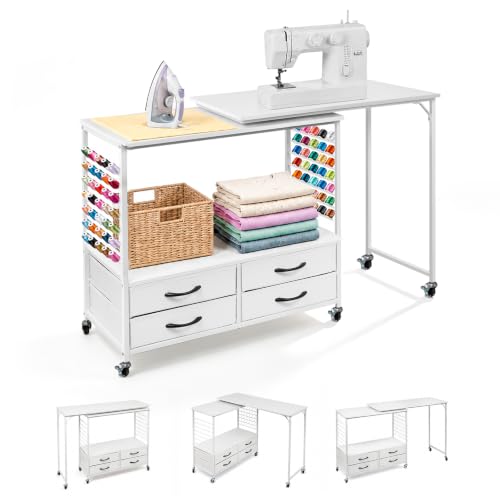
For most home sewers, a fold-away sewing cabinet such as those from Arrow gives the best balance of workspace and storage, a basic fold-down or drop-leaf craft table suits small rooms and occasional projects, and an acrylic extension table that fits your specific machine is the cheapest way to improve quilting and large-project support. The right answer depends on your room, your machine type, and how often you leave the table set up.
Our top picks


As an Amazon Associate we earn from qualifying purchases at no extra cost to you.
Three Kinds of Sewing Table
People searching for sewing tables are really choosing between three products. A sewing cabinet is a piece of furniture with a lift or drop-in platform for the machine and storage underneath. A craft or cutting table is a large work surface for fabric cutting and layout, often height-adjustable. An extension table is a clear acrylic or hard plastic surface that bolts or clips onto the machine’s free arm and extends the flat bed. Many sewers end up with one of the first two plus an extension table.
Best Sewing Tables at a Glance
| Option | Type | Best for | Limits |
|---|---|---|---|
| Arrow sewing cabinets (such as the Gidget and Sylvia lines) | Fold-out cabinet with machine platform and storage | Small homes, dedicated sewists, quilters | Heavy to move; some models fit certain machine sizes only; compare the opening dimensions to your machine |
| Studio Designs Sew Ready line | Table or cabinet with drop-in platform | Budget to mid-range hobbyists | Engineered wood; limited weight capacity |
| Brother and Janome acrylic extension tables | Machine-specific extension | Quilting and large projects on an existing machine | Each fits specific machine models only |
| Foldable cutting tables with adjustable legs | Craft and cutting table | Pattern cutting and layout | Not designed to hold a machine’s weight at the bed edge |
| Basic folding sewing table | Drop-leaf utility table | Small spaces and occasional sewing | Smaller work surface and less stable at high speed |
Product lines change frequently. Confirm the current model name, dimensions, and listed weight capacity on the maker’s page before deciding.
Match the Table to Your Machine
Standard domestic machines
Most home machines from brands such as Brother, Janome, Singer, Bernina and Juki are light enough for any sturdy sewing table. Check the machine’s weight against the table’s stated capacity, and note that a table which suits a lightweight machine may flex under a heavier model.
Machines with a flatbed or drop-in design
Cabinets with a drop-in or lift platform require the machine to be dropped into a cutout, with the bed level with the table surface. Look at the cutout size the maker lists and compare it to the machine’s footprint. Some makers publish a list of compatible machines, which saves guesswork. Machines with a free arm rely on an extension table to give a flat bed.
Longarm and quilting machines
These use dedicated frames and are outside this guide. Seek the maker of the machine for a compatible table.
What to Look For
- Surface size: wide enough for the fabric you usually sew. Quilters generally want a larger surface or an extension to support bulky quilts.
- Stability: a table that wobbles at speed causes uneven stitching. Look for locking casters, cross-bracing, or a solid base.
- Height: sewing tables are generally set slightly lower than regular desks so your forearms stay relaxed. Adjustable-height models suit different chairs and users.
- Storage: drawers and shelves for thread, rulers, and bobbins keep supplies at hand. Fold-away cabinets hide the work in a living room.
- Lighting and power: a cabinet with a place to run the foot pedal cord and a power strip reduces tangles and trip risk.
- Assembly: many tables ship flat-packed and need a screwdriver and some time. Follow the instructions and tighten fittings periodically.
Ergonomics and Safety
Sit with your elbows at roughly a right angle and your feet flat or on the pedal comfortably. If you have back, neck or wrist pain while sewing, consider seeing a clinician or physiotherapist rather than relying on furniture alone. Keep cords away from walkways, and unplug the machine before changing needles or clearing jams. Do not use a table beyond the weight capacity the maker lists, and keep children and pets away from folding mechanisms and moving casters.
Budget Tiers in Plain Terms
Budget: basic folding sewing tables and engineered-wood desks with limited storage. Mid-range: Studio Designs-style tables and acrylic extension tables for existing machines. Premium: solid-wood or high-quality laminate cabinets such as those from Arrow, which offer sturdier construction, better storage, and a fold-away design. If you sew weekly, the sturdiness of a cabinet is usually worth more than extra drawers.
Pick X If You Want…
| If you want… | Pick | Why |
|---|---|---|
| A sewing space that folds away in a living room | An Arrow sewing cabinet | Closes into a piece of furniture |
| The lowest cost | A basic folding table or drop-in desk | Entry price with fewer features |
| Better quilting support on your machine | A machine-specific acrylic extension table | Extends the flat bed without new furniture |
| A fabric cutting and layout surface | A height-adjustable craft table | Large surface, comfortable standing height |
| Maximum stability for heavier machines | A solid cabinet with a drop-in platform | The machine sits level and secure |
| Small apartment storage | A drop-leaf or fold-down table | Takes little room when closed |
Setting Up Your Sewing Space
A good table is only part of a comfortable sewing setup. Light matters as much: a daylight-style task lamp positioned to the side of the needle reduces eye strain and shadows. Many sewers also keep the iron and pressing surface within arm’s reach of the machine, because pressing seams is as frequent as stitching them. A compact ironing board next to the table, or a wool pressing mat on a cutting table, saves steps and keeps the project flat.
Think about the floor, too. A hard floor lets a chair roll easily but can let the pedal slide, while a rug can catch the chair wheels. A non-slip pedal mat solves the first problem, and a hard chair mat solves the second. Keep the machine’s manual nearby for threading diagrams and troubleshooting. If you share the room with other people, a fold-away cabinet or a table on locking casters lets you pack away pins and rotary cutters out of reach of children and pets.
Finally, plan the storage. Thread, bobbins, feet and scissors are best kept in shallow drawers or clear boxes so you can see them at a glance. If the table has no drawers, a rolling cart beside it fills the gap. Lock the cart’s wheels while you sew, so it does not drift away as you reach for supplies.
Alternatives
A standard desk with a sewing riser
A normal desk can work if you add a sewing machine insert or a riser, and a separate cutting mat on a counter. It is an inexpensive route if you do not need dedicated storage.
A kitchen island or dining table
Many sewers use a dining table with a cutting mat. It works, but the height may be too tall for comfortable sewing, and you will need to pack up each session.
A portable sewing case or rolling tote
If you sew at classes or sewing circles, a rolling case holds the machine and supplies and avoids a permanent table. Pair it with an extension table for added support.
Frequently Asked Questions
What height should a sewing table be?
Sewing tables are commonly set a little lower than a standard desk, but there is no single correct height. Choose the height that lets your forearms rest level while you sew, and use an adjustable chair or footrest to fine-tune it.
Will my machine fit in a sewing cabinet?
Only if the cutout and lift mechanism match the machine’s size and weight. Makers like Arrow publish cutout sizes and compatible-machine information, so compare them to your machine’s manual before buying.
Do I need an extension table?
It is not necessary, but quilters and people sewing large projects often find an extension helps by supporting fabric weight and keeping the bed flat. Extension tables are generally machine-specific, so look for your machine’s model number.
Can I use a regular table for sewing?
Yes, but the height and stability may not suit extended sewing. If the table wobbles or the machine vibrates it across the surface, a purpose-built table will improve comfort and stitch quality.
Are fold-away cabinets stable enough?
Quality cabinets are designed to be stable once opened and locked, but cheap ones can flex. Look at the maker’s stated weight capacity and read reviewer reports about wobble before buying.
How do I keep my sewing area safe?
Keep the pedal cord clear of walkways, avoid overloading power strips, and unplug the machine for needle changes. Store scissors, rotary cutters and pins out of reach of children and pets.
FAQ
What height should a sewing table be?
Will my machine fit in a sewing cabinet?
Do I need an extension table?
Can I use a regular table for sewing?
Are fold-away cabinets stable enough?
How do I keep my sewing area safe?
More from Amazon
Programs that pair well with the guide above. Offers and eligibility are set by Amazon and may change.
Free shipping on eligible items, Prime Video and more. Eligible new members can start with a free trial.
Start a Prime free trialAudiobooks and podcasts to listen to on the go. Eligible new members can start with a free trial.
Try Audible freeAd-free music streaming. Eligible new subscribers can start with a free trial.
Try Music Unlimited freeA free business account with business pricing and bulk-buying tools for work, shop or home office.
Create a business accountAs an Amazon Associate we earn from qualifying purchases.