Key takeaways
- Borosilicate glass body lets you monitor boiling and water level visually
- Removable lid simplifies deep cleaning and descaling
- Glass construction requires more careful handling than stainless alternatives
Walk into any kitchen appliance aisle or scroll through listings for electric kettles for boiling water and you will notice they look nearly identical. Yet the experience of using them day after day differs enormously. Some kettles sit on your counter for five years without a complaint; others develop a faint plastic aftertaste within a month or crack at the base of the handle. The difference almost always comes down to material choices, how the heating element is mounted, and whether the design accounts for real-world cleaning.
What separates a worthwhile pick from a frustrating one is surprisingly easy to pin down: water should never touch plastic in its travel path from reservoir to spout, the base should seal tightly enough to avoid steam leaks without trapping moisture inside the housing, and the lid needs to come off completely so you can scrub scale buildup. Price in this category ranges widely, but expensive does not mean better. The eight models compared here span from fifteen to thirty dollars, and several of the cheapest ones outperform pricier options on the features that actually matter.
Our top picks





As an Amazon Associate we earn from qualifying purchases at no extra cost to you.
Quick Picks
| Product | Best For | Price |
|---|---|---|
| Chefman Glass Kettle | Visible water level, glass build on a budget | under $30 |
| Cosori No-Plastic (Black) | Plastic-free water path in a mid-range body | under $30 |
| COMFEE’ Stainless Kettle | LED indicator, fast 1500W boil | under $30 |
| OVENTE White KP72W | Lowest-cost reliable daily boiler | under $20 |
| Hamilton Beach 1L Kettle | Small households, limited counter space | under $30 |
| OVENTE Black KP72B | Same value in a darker finish | under $20 |
| Amazon Basics Glass Kettle | Simple glass carafe, name-brand assurance | under $30 |
| Cosori No-Plastic (White) | Premium finish, same sealed interior | under $30 |
How We Picked
Four criteria drove the selection. First, capacity and wattage together determine how quickly a kettle reaches a rolling boil and how many cups it can handle before you refill. Second, material contact between water and plastic is the single biggest quality-of-life variable—owner reviews consistently flag off-flavors from kettles where the internal spout path uses plastic. Third, cleaning access matters over months of use, so removable lids and wide openings score higher than sealed designs. Fourth, price-to-feature ratio: we noted which models offer auto shut-off, boil-dry protection, and indicator lights without pushing past the twenty-five-dollar line.
The 8 Best Electric Kettles For Boiling Water in 2026
Chefman Glass Kettle
The Chefman 1.8L borosilicate glass kettle is the best choice if you want to see water level and boil activity at a glance. At 1500W it matches the fastest contenders here, and the removable lid makes descaling straightforward. Owner feedback highlights the clean-pouring spout and the fact that the glass body resists staining. The stainless steel internal filter catches mineral flakes, and BPA-free construction covers every plastic component that touches steam or water. One consideration: glass demands a gentler hand, and the base housing is still plastic. Skip this if your household includes children who might bump it off the counter.
- Borosilicate glass body lets you monitor boiling and water level visually
- Removable lid simplifies deep cleaning and descaling
- Glass construction requires more careful handling than stainless alternatives
Cosori No-Plastic (Black)
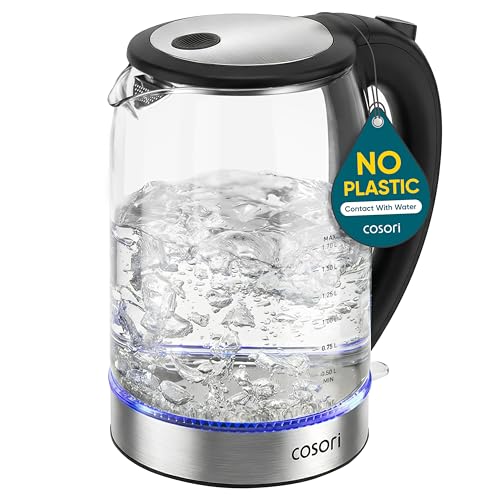
For anyone who has been bothered by a plasticky taste in freshly boiled water, the Cosori 1.7L addresses the root cause directly: no plastic touches the water from reservoir to spout. The stainless interior is smooth and easy to wipe. In the black finish it looks modern on a countertop. Owner reviews praise the quiet heating and the solid lid hinge. The trade-off is that Cosori does not publish a wattage rating for this model, and it sits near the upper end of the budget range without LED indicators or a visible water window. Skip it if you want the fastest possible boil or a transparent body.
- Water never contacts plastic anywhere in its path
- Smooth stainless interior resists staining and odor retention
- No published wattage rating makes speed comparison difficult
COMFEE’ Stainless Kettle
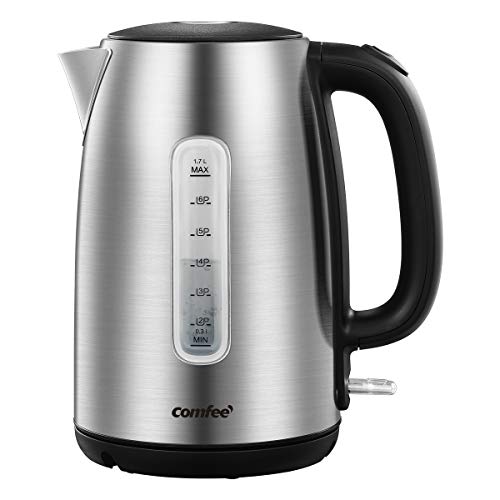
The COMFEE’ 1.7L is the feature-forward option for under twenty-five dollars. It pairs 1500W power with a cool-touch stainless steel exterior and an LED light that confirms the element is running—useful in dim kitchens. Auto shut-off and boil-dry protection handle the safety concerns that cheap kettles often ignore. Owners mention the comfortable handle angle and the fact that the lid opens wide. The main criticism centers on the plastic water window, which can yellow over extended use. Skip this if you are sensitive to any plastic component touching steam, or if you prefer a fully glass carafe.
- LED indicator provides clear visual confirmation during boiling
- 1500W element and 1.7L capacity deliver a fast, full pot of water
- Plastic water-level window may discolor with prolonged use
OVENTE White KP72W
At fifteen dollars ninety-nine, the OVENTE white KP72W is the cheapest sensible kettle in this group. The 1100W element means a full 1.7L reservoir takes noticeably longer than the 1500W rivals, but for single-cup use the difference shrinks to a matter of seconds. BPA-free plastic construction keeps costs low, and the cordless base with auto shut-off covers the essential safety features. Owners describe it as a no-nonsense workhorse that does exactly what you expect. Skip it if boil speed matters or if you want water kept away from all plastic surfaces.
- Lowest price in the comparison with cordless base and auto shut-off
- Compact footprint suits small counters or dorm rooms
- 1100W element is slower to reach a full boil than 1500W models
Hamilton Beach 1L Kettle
Hamilton Beach’s one-liter model targets households that boil water for one or two cups at a time. The smaller capacity means the 1L reservoir heats faster than a 1.7L jug would, even at a comparable wattage. It is the shortest and narrowest option here, fitting on crowded counters without dominating the space. Owner reviews note the simple on-off switch and the lack of indicator lights as a positive for reliability—fewer parts to fail. The downside is capacity: if more than two people need hot water, you will refill and wait. Skip it if you routinely prepare tea for a family or need the extra water for cooking tasks like blanching.
- One-liter size heats quickly and fits tight countertop layouts
- Straightforward on-off design with fewer failure points
- Capacity is the smallest here, requiring refills for multiple servings
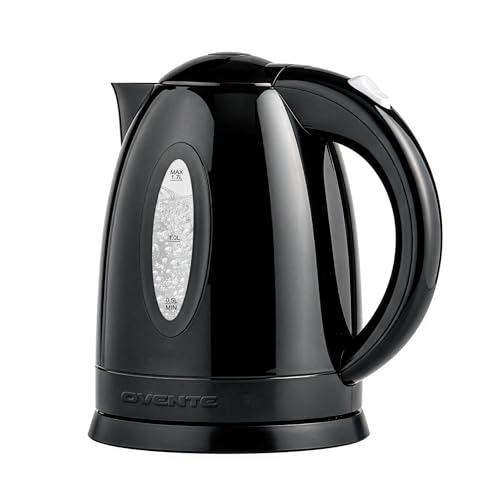
OVENTE Black KP72B
The black KP72B is functionally identical to the white OVENTE above—same 1.7L capacity, same 1100W element, same BPA-free construction, same auto shut-off—just in a darker finish that hides minor water spots and heat discoloration better over time. Owners who chose the black variant specifically mention that it blends more easily with modern kitchen appliances and does not show tea stains as readily. If color matters for your kitchen aesthetic and you want the lowest price with a clean look, this is the pick. Skip it only if you prefer a transparent or stainless body for visibility into the water level.
- Same value as the white model with a finish that resists visible staining
- Cordless base and auto shut-off included at the lowest price tier
- Still lacks a water-level window or any indicator light
Amazon Basics Glass Kettle
Amazon Basics offers a glass carafe kettle that mirrors the Chefman in concept—transparent body, 1.7L capacity, 1500W element, auto shut-off, and boil-dry protection—at the same twenty-three-dollar-fifty-two price point. The water level indicator strip on the side is easy to read, and the black-and-silver color scheme looks understated. Owners describe the boiling as quick and the pour as drip-free. The chief complaint in reviews is that the lid gasket can loosen slightly over months, letting steam escape from the top during the final seconds of boiling. Skip it if you find gasket maintenance frustrating or want a sealed stainless interior instead.
- Transparent glass body with side water-level indicator for easy monitoring
- 1500W element matches the fastest-boiling models in this group
- Lid gasket may lose its seal over extended use
Cosori No-Plastic (White)
The white Cosori 1.7L is the premium finish of the no-plastic-contact line, priced at twenty-nine dollars ninety-nine. It offers the same sealed stainless interior as the black model, which means water never passes through a plastic spout or touches any polymer in the heating chamber. The white housing gives a cleaner, more contemporary appearance that some owners say matches their kitchen better than the darker version. The higher price reflects the color and finish rather than any mechanical upgrade. Skip it if you do not care about exterior color and want the same internal build for three or four dollars less.
- Stainless interior with zero plastic contact for a pure-taste boil
- Crisp white finish appeals to modern and minimalist kitchen setups
- At nearly thirty dollars, it is the priciest model here without adding wattage or indicator features
Buying Guide
Capacity and Wattage Together
A 1.7L reservoir is the standard household size in this category, and anything below 1.2L limits you to one or two servings before a refill. Wattage determines speed: the 1500W models here bring a full pot to boil meaningfully faster than the 1100W OVENTE units. If you routinely need boiling water for cooking pasta, blanching vegetables, or preparing tea for more than two people, prioritize 1500W and 1.7L or above. If your usage is single-cup coffee or instant oatmeal, the smaller Hamilton Beach at one liter heats fast enough and takes up less counter space.
Material Contact and Build Quality
The most common complaint pattern across owner reviews is a lingering plastic taste in hot water. This happens when the internal spout path or the seal around the heating element uses polymer. The Cosori models eliminate that variable entirely; the stainless COMFEE’ and glass Chefman and Amazon Basics options minimize it. If you are sensitive to taste, look for wording that specifies no plastic contact or a fully stainless or glass interior. BPA-free alone does not guarantee absence of taste—it only means the plastic lacks that specific compound.
Cleaning Access and Longevity
Scale buildup from hard water is inevitable. A removable lid or wide-opening design lets you reach the interior with a sponge or cloth without disassembly. The Chefman and COMFEE’ both score well here in owner feedback. Sealed lids that only crack open a few inches become a maintenance headache after six months. If you live in an area with hard water, factor descaling frequency into your choice: glass kettles show scale immediately so you can act on it, while opaque stainless hides it until the heating slows visibly.
Our Verdict
The top pick is the COMFEE’ Stainless Kettle. It combines 1500W speed, a 1.7L capacity, LED confirmation, and both auto shut-off and boil-dry protection in a cool-touch exterior—all at under twenty-five dollars. It covers the widest range of daily needs without requiring a compromise on safety features. For a budget pick, the OVENTE KP72W at fifteen dollars ninety-nine remains the best value if you accept slower boiling and a simpler interface; it has no meaningful functional weaknesses at its price. The Cosori No-Plastic takes the win under one specific condition: if you or someone in your household is genuinely sensitive to any trace of plastic taste, the sealed interior is the only design here that addresses it conclusively.
FAQ
Is a glass kettle better than stainless steel?
Glass lets you see scale and boiling activity in real time, which helps you clean at the right moment rather than after a noticeable slowdown. Stainless steel hides buildup but is far more resistant to impact and thermal shock. Neither material is universally superior—choose based on whether you value visibility or durability more.
How long should a 1.7L kettle take to boil?
At 1500W a full 1.7L reservoir typically reaches a rolling boil in roughly four to six minutes depending on starting water temperature and altitude. The 1100W OVENTE models will take noticeably longer. If a kettle in your kitchen is doubling its normal boil time, mineral buildup on the element is the likely cause and a citric acid descale should resolve it.
Do I need boil-dry protection?
Yes, and most models in this comparison include it. Boil-dry protection shuts the element off if the reservoir empties before you notice, preventing damage and reducing fire risk. If a kettle lacks this feature, it is cheaper initially but not a wise investment for a household where someone might forget to turn it off.
Can I boil milk or cook in an electric kettle?
Most owner manuals advise against it because milk sugars scorch onto the element and create a persistent odor that is difficult to fully remove. If a kettle advertises a “milk” or “cooking” mode, it likely has a coated or removable heating plate. For plain hot water tasks, the models listed here are all designed for water only.