Our Top Picks
 Aquasure Harmony Series Grains Whole House Water Softener64,000 Grains15 x 15 x 60 Inches149 PoundsCheck on Amazon
The best water softeners for most homes in this set are the mid-sized, metered salt-based units, such as the Aquasure Harmony models and the Kenmore 350, matched to your household’s hardness and the number of people in it. The iSpring 45,000-grain unit is the lowest-priced large-capacity listing, the two Aquasana SimplySoft models carry an NSF/ANSI 44 claim in the title, and the Kenmore Elite 520 is a hybrid softener plus filter, which solves a different problem from the rest. Every detail below comes from listing titles, so confirm the specifics on the live page.
Top picks at a glance
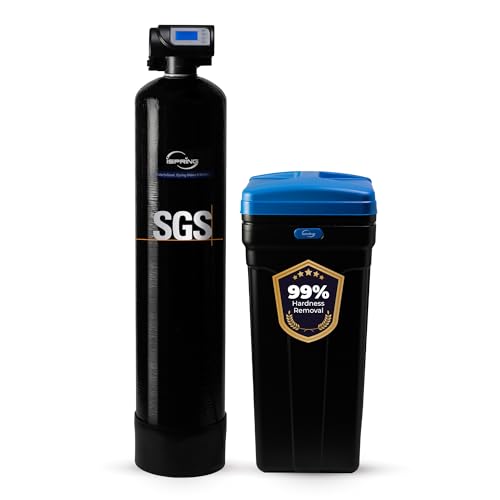
iSpring WCSTB45KG 45,000 Grains Whole House Water Softener with Brine Tank


As an Amazon Associate we earn from qualifying purchases. Product prices and availability are accurate as of the date/time indicated.

Aquasure Harmony Series 40,000 Grains Whole House Water Softener with High Performance Automatic Digital Metered Control Head | Reduces Hardness & Minerals | Improve Water Quality | for 3-4 bathrooms


As an Amazon Associate we earn from qualifying purchases. Product prices and availability are accurate as of the date/time indicated.
Aquasure Harmony Series Grains Whole House Water Softener with High Performance Automatic Digital Metered Control Head | Reduces Hardness & Minerals (64,000 Grains)


As an Amazon Associate we earn from qualifying purchases. Product prices and availability are accurate as of the date/time indicated.
| Model | Key point from the title | Price tier | Best for |
|---|---|---|---|
| iSpring WCSTB45KG | 45,000 grains, brine tank | Budget | Large capacity at the lowest price |
| Aquasure Harmony 32,000 | Metered head, 1-2 bathrooms | Budget | Small homes with moderate hardness |
| Aquasure Harmony 40,000 | Metered head, 3-4 bathrooms | Budget | Mid-sized family homes |
| Aquasure Harmony 48,000 | High-efficiency digital metered head | Mid-range | Larger households, harder water |
| Aquasure Harmony 50,000 | Metered head with pre-filter | Mid-range | Homes with some sediment |
| Kenmore 350 | 32,000 grain, 1-4 people, smart regeneration | Mid-range | Households that like a known retail name |
| Aquasure Harmony 64,000 | Metered head, largest Aquasure listing | Premium | Big homes or very hard water |
| Aquasana SimplySoft 40K | NSF/ANSI 44, 15.5 GPM, cabinet | Premium | Buyers who want certification and warranty |
| Kenmore Elite 520 Hybrid | Softener plus filtration, NSF-certified | Premium | One system for scale and taste |
| Aquasana SimplySoft 60K | NSF/ANSI 44, 16.6 GPM, 5/10-year warranty | Premium | Large households with high flow needs |
What is changing with whole-house softeners
Metered regeneration is now the default on many listings. Rather than regenerating on a fixed schedule, a metered control head counts water use and starts a cycle when the capacity is nearly consumed. That is generally more efficient with salt and water than a timer, although the benefit depends on how well it is set up for your hardness.
Certification wording has also become more visible. The Aquasana titles cite NSF/ANSI 44, a standard for residential cation-exchange softeners, and the Kenmore Elite lists NSF certification. A title is not proof, so the sensible habit is to look up the exact model in the certifier’s public database before treating it as verified.
Third, hybrid and combined systems are growing. The Kenmore Elite 520 pairs softening with whole-house filtration, aimed at buyers who dislike buying two systems. Softeners and filters do different jobs, and a combined unit only helps if the filtration stage addresses your actual concern.
Finally, buyers are more comfortable ordering large appliances online, so listings lean on capacity and flow numbers. Those figures matter, but sizing depends on hardness, household size and plumbing, which no title can know for you.
One more pattern is worth noticing in this set: five of the ten entries come from a single Aquasure family that differs mainly in capacity. That is convenient for sizing, since you can stay with one design and move up or down, but it also means the listings look alike, and small wording differences, such as a pre-filter or a bathroom guideline, can be easy to miss.
How we picked these
We compared the ten listings on what their titles state: capacity in grains, control type, flow claims, certification wording, warranty wording and the households they say they suit. We then sorted them by how clearly each title supports a purchase decision and flagged ambiguous or near-duplicate entries. Nobody on the team used or measured these units. Our basis is published specifications, manufacturer documentation and buyer reviews, and all figures are seller claims or labeled estimates.
The ten systems
iSpring WCSTB45KG 45,000-Grain Whole House Softener
The title gives a 45,000-grain whole-house water softener with a brine tank, and that is nearly all it says. It does not state whether the control head is metered or timer-based, the flow rate, or any certification, so those are the first things to confirm on the listing.
It is the lowest-priced unit in this group, and capacity per dollar looks strong on paper. A household that wants a mid-to-large capacity and is willing to read the manual closely may find it appealing.
Pros
- Large stated capacity at the lowest price tier
- Brine tank is named in the title
Cons
- Control type, flow rate and certification are not stated
- Fewer reassuring details than the others
Check the listing for: control head type, resin details, bypass valve, warranty and the support contact. Question to ask: how will regeneration be triggered, and what does the manufacturer say about sizing for my hardness? As a scenario, a family of four on moderately hard water who is comfortable reading a manual and arranging a plumber could save money here, while a buyer who wants clear published flow and certification details will find more to go on elsewhere in the set.
Aquasure Harmony 32,000-Grain Whole House Softener
This listing describes a 32,000-grain whole-house softener with a high-performance automatic digital metered control head that “reduces hardness and improves water quality,” for 1-2 bathrooms. The bathroom guidance is the seller’s, and it is a rough proxy, since hardness and household size matter more than bathroom count.
It suits a small household with moderate hardness. A couple in a two-bath home could be a good match, but a four-person family with very hard water will find it regenerating often.
Pros
- Metered head named in the title
- Low price tier among the Aquasure range
Cons
- Smallest capacity in the Aquasure group
- Bathroom guidance is a loose sizing proxy
Check the listing for: flow rate, certification and whether a bypass is included. Question to ask: with my hardness and household size, how often will it regenerate? Using the planning math later in this guide, a two-person home at moderate hardness would see long gaps between cycles, which is the situation this size is built for. A household that adds guests, a hot tub or a larger family should treat it as the floor, not the target.
Aquasure Harmony 40,000-Grain Whole House Softener
The 40,000-grain model uses the same metered head and states it reduces hardness and minerals and improves water quality, “for 3-4 bathrooms.” It is one of five Aquasure Harmony listings in this set, so differences are mainly capacity and a few feature wordings.
For a family of four with moderate-to-hard water, this midpoint is a reasonable starting estimate. It sits below the 48,000 and 50,000 models in price, and above the 32,000.
Pros
- Middle capacity with a metered head
- Positioned for larger bathroom counts
Cons
- Near-duplicate of its siblings, so comparison takes care
- No flow rate or certification in the title
Check the listing for: flow rate, warranty, and the size of the tank and resin. Question to ask: is the jump to 48,000 grains worth it for my hardness? A realistic scenario is a four-person household with children, where laundry and showers cluster in the evening; a unit in this middle band spaces out cycles without the footprint and cost of the largest tanks. The 32,000 and 50,000 siblings are the other two points of comparison.
Aquasure Harmony 48,000-Grain Whole House Softener
This title mentions a high-efficiency digital metered control head and a 48,000-grain capacity. It does not give a bathroom count, flow rate or certification.
It fits a larger household or harder water, where a bigger tank spaces out regeneration. Compared with the 40,000, the main trade-off is a higher price and a larger footprint.
Pros
- High-efficiency metered head is highlighted
- More capacity between cycles
Cons
- No sizing guidance or flow figure in the title
- Higher price than the 40,000 sibling
Check the listing for: dimensions, since larger tanks need more floor space, and the support terms. Question to ask: does my hardness actually require this capacity? For example, a five-person home with water around 20 grains per gallon would have a daily load of roughly 7,500 grains on the planning figure used below, which makes this size a sensible fit, while a couple with softer water would be paying for capacity they never use.
Aquasure Harmony 50,000-Grain With Pre-Filter
The 50,000-grain version adds a “Pre-Filter” in the title along with the automatic digital metered head. A pre-filter is typically a sediment stage that protects the system from particles, but the title does not say what it filters or how often the cartridge needs changing.
It suits homes with some sediment in the supply, such as certain well or older-pipe situations, though a lab test should guide that choice.
Pros
- Pre-filter is bundled, per the title
- Higher capacity than the 48,000
Cons
- Pre-filter specifics are not stated
- Higher price tier for a small capacity step
Check the listing for: the pre-filter’s micron rating, replacement cost and housing details. Question to ask: do I have sediment, and does a 2,000-grain step over the 48,000 matter? The honest answer for most buyers is that the pre-filter, not the extra 2,000 grains, is the reason to consider this version. If your supply is municipal and clear, it may be an accessory you do not need; if you are on a well with visible particles, have the water checked first and then decide.
Aquasure Harmony 64,000-Grain Whole House Softener
The title of this listing is garbled: it reads “Series Grains Whole House Water Softener” with the capacity only at the end as “(64,000 Grains).” Treat the 64,000 figure as the seller’s claim and confirm it on the page.
It is the largest Aquasure listing here. It fits big homes or very hard water, where a smaller unit would cycle constantly. For a typical family it may be more than needed.
Pros
- Largest capacity in the Aquasure range
- Metered head, per the title
Cons
- Typo-prone title raises accuracy questions
- May exceed the needs of an average household
Check the listing for: the exact capacity, dimensions and the amount of resin. Question to ask: could a smaller unit meet my needs and cost less? Large tanks also mean a larger brine tank and more salt per fill, and they take more floor space in a utility room, so measure the install area and the distance to a drain before you commit to the biggest size.
Kenmore 350 Whole House Water Softener, 32,000 Grain
The title offers a 32,000-grain whole-house system for 1-4 people with “smart regeneration” that adapts to household use, reducing hard water and protecting pipes and appliances. The “protects pipes and appliances” claim is marketing language, not a measured result.
Someone who wants a familiar retail name and a single clear household range will appreciate the plain positioning. Compared with the same-capacity Aquasure 32,000, it sits in a higher price tier.
Pros
- Clear household range stated in the title
- Smart regeneration wording
Cons
- Higher price for the same 32,000 capacity
- No certification or flow rate in the title
Check the listing for: how regeneration is triggered, warranty and service availability. Question to ask: does the brand premium include better support? A scenario that favors it is a first-time owner in a small house who wants a plainly stated household range and a recognizable retail name for service questions. A buyer who is comfortable comparing specifications may prefer the Aquasure 32,000 at the same capacity.
Aquasana SimplySoft 40K WH-SF40-BASE
The title lists a 40K grain system, NSF/ANSI 44, 15.5 GPM, metered regeneration, salt-saving efficiency, a base tank and cabinet, and a 5/10-year warranty. It offers the most information of any entry in the set, though the warranty split is unexplained.
It suits a buyer who values stated certification, a published flow figure and a clear warranty. “BASE” suggests extras may be sold separately, so check what is included.
Pros
- Certification, flow and warranty wording in the title
- Cabinet design keeps the brine tank tidy
Cons
- Premium price for 40K capacity
- “Base” version may need add-ons
Check the listing for: what 5/10-year covers (tank versus valve), the certification record and installation parts. Question to ask: is paying more for certification and warranty worth it for me? The 40K model suits a mid-sized family that wants published numbers, while buyers who plan to stay in the house for a decade may value the warranty length. Check whether the warranty is transferable and what proof of purchase or installation the maker requires.
Kenmore Elite 520 Hybrid Softener and Filtration System
This listing pairs a softener with whole-house filtration, calling it NSF-certified 2-in-1 for great-tasting drinking water. It states no capacity, flow rate or filter media, so it cannot be compared grain-for-grain with the others.
It is a different class: it fits a buyer who wants scale control and improved taste in one footprint. It does not necessarily replace checking the water if you have a specific contaminant.
Pros
- Two functions in a single system
- Certification wording in the title
Cons
- No capacity or flow figures in the title
- Unclear which standards the certification covers
Check the listing for: the filter stage details, replacement schedule and which NSF standards apply. Question to ask: what does the filter remove, and how often must I replace it? A household in a small home that wants scale control and better-tasting water without a second tank could find the idea attractive. Because capacity is missing from the title, size it against the manufacturer’s chart for your hardness and family size, and compare the recurring filter cost with a standalone softener plus a separate filter.
Aquasana SimplySoft 60K WH-SF60-BASE
The largest and most expensive entry names a 60K grain system with NSF/ANSI 44, 16.6 GPM, metered regeneration, salt-saving efficiency, base tank and cabinet, and a 5/10-year warranty. It is the sibling of the 40K with more capacity and a higher flow claim.
It suits a large household where several showers and appliances run at once. The 16.6 GPM figure looks high, but confirm whether it is service or peak flow on the listing.
Pros
- Highest flow and strong spec detail
- Certification and warranty named
Cons
- Most expensive in the set
- May be oversized for small homes
Check the listing for: the definition of GPM, tank sizes and included installation parts. Question to ask: do I truly need 60K grains? Under the planning figures later in this guide, a six-person home at 20 grains per gallon would have a daily load around 9,000 grains, which is where a 60K size starts to look reasonable. A smaller household would likely be better served by the 40K sibling and the savings.
Buying guide for water softeners
Know your hardness first
Hardness is measured in grains per gallon or parts per million, with one grain per gallon being about 17 ppm. Public suppliers publish reports, and well owners should use a lab test. Iron and manganese change the picture because they may need extra capacity or pretreatment, so test them too.
Size the system
A common planning method multiplies people in the home, daily water use per person, and hardness. Around 75 gallons per person per day is a rough planning figure, not a measurement. The result is the grains consumed per day, and the capacity divided by that gives days between regenerations.
Metered versus timer control
Metered heads start regeneration based on use, which is generally more efficient. Timer heads regenerate on a schedule whether or not you used the water, which can waste salt during low-use weeks such as vacations. Check which one your listing uses, and read how to set the hardness value, because a wrong setting can undercut either design.
Salt, resin and upkeep
Most salt-based softeners use a brine tank that needs periodic refilling and an occasional clean. Resin gradually wears and can foul with iron, so the water test matters again at the maintenance stage. Ask the maker which salt forms it recommends and what the service schedule looks like. Some households also consider potassium-based alternatives; that is a cost and compatibility question to settle with the manufacturer’s guidance, not a one-size answer.
Flow rate and plumbing
A softener restricts flow if undersized. Flow figures in listings like the Aquasana’s are seller claims, and whether they are service or peak numbers should be checked. Peak household demand depends on how many fixtures run at once.
Certification, warranty and installation
Look up certification claims in the certifier’s database. Compare warranty lengths for the tank, valve and electronics. Installation involves plumbing, drain routing and electrical power, so use a qualified professional and follow the manufacturer’s instructions and local codes. Many water-using appliances also have hardness guidance; for example, see our explainer on condensing tankless gas water heaters. Renters or those who cannot install a whole-house system may prefer countertop water filters, though those address drinking water, not scale.
Worked example: sizing for one household
Assume four people at 75 gallons each per day, which is 300 gallons per day, and water at 15 grains per gallon of hardness (about 257 ppm). Daily load: 300 x 15 = 4,500 grains. A 32,000-grain unit at full rated capacity lasts about seven days; a 48,000-grain unit about 10.7 days. In practice, efficient salt settings often deliver less than the full rating. If we assume 70 percent usable capacity, those fall to roughly five days and 7.5 days. The estimate suggests the 32,000 would regenerate about every five days, which is workable, while the 48,000 gives a weekly rhythm. Add iron or a larger household, and the bigger models make more sense. These are labeled estimates, not measurements.
| Spec concept | What to look for | Why |
|---|---|---|
| Grain capacity | Daily load times 7 to 10 days | Spaces out regeneration |
| Control head | Metered, with clear settings | Salt and water efficiency |
| Flow rate | Service figure above peak demand | Avoids pressure drop |
| Certification | Model-specific database listing | Verifies the claim |
| Warranty | Tank, valve and electronics terms | Long-term cost |
| Footprint | Tank and brine dimensions | Fits the install space |
Mistakes buyers make
The first mistake is sizing by bathrooms alone, when hardness and household size drive the load. Second is buying the largest capacity without checking whether the plumbing can support it. Third is skipping the water test, especially on wells where iron changes the plan. Fourth is assuming a softener also filters drinking water; it generally does not. Fifth is trusting certification wording without looking it up. Sixth is installing without checking drain and code rules, which can cause leaks or violations. Seventh is ignoring salt upkeep, which affects performance.
Verdict by use case
Best low-price large capacity: the iSpring, after confirming its control type. Best for small homes: the Aquasure 32,000 or Kenmore 350. Best for a family of four: the Aquasure 40,000 or 48,000, subject to your hardness. Best with a pre-filter: the Aquasure 50,000. Best certified premium: the Aquasana 40K or 60K. Best for scale plus taste: the Kenmore Elite 520. Largest homes: the Aquasure 64,000. Confirm each detail on the live page.
Related guides
- Rechargeable Electric Toothbrush With Travel Case
- Countertop Water Filters Without Installation
- Skin Lifting And Tightening Devices
Frequently asked questions
What does the grain capacity of a water softener mean?
Grain capacity is the amount of hardness a softener can remove between regenerations, measured in grains of hardness minerals. Higher numbers last longer between cycles for the same water, but the listed figure is usually a maximum, and efficient salt settings often deliver less. Size by your household’s daily hardness load rather than by the biggest number, and check the manufacturer’s sizing guidance before buying.
How do I know how hard my water is?
Start with your water utility’s annual quality report if you are on a public supply, or use a hardness test strip or a lab test if you are on a private well. Results appear as grains per gallon or parts per million, and one grain per gallon is roughly 17 ppm. A lab test is worth it if iron or other minerals are present, because they change sizing and care needs.
Does a water softener make water safe to drink?
No. A salt-based softener exchanges hardness minerals, mostly calcium and magnesium, for sodium or potassium. It is not designed to remove bacteria, lead or other contaminants, so a separate filter or treatment may be needed for drinking concerns. Anyone on a sodium-restricted diet should ask their doctor about softened water, and private wells should be checked by a certified lab.
Can I install a whole-house softener myself?
Some owners do, but plumbing, drain routing and electrical connections vary by home, and mistakes can cause leaks or code issues. Installation of plumbing and electrical equipment is best done by a qualified professional, and permit rules differ by location. Follow the manufacturer’s instructions and local codes, and confirm that a DIY install will not void the warranty before you start.
How often do softeners need salt?
It depends on water hardness, household size and the unit’s efficiency settings, so there is no single answer. As a rough planning habit, check the brine tank monthly, keep salt above the water line and avoid letting it bridge into a crust. Salt types differ, so check what the manufacturer recommends, and be ready to clean the tank if sludge builds up.
Is a hybrid softener and filter better than a separate softener?
Not automatically. A combined unit saves space and can simplify installation, but you depend on one system for two jobs, and filter replacement adds recurring cost. A separate softener plus a filter chosen for your specific concern gives more control. Check which contaminants the filter addresses, what the certification covers, and the replacement schedule before choosing.