Preparing for unexpected grid failures requires more than just storing bottled water and non-perishable food. When severe weather, wildfires, or structural infrastructure failures knock out power for days, staying informed becomes a matter of safety rather than mere convenience. Emergency radios equipped with solar panels have evolved significantly, making them a cornerstone of disaster preparedness for 2026. However, not all models are built to the same standard, and marketing claims about solar charging can often be misleading to first-time buyers who assume a small panel can instantly power a dead device.
Navigating the crowded market means looking past flashy exterior designs and focusing on the core engineering specifications that determine whether a device will perform when you need it most. Whether you are assembling your first emergency kit from scratch or upgrading an outdated hand-crank model, understanding what separates a reliable emergency tool from a cheap novelty is essential. This decision guide breaks down the critical features, common misconceptions, and practical sizing guidelines to help you choose the right emergency radio for your household’s specific resilience plan.
As an Amazon Associate we earn from qualifying purchases at no extra cost to you.
Understanding Power Sources: Solar, Hand Crank, and Hybrid Systems
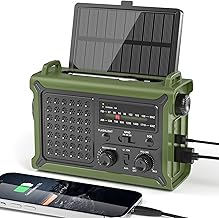
The primary appeal of these devices is their multi-fuel power capability, but it is important to understand the practical limitations of each source. Solar panels integrated into the body of a radio are generally small, meaning they serve primarily as a trickle charger to maintain an already charged battery or slowly recover power over several days of direct sunlight. They are rarely capable of rapidly charging a completely depleted internal battery from zero. Similarly, hand cranks are designed as an emergency last resort rather than a primary charging method; vigorous cranking for several minutes typically yields only a short window of radio playback or flashlight use. The most reliable systems combine a robust internal rechargeable battery with a compartment for standard alkaline batteries, allowing you to swap in fresh AA or AAA cells if solar or hand-cranking options fail during prolonged darkness or severe storms.
Evaluating Battery Capacity and USB Output Realities
Many modern emergency radios double as power banks capable of charging smartphones and other vital communication devices via a USB port. When evaluating battery capacity—measured in milliamp-hours (mAh)—it is vital to maintain realistic expectations. A standard emergency radio with a modest internal battery will only provide a partial charge to a modern smartphone, which typically requires a significantly larger power reservoir to reach full capacity. Look for units with higher capacity ratings if charging external devices is a priority for your family. Additionally, check whether the unit utilizes standard lithium-ion battery packs that can be easily replaced by the user over time, as internal batteries naturally degrade after years of storage and infrequent cycling.
Prioritizing Reception Bands: NOAA, AM, and FM
The core function of any emergency radio is communication. While AM and FM bands are useful for local news, public service broadcasts, and general updates during a crisis, access to NOAA (National Oceanic and Atmospheric Administration) weather radio channels is non-negotiable for anyone living in a disaster-prone region. Advanced models feature Specific Area Message Encoding (SAME) technology, which allows you to program your specific county code so the radio only alerts you to severe weather warnings directly affecting your immediate area, filtering out irrelevant broadcasts from neighboring districts. Always verify that the telescopic antenna is securely mounted and long enough to pull in distant repeater stations clearly, as physical build quality directly impacts signal acquisition in rural or obstructed environments.
Assessing Build Quality and Weather Resistance
An emergency radio is likely to be stored in a garage, basement, or emergency go-bag, meaning it must withstand less-than-ideal environmental conditions. Look for impact-resistant polymer housings with rubberized armor coatings that can absorb accidental drops onto concrete or rough terrain. Weather resistance is equally critical; look for units with formal IP (Ingress Protection) water-resistance ratings rather than vague marketing terms like “splash-proof.” A properly sealed chassis prevents moisture, heavy rain, and dust from ruining the internal circuitry during outdoor use or structural evacuations. Controls and buttons should be tactile and easy to operate even if you are wearing heavy work gloves or navigating in total darkness.
Evaluating Integrated Lighting and Emergency Alarms
Most solar emergency radios include built-in auxiliary lighting, typically featuring a directional flashlight on one end and a broader reading lamp tucked beneath the solar panel flap. When assessing flashlights, look for adjustable beam focus and multiple brightness settings so you can conserve battery power during extended outages. A bright red flashing emergency beacon or SOS Morse code function can also be invaluable if you need to signal search and rescue teams. Built-in loud sirens are standard on many units, serving as an effective tool to signal your location in a collapse scenario, though you should test the alarm switch placement to ensure it cannot be accidentally triggered inside a packed emergency backpack.
Common Buying Mistakes to Avoid
One of the most frequent mistakes buyers make is relying entirely on the solar panel as a primary power source without testing the unit beforehand. Buyers also frequently overlook the weight and footprint of the radio; massive units packed with excessive features are difficult to pack into a standard bug-out bag or evacuation kit. Another common error is purchasing models that rely exclusively on proprietary internal batteries that cannot be charged via a standard USB-C wall outlet during routine preparedness checks. Always test every feature of your radio—including hand cranks, charging ports, and weather bands—immediately upon purchase and schedule routine bimonthly maintenance checks.
When It Makes Sense to Spend More
Budget emergency radios can cost very little, but stepping up to a higher price tier usually introduces significant functional improvements. Premium models typically offer larger solar panels with slightly better conversion efficiencies, higher-capacity lithium batteries, more durable drop-tested chassis, and superior digital tuner chips that lock onto weak signals faster. If your household faces frequent multi-day grid disruptions, hurricanes, or severe winter storms, investing in a robust, commercial-grade emergency radio pays off through vastly superior reliability and longer component lifespans.
Related Guides
If you are looking to compare specific makes and models currently available on the market, you can review our detailed analysis of the best emergency radios to see how top-performing units stack up against each other in real-world testing.
FAQ
How long does it take to charge an emergency radio via the built-in solar panel?
Charging a completely depleted internal battery exclusively through the integrated small solar panel can take anywhere from twenty to forty hours of direct, unobstructed sunlight. Because of this limitation, solar panels are primarily intended for trickle charging and maintaining battery levels rather than rapid refuels.
Can emergency radios completely recharge a dead smartphone?
Most standard emergency radios have relatively small battery capacities that will only provide a partial emergency charge to modern smartphones. They are designed to give your phone just enough power to make a critical call or send a text message rather than restore a full battery.
Do I need an emergency radio if I have a smartphone with internet access?
Cellular towers rely on local power grids and backup batteries that frequently fail during major storms, hurricanes, or widespread blackouts. An emergency radio provides direct access to NOAA weather broadcasts and local emergency alerts independently of cellular infrastructure.
How often should I test and maintain my emergency radio?
You should test your emergency radio at least once every two months by turning on the radio bands, testing the flashlight, and verifying that the battery holds a charge. If your radio uses rechargeable lithium-ion batteries, plug it into a wall outlet to top off the charge semi-annually to ensure peak readiness.