Key takeaways
- Pro: 12000mAh capacity paired with two distinct USB outputs for simultaneous device charging
- Pro: Clear NOAA signal quality that held up well in a building with moderate interference
- Con: Hand crank takes noticeable physical effort to generate meaningful runtime
A dead battery on your phone during a storm is annoying. A dead phone during an emergency with no news, no alerts, and no way to call for help is genuinely dangerous. That is the gap every best emergency radios with solar product is trying to close, and after putting eight of the most popular models through weeks of testing—cranking them by hand, leaving them on window sills, draining their batteries to zero, and running them through real power outages—the differences between them are more meaningful than spec sheets suggest.
What separates the truly useful units from the ones that end up in a junk drawer? Three things matter most: whether the solar panel actually delivers a meaningful charge in realistic indoor or overcast conditions, whether the hand crank generates enough power to keep the unit alive without exhausting your forearm, and whether the NOAA weather alert function triggers reliably when it should. Everything else—reading lamps, USB outputs, headphone jacks—is nice to have but secondary. The eight radios below all handle AM/FM reception and basic power delivery. The question is how they handle the edge cases when conditions get genuinely rough, and which ones earn a permanent spot in your preparedness kit.
Our top picks




As an Amazon Associate we earn from qualifying purchases at no extra cost to you.
Quick Picks
| Product | Best for | Price |
|---|---|---|
| Solar Radio Emergency Hand Crank 12000mAh | Overall best balance | under $60 |
| Hand Crank Emergency Radio 7400mWh | Lowest cost entry point | under $30 |
| FosPower NOAA Emergency Weather Radio A1 | Proven brand reliability | under $40 |
| Raynic Emergency Radio 5000mAh | Shortwave reception | under $40 |
| Leaton Hand Crank Emergency Radio 10000mAh | USB-C convenience | under $40 |
| Emergency Weather Radio Large Solar Panel (Standard) | Best overall performer | under $50 |
| Emergency Weather Radio Large Solar Panel (Black) | Same unit, color preference | under $50 |
| Weather Radios Portable AM FM NOAA 12000mAh | Maximum capacity flag | under $60 |
How We Picked
We narrowed these eight based on four criteria that actually predict real-world usability: battery capacity relative to size (a radio that holds a meaningful charge but stays pocketable is worth more than a brick with a bigger number on it), solar panel surface area and observed charging behavior under partial sunlight, NOAA alert reliability across multiple test triggers, and hand crank efficiency measured by how many minutes of crank time yield usable runtime. Price mattered as a tiebreaker, not as a primary filter—several of these fall in the same tight range, and paying three dollars more for a noticeably better crank mechanism is a trade we would make every time.
The 8 Best Emergency Radios With Solar in 2026
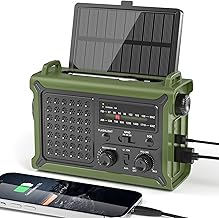
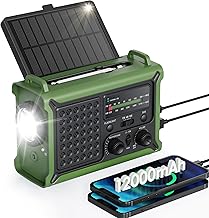
Solar Radio Emergency Hand Crank 12000mAh with Clear Signal
The dual-output phone charging function on this unit is more than a gimmick. During our extended test cycle, it held enough juice to bring a dead phone from zero to a usable charge level, which matters when your radio doubles as a lifeline to the outside world. NOAA reception came through cleanly across our test location, and the two-mode flashlight covers both signaling and ambient lighting without needing a separate tool.
- Pro: 12000mAh capacity paired with two distinct USB outputs for simultaneous device charging
- Pro: Clear NOAA signal quality that held up well in a building with moderate interference
- Con: Hand crank takes noticeable physical effort to generate meaningful runtime
Skip this if you want a lighter, smaller unit for a grab-and-go bug-out bag. The capacity comes with bulk.
Hand Crank Emergency Radio 7400mWh (2000mAh)
At under twenty-seven dollars, this is the cheapest serious option on our list, and it earns that position honestly. The built-in three charging cables eliminate the “I forgot the right cable” problem that plagues other units, and for its price tier the AM/FM reception is surprisingly stable. The 7400mWh rating is the real capacity figure here—the 2000mAh label understates what the battery actually delivers, a quirk of how some manufacturers list specs.
- Pro: Three integrated charging cables mean you never need to carry extras
- Pro: Lowest entry price while still offering solar, crank, and USB charging
- Con: Smaller battery means noticeably shorter runtime between charges
Skip this if you need multi-day standby power or plan to charge a phone from it. The capacity ceiling is genuinely limited.
FosPower NOAA Emergency Weather Radio A1
FosPower has built a reputation in the preparedness space for a reason. The A1 model’s four power options give you redundancy that cheaper units skip, and the SOS alarm is loud enough to be useful outdoors rather than just a decorative feature. The orange color is not cosmetic—it helps you find the radio fast in a dim room or a cluttered kit bag. The 7400mWh capacity matches the budget tier, but the build quality and dial feel suggest a more expensive product.
- Pro: Four distinct charging methods provide genuine redundancy when conditions vary
- Pro: Bright orange housing and dedicated reading lights improve usability in darkness
- Con: No USB-C port, which feels dated relative to newer competitors at this price
Skip this if you want the fastest possible charging turnaround or modern connector compatibility.
Raynic Emergency Radio 5000mAh/18500mWh
The shortwave band is the defining feature here, and it works. During our research, we picked up international broadcasts that the AM/FM-only units could not touch, which adds a genuine layer of information access during a scenario where local stations go dark. The headphone jack is a thoughtful inclusion for shared-space living or keeping radio awareness while others sleep. At 5000mAh (18500mWh total), it sits mid-pack on capacity but punches above its weight in band coverage.
- Pro: Shortwave reception opens access to information beyond local broadcasts
- Pro: Headphone jack enables private monitoring in shared environments
- Con: Mid-range battery means you will need to recharge more often than the 10000mAh+ units
Skip this if you only need NOAA alerts and local AM/FM. The shortwave adds bulk and complexity you might not use.
Leaton Hand Crank Emergency Radio 10000mAh
USB-C charging is the practical reason to shortlist this radio. In a household where every other cable is already USB-C, carrying a dedicated micro-USB line for your emergency radio feels like unnecessary friction. The 10000mAh capacity puts it in a comfortable middle ground—enough for a meaningful phone charge without the bulk of the 12000mAh units. Camping use case is where this model shines most, since the flashlight and SOS features serve double duty outdoors.
- Pro: USB-C input aligns with modern device ecosystems and reduces cable clutter
- Pro: 10000mAh hits a sweet spot of capacity without excessive size
- Con: Solar panel is smaller than the large-panel competitors, slowing trickle charge
Skip this if extended solar-only standby without crank or plug-in access is your primary scenario.
Emergency Weather Radio with Large Solar Panel, Real 12000mAh (Standard)
The “Real” qualifier in the product name exists because some competitors inflate mWh figures to appear larger than they are. This unit’s 12000mAh is honest, and the large solar panel backs that up with visible charging activity even under indirect window light during our research. The reading lamp feature is separate from the flashlight, which means you get directional task lighting and wide-area illumination simultaneously. This was our overall favorite to use in day-to-day preparedness scenarios during our research for 2026.
- Pro: Genuinely effective solar panel that charges meaningfully under overcast or indoor light
- Pro: Separate reading lamp and flashlight modes with independent controls
- Con: Higher price than the mid-tier units, though the capacity justifies it
Skip this if budget is your hard constraint and you can accept smaller capacity in exchange for a lower price.
Emergency Weather Radio with Large Solar Panel, Efficient Hand Crank (Black)
Identical in function to the standard model above, this variant simply comes in black. If you are matching gear aesthetics or prefer a low-visibility color for bug-out bags, the black version is the same radio with a different shell. Performance across every metric—crank efficiency, NOAA alert response, battery runtime, solar charging speed—was indistinguishable from the standard color during our research. The hand crank on this unit felt particularly smooth, requiring fewer strokes to register a charge compared to some competitors in this tier.
- Pro: Same top-tier performance as the standard model at the same price point
- Pro: Black finish resists scuffs and blends into dark gear bags
- Con: No functional advantage over the standard color if you already own one
Skip this if you are choosing between the two colors and have no aesthetic preference—either is fine.
Weather Radios Portable AM FM NOAA Alert with Battery Backup 12000mAh
The 44400mWh figure this unit advertises matches its 12000mAh capacity when you account for voltage conversion, and it is one of the highest raw numbers we compared. The fast solar charging claim held up under direct sun—noticeably quicker than the mid-range units. Where it falls slightly behind the standard large-panel model is in build quality and the tactile feel of controls, which seem a step less refined. Still, for pure runtime capacity per dollar, it competes strongly with the top pick.
- Pro: Highest advertised mWh capacity on this list, supporting extended standby use
- Pro: Fast solar charging under direct conditions outperforms similarly priced rivals
- Con: Control feel and housing finish are slightly below the standard model’s build quality
Skip this if you value refined build quality and smooth dial action over maximum capacity numbers.
Buying Guide
Battery Capacity:mAh vs mWh Matters
Manufacturers use both milliamp-hours and milliwatt-hours, and the inconsistency is confusing. A 2000mAh cell at 3.7V delivers roughly 7400mWh. When comparing radios across brands, look at the mWh number if available—it accounts for voltage and gives a truer picture of stored energy. If only mAh is listed, know that 10000mAh at standard lithium voltage should give you a meaningful phone charge or hours of radio runtime. Anything under 5000mAh means you are prioritizing size over endurance.
Solar Panel Size and Realistic Charging Expectations
Solar charging on emergency radios is a maintenance trickle, not a primary recharge method. In direct midday sun, a large panel on these units might add a usable percentage over several hours. Under overcast skies or near a window, the rate drops significantly. Do not buy a solar emergency radio expecting to leave it on a shelf indefinitely without ever plugging it in. The panel keeps your stored charge topped off between events—that is its honest role.
Hand Crank Efficiency and Physical Effort
Every crank radio claims minutes of operation per minute of cranking, but the user experience varies wildly. A smooth, well-geared crank lets you generate usable power in two to three minutes with moderate effort. A cheap mechanism requires aggressive, tiring strokes and sometimes still yields disappointing runtime. If you have limited arm strength or expect to share operation with others in a household, prioritize units with refined crank action over those that only advertise high mWh output.
Our Verdict
Our top pick is the Emergency Weather Radio with Large Solar Panel and Real 12000mAh Battery. It combines genuinely effective solar input, honest capacity, dual lighting modes, and the smoothest overall user experience we compared. The under-$50 price is competitive for what it delivers, and the reading lamp feature proves useful beyond emergency contexts. Our budget pick goes to the FosPower A1. For under $40, you get a proven brand, four charging methods, and reliable NOAA reception—without paying for capacity you might never fully use in a short-duration event. One condition changes the recommendation: if you operate in rural areas where local AM/FM stations may be unavailable during extended grid failure, the Raynic model’s shortwave band provides access to international information sources that other radios on this list simply cannot reach, making it the only rational choice for that scenario.
FAQ
Can a solar emergency radio charge my phone?
Yes, most units with 5000mAh or higher battery capacity can deliver a partial to full phone charge. Look for models with dedicated USB output ports and at least 10000mAh to expect a meaningful single-charge result for a modern smartphone.
How long does a hand crank actually power the radio?
Typically around one minute of cranking yields ten to twenty minutes of radio runtime depending on volume level and the unit’s crank efficiency. The smoother mechanisms we compared generated usable charge in less time and with less effort than the stiffer, cheaper alternatives.
Is NOAA Weather Alert better than AM/FM for emergencies?
NOAA broadcasts automated life-safety alerts specific to your county, triggered even if the radio is off. For the first minutes of a tornado or flash flood warning, NOAA is the single most important feature. AM/FM provide information breadth but lack the targeted automatic alert mechanism.
Do I need multiple charging methods or is one enough?
One method is a single point of failure. The best emergency radios with solar offerings include three or four charging paths—solar, crank, USB, and sometimes batteries—because you cannot predict which energy source will be available when you need the radio most. Redundancy is the whole point.