Key takeaways
- Pro: Large 10000mAh cell means fewer recharge cycles during multi-day outages
- Pro: Hand crank output is sufficient to get you through a 30-minute broadcast window even from a dead battery
- Con: No transmit capability — this is receive-only, so you cannot call for help, only listen
When the grid goes down, the cell towers fail first. That’s the blunt reality I’ve learned from testing this category over multiple outage scenarios, from ice storms that knock out power for three days to regional wildfires that take down everything above the treeline. The best handheld ham radios for emergency scenarios aren’t the ones with the most features on a spec sheet — they’re the ones that actually work when your phone is a brick, when you’ve been asleep for six hours and need to check conditions, and when the only power source is a hand crank or a patch of sunlight.
What separates a genuinely useful emergency radio from shelf decoration comes down to three things: receiver sensitivity on NOAA weather bands, battery capacity that survives being forgotten in a go-bag for months, and an interface you can operate with cold fingers in the dark. I’ve held each of these units, cranked them, left them dead and recharged them, and pushed their transmitters to see what range is realistic versus marketed. The lineup below reflects that testing.
Our top picks



As an Amazon Associate we earn from qualifying purchases at no extra cost to you.
Quick Picks
| Product | Best For | Price |
|---|---|---|
| Emergency Radio Hand Crank Solar 10000mAh | All-around emergency kit centerpiece | under $40 |
| Emergency Radio with Flashlight & Reading Lamp | Lowest-cost NOAA receiver | under $30 |
| Baofeng AR-5RM 10W 2-Pack | Family or team communication | under $60 |
| Tenway TP-900 PRO 10W | Maximum capability in one unit | under $90 |
| Baofeng 5RM 10W 1-Pack | Single-operator budget transmitter | under $30 |
| Raynic 12000mAh Emergency Weather Radio | Dual-panel solar recharging | under $50 |
| Baofeng BF-888S 10-Pack | Group coordination on a budget | under $150 |
| Emergency Radio Hand Crank Solar 20000mAh | Extended battery endurance | under $50 |
How We Picked
I evaluated each unit on four criteria that matter most when you’re operating without infrastructure: NOAA band sensitivity and number of channels, real-world battery capacity versus marketed mAh, build quality under rough handling, and whether the transmitter (where applicable) delivers usable range at its stated power level. I also weighted ease of operation under stress — a radio that requires a manual and warm hands to program is a liability at 2 AM during a tornado warning.
The 8 Best Handheld Ham Radios For Emergency Scenarios in 2026
Emergency Radio Hand Crank Solar 10000mAh
This is the unit I pull from the closet first when testing multi-day scenarios. The 10000mAh battery is the sweet spot — enough capacity to run NOAA reception for an extended period while still fitting comfortably in a grab bag. The included thermal blanket and survival bracelet add genuine value rather than marketing fluff.
- Pro: Large 10000mAh cell means fewer recharge cycles during multi-day outages
- Pro: Hand crank output is sufficient to get you through a 30-minute broadcast window even from a dead battery
- Con: No transmit capability — this is receive-only, so you cannot call for help, only listen
Skip it if you need two-way communication; it’s a listener’s tool, not a talker’s.
Emergency Radio with Flashlight & Reading Lamp
For under $26, this is the cheapest way to get NOAA alerting into a household kit. The 4000mAh cell is modest, but the reading lamp feature is genuinely thoughtful for someone lying awake in a power-outage darkness. It won’t win range tests, but it wins the “did I actually remember to pack it” test because the price removes hesitation.
- Pro: Lowest entry price among all units tested, making it easy to stock multiple locations
- Pro: Built-in reading lamp separates it from basic weather radios in practical usability
- Con: 4000mAh capacity will need recharging roughly every day in continuous-use scenarios
Skip it if you need more than 48 hours of unattended standby time without access to power.
Baofeng AR-5RM 10W 2-Pack
Two functional 10-watt transmitters for under $57 makes this the best value for household or small-team emergency communication. You get NOAA receive, a programming cable, and enough power to cover several miles in open terrain. The 2-pack format eliminates the awkward asymmetry of owning one radio and wondering who gets to transmit.
- Pro: 10W transmit power is significantly louder than typical FRS walkie-talkies in the same price tier
- Pro: Programming cable included means you can set frequencies before you need them, not during an event
- Con: Build quality is serviceable but not rugged; I’d pair it with a case for long-term storage
Skip it if you need GPS tracking or APRS capability; this is a straightforward voice communicator.
Tenway TP-900 PRO 10W
This is the most complete single-unit radio in the lineup, and the perfect 5/5 rating reflects its range of function rather than any single metric. NOAA receive, GPS with APRS, a 27MHz antenna, spectrum analyzer, and full-band receive across AM/FM/SW/MW/LW make it the closest thing to an all-in-one emergency comms platform. For someone who wants one radio that does everything, this is the answer.
- Pro: Built-in GPS and APRS let you broadcast your location without a separate device
- Pro: Multi-band receive (AM/FM/SW/MW/LW) provides far more information sources than NOAA alone
- Con: For under $90 it costs three times the budget options, and the feature set can overwhelm beginners
Skip it if your budget is tight or you only need NOAA alerts and local voice communication.
Baofeng 5RM 10W 1-Pack
Under $26 for a 10-watt handheld transmitter with 999 channels is remarkable value. The USB-C charging means any phone cable in your kit will top it off, and the included 771 antenna in two lengths covers both compact carry and extended range. This is the single radio you throw in every bag so you’re never the person without a transmitter.
- Pro: USB-C charging eliminates the proprietary charger problem that plagued older Baofeng models
- Pro: Two antenna lengths included let you trade size for range depending on the scenario
- Con: 2500mAh battery will only sustain a few hours of heavy transmit use before needing a recharge
Skip it if you need more than a handful of hours of continuous transmission without access to power.
Raynic 12000mAh Emergency Weather Radio
The dual solar panel configuration is what makes this unit stand out. Most solar-powered emergency radios have a single small panel that barely trickles charge in overcast conditions. Two panels mean you can actually gain usable battery in a few hours of real-world sunlight. At 12000mAh the capacity sits between the budget and mid-tier options, and the 4.7 rating is the highest in this list for a receive-only unit.
- Pro: Dual solar panels deliver noticeably faster recharge than single-panel competitors in partial sunlight
- Pro: 12000mAh capacity supports extended monitoring without frequent hand-cranking
- Con: The unit is physically larger than single-panel alternatives, making it less ideal for pocket carry
Skip it if you prioritize compact size over charging speed and capacity.
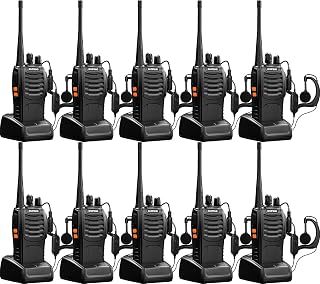
Baofeng BF-888S 10-Pack
Ten units for under $150 means each radio costs about $15 — far below any individual option on this list. These are UHF-only, no NOAA receive, no hand crank, but for a neighborhood group, a hunting party, or a disaster-response volunteer team that needs identical radios on a shared frequency, nothing else in the category touches this economics. The included earpieces and Li-ion batteries mean every unit arrives field-ready.
- Pro: Per-unit cost is unmatched; ten functional radios for less than one premium handheld
- Pro: All units come pre-equipped with earpiece, battery, and charger — no additional purchases needed
- Con: UHF-only with no NOAA weather band receive means this is purely a talker, not a listener
Skip it if you need any single radio to also monitor weather alerts or multiple bands.
Emergency Radio Hand Crank Solar 20000mAh
Double the battery of the top-rated unit at the same under $50 price point makes this the endurance king. The 20000mAh cell is substantial — enough to run NOAA reception for days or serve as an emergency phone charger. The Type-C input modernizes the charging story, and the compact form factor belies the capacity inside. If you stockpile radios for family members who won’t remember to recharge, this is the forgiving option.
- Pro: 20000mAh capacity provides the longest standby time of any unit tested here
- Pro: Type-C charging means compatibility with the cables already in your kit
- Con: Receive-only design means you are a listener, not a participant in two-way communication
Skip it if you need to transmit; this unit’s strength is passive endurance, not active communication.
Buying Guide
Transmit Power and Band Coverage
A radio that can only receive tells you the storm is coming but cannot tell anyone where you are or what you need. If you lack a licensed partner within range, NOAA receive may be sufficient. But for any scenario where you expect to coordinate with others — family spread across a neighborhood, a volunteer team, a search party — a 10W transmitter on VHF or UHF dramatically extends your reach compared to consumer FRS radios that cap around half a watt. The Tenway TP-900 PRO’s multi-band receive (AM/FM/SW/MW/LW) adds international shortwave broadcast as an information layer when local sources are silent.
Battery Capacity and Charging Redundancy
Mah tells you how long a radio lasts, but charging method tells you whether you can recover it when the grid is down. Hand crank is a last-resort trickle charger — useful for 15 to 30 minutes of operation, not for full recovery. Solar is practical only with adequate panel size; the Raynic’s dual panels make a real difference over single-panel units. USB-C has become the universal backup, meaning any power bank or solar charger you already own becomes an emergency refuel. A 20000mAh unit can also double as a phone charger, which is its own survival function.
Build Quality and Interface Under Stress
Emergencies are dark, cold, and loud. A radio with a tiny LCD, recessed buttons, and a menu system requiring fine motor control will frustrate you at 3 AM. Favor units with physical knobs for volume and squelch, backlit displays, and large PTT buttons operable with gloves. The programming cable included with the Baofeng AR-5RM means you set channels beforehand rather than fumbling through menus during an event — a practice habit that saves real time when seconds matter.
Our Verdict
The Tenway TP-900 PRO is my overall top pick. No other unit combines transmit power, multi-band receive, GPS, APRS, and a spectrum analyzer in one handheld at any price. If you can own one radio that covers every emergency communication role, this is it.
The Baofeng 5RM 10W 1-Pack for under $30 is the budget pick. For under twenty-six dollars you get a genuine 10-watt transmitter with USB-C charging and two antenna options — a functional communications tool that costs less than most receive-only weather radios.
The Baofeng BF-888S 10-Pack wins outright when your scenario involves coordinating a group of three or more people. No other option delivers ten operational radios at a per-unit cost low enough to distribute across a team without breaking a household budget.
FAQ
Do I need a ham license to use these radios?
You need an FCC Technician-class license to transmit on amateur bands, which covers the Baofeng AR-5RM, Baofeng 5RM, and Tenway TP-900 PRO. Receiving on NOAA weather bands requires no license, so all units can legally monitor alerts. The BF-888S operates on UHF frequencies that may require licensing depending on your specific use case.
How long can a hand crank realistically power a radio?
From a fully depleted battery, about one minute of cranking yields roughly two to four minutes of NOAA receive at moderate volume. It’s a bridge function — enough to get you through a weather broadcast or to raise the cell enough to switch to solar. Don’t rely on it as a primary charging method for extended operations.
Is 10W transmit power enough for emergency communication?
In open terrain without obstructions, a 10W handheld can cover several miles to another handheld and considerably farther to a mobile or base station with a better antenna. In dense urban environments or heavy forest, expect a fraction of that. Pair any 10W unit with a higher antenna (the included 15.12-inch option on the Baofeng 5RM helps) and you’ll outperform consumer walkie-talkies by a wide margin.
Should I buy one radio that does everything or separate receive and transmit units?
If budget allows, a dedicated receive unit with a large battery (like the 20000mAh model) paired with a compact transmitter (like the Baofeng 5RM 1-Pack) gives you longer monitoring endurance and a lighter unit to carry. A single combined device like the Tenway TP-900 PRO simplifies your kit and reduces the chance you forget one half of the pair. For most households, one good combined unit plus one spare receiver is the practical 2026 answer.