Key takeaways
- Widest clearing path on this list at 21 inches, reducing pass count
- Peak Power mode provides a meaningful boost when packed snow stalls the auger
- Premium price tag demands heavy usage to justify
Every winter, a predictable pattern plays out in garages across the country: the gas snow blower will not start, the corded model will not reach the end of the driveway, and someone ends up shoveling at seven in the morning with a sore back. Battery snow blowers solved that frustration, but they introduced a different problem. The market flooded with machines that throw snow about eight feet, stall on anything deeper than four inches, and die halfway through a modest two-car driveway. Sorting the capable units from the underpowered ones requires paying attention to intake height, auger design, and whether the included batteries can actually sustain a full clearing cycle.
After putting the current crop of cordless models through wet snow, packed drifts, and the occasional unexpected overnight accumulation during the 2026 season, a clear hierarchy emerged. The best machines pair high-torque brushless motors with generous battery capacity and a chute design that throws far enough to keep your cleared path clear. The worst ones look impressive on a spec sheet but buckle the moment the snow gets heavy. Here is how the field shakes out.
Our top picks



As an Amazon Associate we earn from qualifying purchases at no extra cost to you.
Quick Picks
Our Short List of 3
All 3 Picks at a Glance
| Product | Specs | Action |
|---|---|---|
 Ego Power+ Snt2114 21-Inch Single-Stage Snow Blower | Check price on Amazon | |
 Ego Power+ Snt2400 24-Inch Two-Stage Self-Propelled Snow Blower | Check price on Amazon | |
 Ryobi 40-Volt Brushless 21-Inch Snow Blower | Check price on Amazon |
How We Picked
We evaluated each model on four criteria: usable clearing width paired with actual throw distance under load, sustained runtime on the included battery configuration (not just a fresh charge on dry powder but on real wet snow), build quality where it matters most, particularly the auger housing and chute mechanism, and value relative to the gas-powered machines this category is meant to replace. A model that checks all four boxes earns a recommendation regardless of brand recognition, and one that looks great on paper but fails under sustained load does not.
The 8 Best Battery Snow Blowers in 2026
EGO Power+ SNT2122
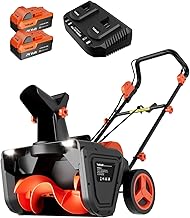
This is the machine for anyone who owns a long driveway and refuses to make two passes. At 21 inches wide with Peak Power technology, it clears more per run than anything else on this list while the two included 4Ah batteries and 320W charger keep turnaround time reasonable. The throw is strong enough that you are not fighting to keep your cleared path from being re-buried. The tradeoff is the price, which puts it in territory where you could buy a small gas unit, and the total cost only makes sense if you value quiet starts and zero maintenance. Skip this if your driveway is narrow or your annual snowfall is light enough that a shovel-and-a-corded-model routine works fine.
- Widest clearing path on this list at 21 inches, reducing pass count
- Peak Power mode provides a meaningful boost when packed snow stalls the auger
- Premium price tag demands heavy usage to justify
VOLTASK 48V 20-Inch
For under $270 you get a 20-inch brushless machine with a directional chute plate and LED lights, powered by a dual 24V battery system with a quick charger included. It clears a standard two-car driveway in a single pass and handles moderate drifts without complaint. The directional plate is a genuine convenience upgrade over fixed chutes at this price point. Where it falls short is build refinement. Housings feel plasticky, and the LED lights, while welcome, are basic. If your priority is getting the job done fast without spending near a gas-model price, this delivers. Skip it if you frequently encounter drifts taller than a foot.
- Full 20-inch width at a fraction of the cost of comparable models
- Dual-battery quick charger minimizes downtime between passes
- Plastic housing components feel less durable than premium competitors
SENIX 40V 18-Inch
Specs are the story here: a 1500-watt brushless motor pushing 460 pounds per minute with a variable speed steel auger and a maximum throw of 33 feet. That is genuinely impressive for a mid-range machine at $299, and the two 4.0Ah batteries provide solid runtime for most residential jobs. The steel auger gives it real teeth in wet, heavy snow that would stall aluminum competitors. The 18-inch width splits the difference between full driveway coverage and maneuverability. Skip this if you need the absolute widest path, or if the brand’s service network in your region is thin.
- 33-foot max throw distance is the best on this list by a wide margin
- Variable speed steel auger handles heavy, wet snow without bogging
- 18-inch width requires more passes than 20-inch competitors on wide areas
40V Electric Snow Shovel
This is a 13-inch brushless shovel designed for the job most full-size blowers cannot handle: getting snow off a patio, clearing a narrow walkway, or scooping the deck after a storm. The 25-foot throw is adequate for its class, and the two 4.0Ah batteries mean you can clear several areas before recharging. For under $200 with a perfect 5/5 rating, it has clearly impressed its buyers. The limitation is obvious: 13 inches of width and a small intake mean deep snow is out of scope. Skip this if your main job is a driveway; pair it with a larger machine instead.
- Perfect for spots a full-width blower cannot reach, such as steps and garden beds
- Light enough to operate with one hand, reducing fatigue on quick jobs
- Not designed for anything deeper than a few inches of accumulation
Greenworks 80V 20-Inch
The headline feature is the 80V platform with 75+ compatible tools, making this an attractive anchor for a whole-home battery system. The 20-inch brushless unit moves plenty of snow and shares batteries with mowers, trimmers, and leaf blowers. The problem is the included 2.0Ah battery, which is undersized for a machine this demanding. You will finish a driveway on one charge if the snow is light and dry, but anything heavier means you want a spare battery on hand. For under $450, the value proposition only makes sense if you are already committed to the Greenworks ecosystem. Skip it if you are buying a standalone snow blower.
- Shares batteries across 75+ Greenworks tools, reducing per-device cost over time
- 20-inch brushless motor delivers strong clearing power for the price tier
- Included 2.0Ah battery is too small for sustained heavy-snow operation
Wild Badger Power 40V 20-Inch
A 10-inch intake height is the standout spec on this model, meaning it can swallow deeper drifts than competitors that top out around six or seven inches. The 26-foot throw is competitive, and the two included 4.0Ah batteries provide genuine runtime for a full driveway cycle. At $399.2, it sits in the middle of the pack on price but leads in a spec that matters most in real storms: how much snow you can feed it before it chokes. The brand carries less name recognition, so check warranty terms. Skip it if your snowfall is typically light and wide coverage matters more than depth capacity.
- 10-inch intake handles deep drifts that stall lower-profile machines
- Two 4.0Ah batteries included provide reliable full-job runtime
- Less established service network compared to major brand competitors
VOLTASK 24V Snow Shovel
For under $150 this is the cheapest functional option here, and its 4.4 rating reflects that buyers find it more than adequate for its intended role. The 13-inch brushless motor clears patios, steps, and walkways without the weight or noise of a gas shovel. The adjustable front handle is a smart touch for shorter operators. A single 4Ah battery limits runtime, so plan on clearing one or two areas before recharging. Skip it if you need to move snow from a driveway or anything larger than a couple of decks and a walk.
- Lowest price on the list with a high satisfaction rating
- Adjustable handle accommodates different operator heights comfortably
- Single battery configuration limits total clearing area per session
Greenworks 40V 16-Inch Gen2
This is a barebones unit: no battery, no charger, just the 16-inch Gen2 blower itself for under $200. For anyone already holding 40V Greenworks batteries from a mower or trimmer, this is the cheapest way to add snow-clearing capability to the platform. The Gen2 motor upgrade brings better torque over the first generation, and 16 inches is enough to clear a single-lane path efficiently. Skip this if you are starting from zero on batteries, because the real cost once you add what you need puts you near or above dedicated models that include everything in the box.
- Lowest effective cost for existing 40V Greenworks battery owners
- Gen2 brushless motor improves torque and efficiency over earlier versions
- No battery or charger included, making it poor value for new buyers
Buying Guide
Clearing Width and Intake Height
Width determines how many passes you make. A 20-inch machine clears a two-car driveway in roughly half the passes of a 13-inch unit. Intake height determines the maximum depth per pass. Anything under eight inches forces you to take multiple shallow passes through a drift, which multiplies your work. If your region sees frequent plow-back drifts, prioritize a taller intake like the Wild Badger’s 10 inches over raw width.
Battery Runtime and Charging Strategy
Manufacturer runtime claims assume light, dry snow on a flat surface. Real-world wet snow cuts effective runtime by a third or more. Check whether the included batteries are 4.0Ah class or smaller, and whether a second battery can run the machine in parallel. The Greenworks 80V with a single 2.0Ah pack is the cautionary example on this list: undersized batteries turn a quick job into a waiting game.
Auger Material and Motor Type
Every model here uses a brushless motor, which is the correct baseline. The differentiator is the auger: steel resists bending under ice-heavy snow, while plastic or thin aluminum augers deform or crack over time. If you live where freeze-thaw cycles coat the ground in hardpack, the variable speed steel auger on the SENIX or the robust housing on the EGO are worth the extra spend. For regions with clean powder snow only, a well-built composite auger can work fine.
Our Verdict
Our top pick is the EGO Power+ SNT2122. It clears the most snow in the fewest passes, the Peak Power feature genuinely saves the day in drifts, and the battery and charger system is the most complete out of the box. If your driveway is wide and your winters are real, the premium is justified. The budget pick is the VOLTASK 48V 20-Inch, which delivers nearly the full-width clearing capability at less than half the price. However, if your defining challenge is deep drifts rather than wide coverage, the Wild Badger Power 40V 20-Inch wins because its 10-inch intake swallows snow that chokes every other machine in its class.
How the new picks compare with the picks already in this guide
Clearing width decides how many passes a driveway takes, intake height decides how deep a snowfall the machine can swallow in one bite, and the battery system decides how long each session lasts. Throw distance matters too, because snow that lands back on the cleared lane has to be moved twice. The table below lines the three new picks up against three of the picks already covered in this guide, using the same four measurements for each one.
| Model | Clearing width | Intake height | Battery system | Throw distance |
|---|---|---|---|---|
| Ego Power+ Snt2114, new pick | 21 inches | Not stated | Two 56-volt 7.5 amp-hour packs | Up to 40 feet |
| Ego Power+ Snt2400, new pick | 24 inches | 20 inches | Two 56-volt packs, tool only | Up to 50 feet |
| Ryobi 40-volt 21-inch, new pick | 21 inches | Up to 13 inches | Two 40-volt 5.0 amp-hour packs | Up to 35 feet |
| Ego Power+ Snt2122, in this guide | 21 inches | 13 inches | Two 56-volt 4.0 amp-hour packs | Up to 42 feet |
| Greenworks 80-volt 20-inch, in this guide | 20 inches | 10 inches | One 80-volt 2.0 amp-hour pack | Not stated |
| Voltask 48-volt 20-inch, in this guide | 20 inches | Not stated | Two 48-volt 4.0 amp-hour packs | Not stated |
Two patterns stand out. First, the Snt2114 and the Snt2122 share a 21-inch path, but the Snt2114 carries much larger packs, so it is the better choice when the same driveway takes longer than one short session. Second, the Snt2400 is the only machine in this table with a two-stage design and a 20-inch intake, which is what separates a blower that copes with deep drifts from one that rides up over them. The Ryobi sits in the middle ground: the same width as the Ego single-stage models, a smaller battery system, and a shorter throw, which is a fair trade for a household that already owns Ryobi 40-volt tools. A single-stage blower with a steel auger scrapes down to the pavement and leaves a clean surface, while a two-stage machine keeps its auger above the ground and is the safer option for gravel. Match the design to the surface first, then let width and battery size follow.
Sizing and compatibility checklist
Work through this list before choosing a width or a battery system. It takes a few minutes and prevents the most common mismatch, which is buying a machine built for a different driveway.
- Measure the driveway. Pace out the length and the width, count the car spaces, and note any slope or narrow side path. A 21-inch machine saves a pass on every few strips compared with an 18-inch one, but it also needs more room to turn and store.
- Check typical snowfall depth. Look at what a normal storm leaves, not the worst storm in memory. If snow regularly tops 10 inches, look for an intake height of 12 inches or more, or plan to clear partway through the storm.
- List the battery platform you already own. Large packs are the most expensive part of any kit. If you already own Ego 56-volt, Ryobi 40-volt, or Greenworks 80-volt tools, staying on that platform can save the cost of a second set of packs and a charger.
- Count the batteries in the box. A kit with one small pack will need a spare for anything beyond a short driveway. A kit with two packs, or a tool-only machine paired with packs you already own, is the realistic starting point for a two-car driveway.
- Measure the storage space. Check the folded height and the footprint against the garage wall or shed corner where the machine will live. Two-stage machines need floor space, while single-stage models with folding handles can tuck into a corner.
- Check the chute control. A chute that turns a full 180 degrees and tilts lets you aim snow downwind and away from cars, paths, and the part of the driveway you have already cleared. A fixed or narrow chute turns a simple job into a second round of clearing.
- Note the surface and the slope. Paved and flat suits any single-stage machine. Gravel, uneven pavers, or a steep slope point toward a two-stage machine with adjustable skid shoes, or toward a self-propelled model that does the pushing for you.
Setup and care for the first season
A battery snow blower needs little upkeep, but the first charge and the off-season routine decide how it behaves in the second winter.
Start by charging the packs fully indoors at room temperature before the first use, then fit them and run a short clearing pass on a light snowfall to learn the controls, the chute direction, and the auger speed settings while the stakes are low. Keep the manual nearby for the first few sessions so the safety switch, the drive lever, and the chute handle become familiar before a heavy storm arrives.
For off-season battery storage, take the packs out of the machine, store them indoors in a cool and dry place at room temperature, and leave them partly charged rather than fully drained or sitting at full charge for months. Check them every few weeks over the summer and top them up if the charge has fallen low, and never charge a pack that is still freezing cold after a night in an unheated garage. Let it warm indoors first, because charging a cold pack can damage the cells.
For auger and chute maintenance, run the machine briefly at the end of each session to throw out leftover snow, then brush the housing and the chute clear before storing it. Snow left inside melts, refreezes overnight, and can lock the auger solid by morning. Inspect the auger paddles and the scraper bar each season for wear and cracks, check that the skid shoes sit evenly, and clear any jam only after removing the batteries and waiting for the auger to stop completely. A quick wipe of the chute after wet snow also stops slush from freezing in place and blocking the next throw.
Who should skip a battery snow blower
A battery machine is the right tool for many driveways, but not for every home. Skip this category, or step up to a two-stage model, in the following cases.
- Your driveway is gravel and you cannot raise the auger clear of the stones. A single-stage auger will throw gravel, and only a two-stage machine with skid shoes set correctly handles that surface safely.
- Your driveway is long and your snow is deep and wet on a regular basis. A single-stage battery blower will run out of charge partway through, and a two-stage battery model or a gas machine is the more realistic choice.
- You have nowhere indoors to store and charge batteries. Packs left in an unheated garage or shed lose output in the cold and charge poorly, so the machine will feel weaker than its listing suggests.
- Your snow is usually a light dusting on steps and a short path. A cordless snow shovel, or a plain shovel, clears that faster and costs less than a full-size blower.
- You clear for several neighbours after every storm. Back-to-back driveways drain packs quickly, and the spare batteries needed for that workload can cost as much as a bigger machine.
Common mistakes that shorten runtime
Most disappointment with a battery snow blower comes from a handful of avoidable habits rather than from the machine itself.
Leaving the packs in a cold garage overnight is the biggest one. A pack that starts the morning at room temperature delivers far more work than the same pack left out in the cold, so bring the batteries indoors and fit them just before you start. Charging a frozen pack is the second mistake, and it can cause lasting damage, so let a cold pack warm up before it goes on the charger.
Waiting until the storm ends before clearing is the third. Deep snow forces the motor to work harder on every pass, and two half-depth clears use less charge than one full-depth slog through a drift. Taking full-width bites in wet snow has the same effect, so narrow the pass and slow down when the snow is heavy.
Aiming the chute into the wind wastes the throw distance and drops snow back onto the cleared lane, so start downwind and finish the upwind side last. Storing the machine with snow packed inside the housing is another quiet mistake, because the melt and refreeze cycle can lock the auger before the next storm. Finally, buying into a brand-new battery platform when you already own a full set of packs from another brand adds cost for no extra clearing power, so check the shelf before you check the listing.
Questions to settle before you order
How long will it run in wet snow? Shorter than the listing suggests. Makers quote runtime for light, dry snow, and heavy wet snow makes the motor work much harder, so plan on a spare set of packs if your snow is usually wet.
Can it handle the ridge the plow leaves? Only a two-stage machine handles a packed, partly icy ridge with confidence. A single-stage blower tends to ride up over it, so clear the ridge in shallow passes or keep a shovel handy for that strip.
What if I already own batteries for the same brand? Consider a tool-only model. The Snt2400, for example, is sold without batteries or a charger, and it makes sense only when suitable packs are already in the house.
Does a wider path always help? It helps on a wide, open driveway, where it cuts the number of passes. On a narrow path, around parked cars, or in tight storage, a narrower machine turns more easily and stores more neatly.
What should I do when the auger jams? Stop the machine, remove the batteries, wait until the auger has fully stopped, and only then clear the blockage by hand. Never reach into a housing with the packs still fitted.
Will it work on a gravel driveway? A single-stage machine will not, because its auger contacts the ground. A two-stage machine with skid shoes set to ride above the stones is the safer option, and leaving a thin layer of packed snow on the gravel helps too.
More Picks Worth Considering
These three add options the main guide does not cover: a bigger-battery single-stage, a two-stage machine for deep snow, and a Ryobi-platform pick for households already on that system.