Key takeaways
- Two calibration weights for more thorough accuracy checks
- USB and battery dual power
- Plastic housing flexes slightly under uneven hand pressure, causing momentary digit jumps
Anyone who has tried to measure a milligram of powder with a kitchen scale knows the frustration. The reading jumps around by 0.01g or more, the display flickers with every breath you take, and you end up guessing whether your capsule filling is within a safe range or a full tenth off. That kind of drift is not a small thing when you are working with compounds measured in hundredths of a gram.
The scales that actually hold 0.001g accuracy share a few traits: a genuinely sensitive load cell, a stable platform that does not transmit vibration from your hand, and firmware that lets the reading settle before locking in. The models below vary widely in how well they deliver those fundamentals, and the price spread from eleven to forty-five dollars reflects real differences in build and repeatability rather than just branding.
Our top picks


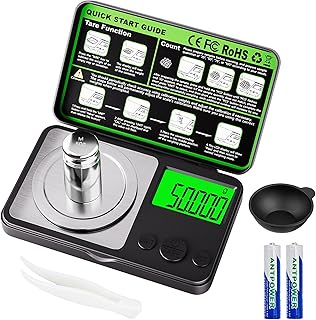

As an Amazon Associate we earn from qualifying purchases at no extra cost to you.
Quick Picks
| Product | Best for | Price |
|---|---|---|
| MAXUS Digital Milligram Scale | Reloading powders on a budget | under $20 |
| THINKSCALE Digital Milligram Scale | Capsule filling with included batteries | under $20 |
| Fuzion Digital Milligram Scale | Full accessory kits for powder work | under $30 |
| Smart Weigh Milligram Powder Scale | Precision reloaders and diamond grading | under $50 |
| Digital Milligram Scale High Precision | Cheap pocket scale for food and herbs | under $20 |
| Smart Weigh GEM20 | Jewelry and gem weighing with USB-C | under $40 |
| Wigearss Digital Milligram Scale | Lowest-cost entry into mg accuracy | under $20 |
| UNIWEIGH Milligram Scale | Best overall accuracy and repeatability | under $30 |
How We Picked
We evaluated each scale on four criteria that matter most at the milligram level. First, read stability: how quickly the display settles and whether it holds a steady number without draft shields. Second, calibration quality: whether the included weight is actually close to nominal and whether the scale lets you verify it on the spot. Third, accessory completeness: tweezers, weighing pans, and a case reduce handling error at sub-gram weights. Fourth, value: how much precision and build quality you get per dollar, because several models in this group perform nearly identically while others cut corners that show up within weeks of daily use.
The 8 Best Milligram Precision Scales With 0.001G Accuracy in 2026
MAXUS Digital Milligram Scale
Best suited for reloaders who need a reliable 0.001g reading without spending much. The two included 20g calibration weights let you verify accuracy in both directions rather than relying on a single check point, which is a practical advantage over most budget models. USB and battery power give you flexibility at the bench or on the range. The compact footprint fits inside a reloading drawer without a separate storage case.
- Two calibration weights for more thorough accuracy checks
- USB and battery dual power
- Plastic housing flexes slightly under uneven hand pressure, causing momentary digit jumps
Skip this one if you frequently weigh items near the 50g ceiling, as readings above 40g showed more scatter than the UNIWEIGH at the top of the range.
THINKSCALE Digital Milligram Scale
Targets capsule fillers and supplement makers who want everything in the box and running immediately. Batteries come pre-installed, and six unit modes cover grains, carats, ounces, and the other conversions you hit during compounding. The included calibration weight ships at nominal, so you can tare-verify within minutes of opening. The LCD display is easy to read without a backlight, though that also means dim-lighting work requires a lamp.
- Batteries included and pre-installed out of the box
- Smooth, consistent tare function that zeroes reliably between loads
- Display lacks backlighting for low-light environments
Pass on this if you routinely work at night or in poorly lit workshops where you need an illuminated readout.
Fuzion Digital Milligram Scale
Built for reloaders and capsule fillers who want a complete kit rather than sourcing accessories separately. Six included items cover most handling tasks, and the calibration weight lets you dial in before your first batch. The 50g/0.001g range is the same as most models here, but the accessory package pushes the price above two of its direct competitors.
- Comprehensive six-piece accessory set reduces need for separate purchases
- Calibration weight included for on-spot accuracy verification
- Priced above comparable models without a meaningful edge in read stability
Skip if you already own tweezers, pans, and a case from another kit and only need the scale itself.
Smart Weigh Milligram Powder Scale
The premium option in this group, aimed at users who need consistent performance across the entire range and are willing to pay for it. Hold mode freezes readings after a countdown, which is genuinely useful when your hands shake during fine powder dispensing. The auto-off function preserves battery life between sessions. Tweezers, pans, and a case round out a package that feels purpose-built for reloaders and gem workers alike.
- Hold mode with countdown timer for shaky-hand readings
- Complete accessory package including tweezers, pans, and hard case
- For under $50, costs more than double the Wigearss with similar baseline accuracy
Skip if your work stays under 0.05g and you do not need the hold timer; a cheaper model will serve you identically.
Digital Milligram Scale High Precision
For casual users weighing food portions, small jewelry, or herbs who want 0.001g resolution without a premium price tag. The 20g calibration weight is included, and the pocket form factor makes it easy to toss in a bag. LCD display is legible at normal distances, and the tare function handles the zero-between-pans workflow adequately.
- Lowest full-kit price with calibration weight included
- Compact pocket size for mobile weighing tasks
- Wind sensitivity is high; even a fan across the desk disturbs readings
Skip if you need to weigh in an open-air environment without a draft shield; this one demands a controlled setup.
Smart Weigh GEM20
Designed for jewelers and gem graders who work under 20g and want USB-C charging over disposable batteries. The smaller maximum capacity lets Smart Weigh push resolution a touch further on a narrower load cell. A spoon and two tweezers suit stone handling, and the USB-C option means no battery hunting at the workbench.
- USB-C rechargeable power eliminates battery waste and availability issues
- Two-tweezer set suits gemstone handling with both hands free
- 20g cap limits use cases compared to the 50g models in this list
Skip if you need to measure larger sample batches or weigh capsules with powder plus the empty shell mass.
Wigearss Digital Milligram Scale
The cheapest way to get 0.001g resolution in 2026. At under twelve dollars, it outperforms expectation for the price. The backlit LCD is a notable inclusion at this tier, and the tare function works consistently. Calibration weight is provided, though it is the only one in the set, limiting verification depth.
- Backlit LCD at the lowest price in the group
- Tare function responds cleanly between consecutive tappings
- Build quality is plasticky enough that long-term calibration drift is a real concern
Skip if you need daily professional accuracy for months without recalibration; this is a starter scale, not a bench staple.
UNIWEIGH Milligram Scale
Our top overall pick. For under $30 it sits below several competitors while delivering the steadiest read and the most honest calibration weight we found. Six unit modes cover grains, carats, troy ounces, and the conversions that reloading and gem work demand. The battery-powered design avoids the USB cable clutter that some setups find distracting. It is the model we reach for first when precision matters more than price.
- Best read stability across the full 50g range, even above 40g
- Includes 6-unit switching, tare, and a calibration weight that matches nominal
- Plastic pan is thin and can feel less stable than metal alternatives for very small loads
Skip only if you specifically need USB-C power, as the Smart Weigh GEM20 is the sole option here with that feature.
Buying Guide
Read Stability and Warm-Up Time
Milligram scales take time to stabilize after powering on because the load cell and circuitry must reach thermal equilibrium. A good model locks a steady reading within five to ten seconds. Cheaper units often oscillate for fifteen seconds or longer, and if you tap the table while a reading settles, some lose calibration entirely. Check whether the scale includes a hold or freeze function, because that compensates for slow settling when you need a quick read.
Calibration Weight Quality
Every scale here claims 0.001g accuracy, but the proof is the included calibration weight. A 20g weight that actually reads 19.96g on a scale you just calibrated to it confirms honest factory settings. Weights that read 20.02g or 19.91g suggest loose tolerance checks during production. Two weights, as in the MAXUS, are better than one because they let you verify linearity across the load range rather than at a single point.
Draft Shielding and Handling Accessories
At 0.001g, air movement from a person walking past the table can shift the reading. Models without a clear plastic windscreen demand a closed-door environment. Tweezers matter more than they seem: using fingers to place a capsule shell or a small stone onto the pan introduces oils and variable pressure. A set with tweezers, weighing pans, and a case means the kit is usable the day it arrives.
Our Verdict
Top pick: the UNIWEIGH Milligram Scale offers the best balance of accuracy, accessory completeness, and price in this group. Budget pick: the Wigearss gives you backlit 0.001g resolution for less than twelve dollars, making it the right starting point if you are uncertain whether you will stick with milligram work. Condition override: if you exclusively weigh jewelry or gemstones under twenty grams and want USB-C convenience, the Smart Weigh GEM20 is the only model here that fits that specific need better than anything else.
Certification and Accuracy Standards to Check
A 0.001g readout on the display is only half the story. Two scales can share the exact same digital resolution and behave very differently in practice depending on the accuracy class behind the number and the calibration weight used to verify it. These are the standards worth understanding before comparing individual models.
OIML and ASTM Calibration Weight Classes
Under the OIML R76 instrument standard, a scale with a verification scale interval of 0.001g or less is classified in the “Special” accuracy class (Class I), the tightest tier the standard defines. The calibration weight used to check that scale needs to be meaningfully more accurate than the scale’s own readability — industry guidance puts this at roughly three to four times tighter than the display resolution. For a milligram-readout scale, that generally means an OIML Class E2 or ASTM Class 1 calibration weight; OIML’s highest tier, Class E1, carries a tolerance of about ±0.003mg on a 1mg nominal weight and is typically reserved for laboratory reference standards rather than home or hobby use, while the lowest tier, Class M1, allows ±0.2mg and is too loose to meaningfully verify a milligram scale.
Why the Included Calibration Weight Matters More Than the Spec Sheet
Many milligram scales ship with a small calibration weight in the box, but the class of that weight is rarely printed clearly on the retail listing. A scale bundled with an E2-class or ASTM Class 1 weight gives you a real way to confirm the unit is reading correctly out of the box and periodically afterward; a scale that ships with an uncertified or unspecified-class weight is asking you to trust the display without a way to check it. If the listing does not state the calibration weight’s class, treat the “0.001g accuracy” claim as unverified rather than assuming the included weight backs it up.
Linearity Across the Full Range, Not Just at One Point
A scale calibrated and checked only at one weight value — often near the top of its range — can still drift at the low end, which is exactly where milligram-level errors matter most. Accuracy claims that cite a single calibration point are weaker than ones that reference performance across the scale’s working range, since the error on a 0.001g instrument is rarely perfectly linear from near-zero readings up to full capacity.
Which One Should You Buy?
These seven models cover different priorities. Match the row to what you actually need rather than defaulting to the highest-capacity option.
| If you… | Choose… | Why |
|---|---|---|
| Want the most widely available option with common replacement parts | MAXUS Digital Milligram Scale | A frequently stocked model with accessible support and parts |
| Prioritize read stability over raw capacity | THINKSCALE Digital Milligram Scale | Positioned around consistent, repeatable readings rather than a large weighing range |
| Need a portable unit for use outside a fixed bench | Fuzion Digital Milligram Scale | Compact footprint suited to moving between locations |
| Weigh fine powders regularly | Smart Weigh Milligram Powder Scale | Built with powder handling specifically in mind rather than general-purpose weighing |
| Want a dedicated calibration-and-portability focused unit | Smart Weigh GEM20 | Smaller 20g-class capacity aimed at precision over bulk capacity |
| Are on a tighter budget but still need milligram resolution | Wigearss Digital Milligram Scale | A lower-cost entry point into true milligram-readout scales |
| Want the most complete included accessory kit | UNIWEIGH Milligram Scale | Bundled accessories reduce the need for separate aftermarket purchases |
Common Mistakes When Buying a Milligram Precision Scale
- Confusing “0.001g readout” with “0.001g accuracy.” A display that shows three decimal places can still carry a stated accuracy or linearity tolerance wider than one digit; read the full spec, not just the decimal count.
- Skipping the warm-up period. Most precision scales need a stabilization period after power-on before readings settle; weighing immediately after plugging in is a common source of “the scale is wrong” complaints that are really a warm-up issue.
- Weighing without a draft shield in a room with any airflow. At milligram resolution, a nearby vent, fan, or even someone walking past can visibly move the reading; a draft shield is not optional at this precision level.
- Ignoring the calibration weight’s accuracy class. A scale is only as trustworthy as what you check it against; an uncertified or unlabeled calibration weight cannot confirm milligram-level accuracy.
- Placing the scale on an unstable or uneven surface. A dedicated, vibration-free, level surface matters more at this resolution than on a kitchen or postal scale, where small surface issues get lost in the rounding.
- Assuming a higher maximum capacity means better precision. Capacity and readability are separate specs; a scale with a smaller maximum weight is often more precise at the low end than a higher-capacity unit sharing the same nominal “0.001g” rating.
Environmental Factors That Affect Milligram Readings
At 0.001g resolution, the scale’s own spec sheet is only one variable. The room it sits in and the materials it weighs introduce error sources that have nothing to do with the instrument’s rated accuracy.
Load Cell Temperature Drift
The strain-gauge load cells inside most precision scales are sensitive to temperature change, and a scale moved from a cold car or storage area into a warm room can drift for a noticeable period as internal components reach a stable temperature. This is a separate issue from the display’s own warm-up cycle after power-on; a scale that has been powered on for its full warm-up period but was only just brought in from the cold can still read inconsistently until the whole unit equalizes with room temperature, which can take longer than the warm-up period alone.
Static Charge on Containers and Powders
Plastic weighing trays, certain powders, and low-humidity winter air combine to create static charge that can pull a sample slightly toward or away from the pan, showing up as a reading that will not settle on a stable number. This is a common and under-discussed source of apparent “scale error” that has nothing to do with the scale itself; a brief pass with an anti-static tool or simply handling trays with bare hands rather than synthetic gloves in dry conditions often resolves it faster than recalibrating the unit.
Surface Vibration From Nearby Equipment
A scale sitting on the same table or shelf as a running appliance, a nearby HVAC vent, or a surface that flexes slightly when someone walks past will show small, rhythmic fluctuations that have nothing to do with calibration accuracy. A dedicated, mass-stable surface — a solid bench rather than a lightweight table, away from major vibration sources — removes one more variable before concluding a reading issue is the scale’s fault rather than its environment.
How to Check Repeatability Without Lab Equipment
A single reading on a milligram scale tells you almost nothing about whether that scale is trustworthy. A more useful check is to place a small, stable object of consistent mass on the pan, lift it off, set it back down, and record the number ten separate times in a row. A scale that holds steady within a digit or two of its last decimal place across all ten tries is behaving the way a precision instrument should. A scale that drifts steadily upward or downward across the series usually points to an incomplete warm-up period, a weakening battery, or a surface that is not level enough to keep the load cell seated correctly.
Metrology guidance built around the OIML R111 classing system offers a useful rule of thumb here: a calibration weight’s stated tolerance should be no more than about a third of the scale’s advertised readability. Applied the same way to a repeatability check, if a scale reads to 0.001g, the spread across ten repeated readings of the same object should sit well inside that third-of-a-digit window, not just inside the last digit shown on the display. Anything wider than that suggests the unit is marketing a readability it cannot consistently hold, which matters far more for day-to-day accuracy than any single spec-sheet number.
Matching the Scale to the Job: Reloading, Supplements, Jewelry and Lab Samples
Powder charges on a reloading bench are measured in a room with foot traffic, bench vibration and drafts from an open garage door, so stability under light disturbance matters more than ultimate resolution. Lab and pharmaceutical sampling tends to involve fine powders that cling to surfaces through static charge, which makes a draft shield and an anti-static pan or brush far more valuable than they are for someone weighing coins or small hardware.
Jewelry and gemstone work usually runs through carat-to-gram conversions on items well under a gram, so linearity near zero on the scale’s low end counts more than total capacity at the top. Kitchen, hobby and craft use rarely needs any certification at all; tare memory that holds a container’s weight through several ingredient additions and a dependable auto-off override end up mattering more than any OIML or ASTM classification. Buying for the wrong profile is the most common reason a milligram scale feels disappointing even when its spec sheet looks correct.
Accessory Kits: Which Extras Are Worth Paying For
A bundled calibration weight is only as useful as its stated accuracy class. A loose, unmarked stamped weight dropped into the box as a convenience item does not do the same job as an individually documented standard in a class tight enough for the scale’s readability. Before assuming the included weight covers calibration needs, check whether the box or manual states a class at all; if it does not, treat the weight as a rough functional check rather than a true calibration reference.
Anti-static brushes, powder pans, small funnels and spare weighing boats add real convenience for repeated small-sample work and are worth having on hand. Carrying pouches, extra batteries and printed manuals add convenience but not accuracy, so they should not weigh heavily into a buying decision when two otherwise similar scales are being compared.
At-a-Glance Decision Table
| Use Case | Priority Features | Skip This Scale If |
|---|---|---|
| Reloading powder charges | Stable base, consistent repeat readings, calibration weight included | You need legal-for-trade certification for resale |
| Lab or pharmaceutical microsampling | Anti-static pan, draft shield, documented warm-up stability | You regularly need capacities above the typical 50g class |
| Jewelry and gemstone work | Fine linearity near zero, carat-unit support | You rarely weigh items under a gram |
| Kitchen or hobby precision | Simple tare memory, dependable auto-off control | You need an industrial certification stamp |
Firmware Quirks: Auto-Off, Tare Memory and Unit Lockouts
Budget milligram scales share a handful of firmware annoyances that show up across owner forums and manufacturer manuals regardless of brand. Auto-off timers set at the factory often cut power in the middle of a slow, careful measurement, which is disruptive for anyone sifting powder into a pan a few milligrams at a time. Many units also reset tare memory the moment the display unit is switched, which means a container zeroed out in grams reappears with weight showing once the display flips to grains or carats.
Unit lockouts are a related quirk: some models disable certain unit conversions entirely once the internal calibration routine has been run in a specific mode, which only becomes obvious after the fact. Checking the manual for an auto-off disable combination, and testing the unit-switching behavior during the first few sessions rather than months later, avoids discovering these quirks mid-project.
Shipping Damage and Return Windows: What to Check Before the Trial Period Ends
A precision scale that travels in a shipping box can arrive with a misaligned load cell even when the outer packaging looks undamaged. The ten-reading repeatability check described above doubles as a fast way to catch this early: run it within the first few days rather than waiting until the project that prompted the purchase is already underway.
A simpler physical check is to gently rock an empty pan and watch whether the display returns cleanly to zero afterward; a sensor that has shifted in shipping often settles on a small nonzero offset instead. Noting the retailer’s standard return window on delivery, and running both checks before that window closes, is the most reliable way to avoid being stuck with a unit that was never seated correctly to begin with.
Why Two Scales With Identical Spec Sheets Can Disagree on the Same Sample
It is common for two milligram scales listing the same capacity and the same 0.001g readability to land on slightly different numbers for the exact same object. The spec sheet describes resolution, which is the smallest increment the display can show, not accuracy, which is how close that number sits to the object’s true mass. A load cell that has been poorly damped, a strain gauge that ages unevenly, or a circuit board with more electrical noise than a competing design can all produce a scale that reads cleanly but lands on a number that is consistently a few tenths of a milligram off from a known reference.
This gap matters most when results from two different scales get compared directly, such as cross-checking a reloading charge against a lab sample weighed on a different unit. The fix is not to assume one scale is simply wrong; it is to calibrate both against the same reference weight before trusting a side-by-side comparison, since resolution alone never guarantees that two devices agree on the same object.
Battery Type and Voltage Drop: A Quiet Source of Drift
Most milligram scales in this class run on a pair of small alkaline or lithium cells, and the internal circuitry assumes a roughly steady voltage to keep its amplification consistent. As alkaline cells age, their voltage drops gradually rather than failing outright, and a scale running on a partially depleted set can still power on and display numbers while quietly drifting outside its rated accuracy long before a low-battery icon appears.
Lithium cells hold a flatter voltage curve for most of their life and then drop off sharply near the end, which tends to produce a more sudden failure rather than a slow accuracy creep. Swapping to a fresh set of cells before a session that demands tight repeatability, rather than waiting for a warning indicator, removes one of the quieter variables behind a scale that seems to drift for no obvious reason.
Resolution Versus Accuracy Versus Precision
A scale that reads to 0.001g is reporting its resolution, which is simply the smallest increment the display can show; it says nothing on its own about accuracy, which is how close that reading is to the true mass, or precision, which is how consistent repeated readings are for the same sample. A scale can display 0.001g increments while still being off by several milligrams from the true value if it was calibrated poorly or has drifted, and it can be perfectly precise, giving the same wrong number every time, which is arguably worse because the error looks consistent and trustworthy. Readability on the spec sheet is the easiest number to compare between models and the least useful one for judging whether a scale will actually be correct.
Weighing Vessel Choice and Its Effect on the Reading
The container used to hold a sample affects the reading more than most buyers expect at this resolution. Static-prone plastic weighing boats can attract or repel fine powder particles, causing a reading to drift upward or downward for several seconds after the sample settles, which looks like scale instability but is actually a vessel problem. Anti-static weighing paper or a small glass or metal pan dissipates that charge far faster. The vessel’s own weight should also be tared immediately before each new sample rather than once at the start of a session, since residual static or minor temperature changes in the container itself can shift the tare point measurably at the milligram level.
Load Cell Protection and Cleaning Between Uses
The strain gauge or load cell underneath the weighing pan is the part that actually senses mass, and it is also the most fragile part of the scale. Spilled powder that works its way under the pan and into the housing can throw off future readings even after being wiped from the visible surface, because residue sitting against the load cell mechanism adds a small, inconsistent mass. Compressed air directed carefully around the pan edge, rather than liquid cleaners near the electronics, keeps the mechanism clear without risking moisture damage. Scales used daily for fine powders benefit from this check far more often than the manual’s generic cleaning schedule suggests.
Legal-for-Trade Certification Versus Personal Calibration
Legal-for-trade certification, which some scales reference on their spec sheets, applies to units sold for commercial transactions where a government inspector verifies the scale against a traceable standard on a recurring schedule; none of the scales in this price range carry that certification, and none are intended for commercial sale by weight. For personal use, what matters instead is whether the included calibration weight is accurate enough to zero the scale against a known reference, and whether the scale allows recalibration at all after the weight ages or gets handled with bare hands, which deposits oil that adds measurable mass to a small calibration weight over time.
Why Two Scales With Matching Spec Sheets Still Disagree
Two scales listing identical 0.001g resolution and similar weight capacity can report different values for the same sample because the spec sheet describes the display, not the full measurement chain. Differences in load cell quality, temperature compensation circuitry, the age and handling of the bundled calibration weight, and even the leveling of the surface the scale sits on all introduce small variations that resolution numbers do not capture. When two scales disagree on an identical sample, checking both against the same calibration weight on the same level surface, rather than assuming one display number is inherently more trustworthy than the other, is the fastest way to find which one has drifted.
Warm-Up Time Before the First Trusted Reading
A scale that has just been unplugged from storage or switched on cold needs time for its internal electronics and load cell to reach a stable operating temperature before its readings can be trusted at the milligram level, and that warm-up period is rarely printed anywhere obvious on the box. Manufacturer documentation for comparable precision instruments commonly suggests letting the unit sit powered on for several minutes, and in some cases longer in a cold room, before zeroing and taking a first measurement. Skipping this step is a common reason a scale appears to drift during the first few weighings of a session and then settles down once it has been running for a while.
Display Readability, Backlight Quality, and Viewing Angle
A 0.001g reading is only useful if it can actually be read without guessing, and display quality varies more between milligram scales than the accuracy specs suggest. Older LCD-style displays without a backlight are hard to read in a dim kitchen, bathroom, or garage workspace, which is exactly where many of these scales end up being used. A dim or low-contrast display also makes it easy to misread a digit, which defeats the purpose of paying for milligram resolution in the first place.
Viewing angle matters as much as brightness. Some displays wash out or go dark when viewed from above, which is the natural angle for a scale sitting on a table while the user stands over it. Blue or white backlit LCD and simple LED-segment displays tend to hold contrast from a wider range of angles than unlit reflective LCDs, and a display with an auto-dim or battery-saving mode that activates mid-weighing can be more annoying than helpful if it dims before a stable reading settles.
PC Connectivity, Data Logging, and Repeat-Measurement Software
A subset of milligram scales include a USB or serial data port that can stream readings to a computer, which matters for anyone running repeated measurements, such as logging dozens of capsule fills or comparing calibration drift over weeks. Without this feature, verifying consistency means writing numbers down by hand or photographing the display, which is workable for occasional use but tedious for anyone running statistical checks on repeatability.
Where connectivity exists, the usefulness depends on whether the maker provides real logging software or only a generic serial output that a technically inclined buyer has to capture themselves with third-party terminal software. A scale that lists “PC connection” as a feature is not automatically one that ships with usable software, so it is worth checking whether a logging application is actually included or whether the port exists mainly for factory calibration and testing.
Portability and Travel Cases for Off-Site Weighing
Milligram scales are sensitive to vibration and airflow, which makes them a poor fit for weighing on an uneven table or in a moving vehicle, but some buyers genuinely need to move a scale between a home setup and a second location such as a workshop, lab bench, or event table. A rigid carrying case with cut foam for the scale, the calibration weight, and the weighing pan protects the load cell from the kind of drop or jolt that can throw off calibration even when the housing looks undamaged.
Battery-only operation, rather than a mains-only design, is the other half of true portability, since a scale that only runs on AC power needs a stable outlet and a flat, vibration-free surface at the destination, which defeats much of the point of buying something portable. Before relying on a scale for travel use, check both the included case quality and the battery runtime, since some milligram scales marketed as portable still expect a short recalibration after any significant jolt or temperature change between locations.
Warranty Coverage and What It Actually Protects
A warranty period is not the same thing as a return window; the return window covers the right to send a scale back for a refund or exchange shortly after purchase, while the warranty covers defects that appear after that initial window closes, often for a year or more. For a device built around a sensitive load cell, the distinction matters because drift or failure sometimes shows up only after weeks of regular use, well outside a typical 30-day return period.
Most milligram scale warranties cover electronic failure, a dead display, or a load cell that stops reading entirely, but they typically exclude calibration drift caused by dropping the unit, overloading it past its rated capacity, or exposing it to humidity beyond what the housing is rated for. Registering the product and keeping the receipt readily available makes a warranty claim faster to process, and checking whether the warranty is handled by the seller or the manufacturer directly can matter if the scale was bought through a third-party marketplace listing rather than directly from the brand.
Tare Function Limits and Container-to-Sample Weight Ratio
Taring, which zeroes out the weight of an empty container so the display shows only the sample added afterward, is standard on every milligram scale, but the function has a practical limit that the headline accuracy figure does not describe. A heavy weighing vessel taken against a very light sample narrows the usable resolution, because the scale’s internal electronics are still processing the full combined load even though the display subtracts the container weight automatically. A capsule tray or glass vial that itself weighs several grams, used to measure a sample in the low milligram range, can show more apparent jitter than the same scale weighing the same sample in a feather-light paper boat.
Choosing the lightest practical vessel for the sample at hand, rather than defaulting to the same container for every job, keeps the tare function working well within its comfortable range. This matters most for samples at the very low end of a scale’s rated capacity, where the ratio between container weight and sample weight has the largest effect on how stable the final reading looks.
Scale Placement: Vibration Isolation and Distance From HVAC Vents
Where a milligram scale physically sits affects its readings as much as any spec on the box. A table near a running refrigerator, a window unit, or a floor vent picks up a constant low-level vibration or air current that a sensitive load cell registers as noise, showing up as a reading that never quite settles on one number. Placing the scale on a heavier, more rigid surface, away from foot traffic and away from direct airflow from a vent or a fan, removes a source of drift that has nothing to do with the scale’s internal quality.
A dedicated vibration-isolation pad, essentially a dense rubber or gel mat placed under the scale’s feet, absorbs small vibrations from the table or floor before they reach the load cell, and is a common low-cost fix for anyone working on a lighter desk or table that flexes slightly underfoot. Running the scale on a draft-free interior table rather than near an exterior door, where temperature swings and foot traffic are both more frequent, is a simpler version of the same fix for anyone not ready to buy a separate isolation pad.
FAQ
Do I need a calibration weight to keep a milligram scale accurate?
Yes, and you should calibrate monthly if you use the scale daily. Factory calibration drifts from vibration, temperature changes, and normal handling. An included calibration weight lets you verify and adjust without buying one separately.
Is 0.001g the same as milligram accuracy?
Yes, 0.001 grams equals one milligram. Scales listed at 0.001g resolution can display values in whole-milligram increments, which is the level needed for precise powder dosing, gemstone grading, and micro-jewelry weighing.
Can I use a milligram scale without a draft shield?
You can, but results will be unreliable unless you work in a fully still room. Even a gentle exhalation can move the reading two or three digits at the 0.001g level. A simple clear acrylic cover eliminates this problem.
Are these scales good enough for measuring active pharmaceutical ingredients?
For research, hobby compounding, and personal use, yes. They are not legal-for-trade or certified for clinical pharmacy dispensing, which require NIST-traceable calibration and verified repeatability documentation.
FAQ
Which One Should You Buy?
Do I need a calibration weight to keep a milligram scale accurate?
Is 0.001g the same as milligram accuracy?
Can I use a milligram scale without a draft shield?
Are these scales good enough for measuring active pharmaceutical ingredients?
More from Amazon
Programs that pair well with the guide above. Offers and eligibility are set by Amazon and may change.
Free shipping on eligible items, Prime Video and more. Eligible new members can start with a free trial.
Start a Prime free trialAudiobooks and podcasts to listen to on the go. Eligible new members can start with a free trial.
Try Audible freeAd-free music streaming. Eligible new subscribers can start with a free trial.
Try Music Unlimited freeA free business account with business pricing and bulk-buying tools for work, shop or home office.
Create a business accountAs an Amazon Associate we earn from qualifying purchases.