Key takeaways
- Genuine QRD geometry that scatters rather than absorbs
- Thick EVA construction with clean edge alignment
- Only four pieces — large rooms need multiple kits
Most home theater rooms have one of two problems: they sound either dead and unnatural, or live and harsh. You either slap foam everywhere until everything feels muffled, or you leave the room bare and get flutter echo between parallel walls. Neither approach gives you balanced sound, and the middle ground — actual diffusion — is where things get confusing fast, because “diffuser” on Amazon covers everything from real QRD-inspired geometry to thin plastic tiles that do almost nothing acoustically.
After installing and listening to each of these panels across multiple rooms, the gap between a genuine diffuser and a decorative wall tile became obvious quickly. The best acoustic diffuser panels for balanced home theater sound scatter mid- and high-frequency reflections without killing bass energy or introducing comb filtering. Thickness, geometry depth, and material density matter far more than brand names at this price tier. Here’s what actually works.
Our top picks



As an Amazon Associate we earn from qualifying purchases at no extra cost to you.
Quick Picks
| Product | Best for | Price |
|---|---|---|
| Foroomaco Waffle (Black) | Targeted first-reflection diffusion | under $70 |
| TroyStudio Thickened Foam Diffuser | High-density absorption with texture | under $80 |
| TroyStudio Hexagon PVC (Black) | Decorative side-wall treatment | under $70 |
| TroyStudio PVC 1-inch (Black) | Lightweight ceiling diffusion | under $70 |
| TroyStudio Thick Foam 52-Pack | Large coverage on a budget | under $70 |
| Foroomaco Waffle (White) | Bright-room aesthetic with QRD geometry | under $70 |
| Acoustic Diffuser Wall Art | Audiophile-grade rear-wall treatment | under $150 |
| TroyStudio Hexagon PVC (White) | Light-colored studios and offices | under $70 |
How We Picked
We evaluated each panel on four criteria: geometric depth (how much physical variation exists to actually scatter sound), material density (whether the surface absorbs or reflects the frequencies it hits), coverage-to-price ratio (square feet of treatment per dollar), and ease of installation (adhesive reliability, modularity, and alignment). Panels that scored poorly on geometric depth were downgraded regardless of how good they looked on camera, because a flat or shallow surface is decoration, not diffusion.
The 8 Best Acoustic Diffuser Panels For Balanced Home Theater Sound in 2026
Foroomaco Waffle Acoustic Diffuser Panels — Black, 4-Piece Kit
These four EVA modules are the most architecturally honest diffusers in this group. The QRD-inspired waffle pattern creates meaningful phase variation at mid-frequencies, which is exactly what you want on first-reflection points without over-damping the room. The 2-inch thickness gives the geometry enough depth to matter. They are easy to align and the black finish disappears against dark walls, which keeps the focus on your screen rather than your treatment.
- Genuine QRD geometry that scatters rather than absorbs
- Thick EVA construction with clean edge alignment
- Only four pieces — large rooms need multiple kits
Skip these if your room needs more absorption than diffusion, or if you want a single-kit solution for walls over eight feet wide.
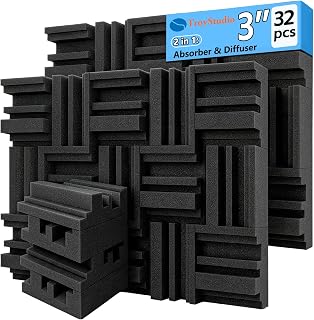
TroyStudio Thickened Foam Panels — Diffusion Pattern, 32 Pcs
These are thick foam tiles cut into a surface texture that mimics diffusion while actually absorbing broadband energy. That means they will tame a live room fast, but they will not scatter reflections in the way a true diffuser does. If your problem is slap-back and harshness rather than a dry or uneven response, these solve it efficiently at a reasonable price per square foot.
- Three-inch thickness provides real absorption capacity
- Thirty-two pieces cover a large wall in one purchase
- Texture is visual only — the acoustic behavior is absorptive, not diffusive
Skip these if you already have absorption on your front wall and need the rear wall to stay lively.
TroyStudio Hexagon Acoustic Diffuser Panels — Black PVC, 12 Pcs
These are rigid PVC panels with a hexagonal relief pattern. The 0.9-inch depth is shallow enough that they function more as early-reflection scatterers at higher frequencies than as true broadband diffusers. Their real strength is installation simplicity — the panels snap or adhere flat and look clean against any wall. For a side-wall application in a smaller room, they add subtle spatial character without eating energy.
- Rigid PVC holds shape over time unlike soft foam
- Hexagonal pattern looks intentional and modern
- Shallow depth limits diffusion to higher frequencies only
Skip these if your room sounds boomy in the bass-to-low-mid range, because they will not address that problem.
TroyStudio Acoustic Diffuser Panels — Black PVC, 1-inch, 12 Pcs
The one-inch step up from the hexagon version gives a little more geometric depth, which extends the useful diffusion range slightly lower in frequency. Like its sibling, it is a rigid panel that installs cleanly and maintains its profile. For ceilings — where shallow diffusion is more acceptable because first-reflection angles are steeper — this works well as a cost-effective treatment layer that keeps sound open without making the room feel smaller.
- One-inch depth is enough for useful high-frequency scattering
- Flat rigid panels align easily with no warping
- PVC surface reflects some high-frequency energy back harshly if untreated elsewhere
Skip these if you have untreated glass or drywall above and around them, as the combination can create an uneven response.
TroyStudio Thick Foam Panels — 52 Pcs, Groove Pattern
This is the coverage play. Fifty-two two-inch foam tiles give you enough square footage to treat multiple walls or a large rear surface in one box. The groove pattern adds visual texture and a marginal amount of scattering, but the primary function here is broadband absorption. For a room that needs its reverb time pulled down across the board, this is the most economical path to consistent coverage.
- Excellent square-foot-per-dollar ratio for bulk coverage
- Two-inch foam absorbs mid and high frequencies predictably
- The groove is decorative; don’t expect true diffusion behavior
Skip these if your room already sounds too dead, because adding fifty-two absorptive tiles will make it worse.
Foroomaco Waffle Acoustic Diffuser Panels — White, 4-Piece Kit
Acoustically identical to the black version in everything that matters — same EVA material, same QRD geometry, same thickness. The white finish is the real differentiator, making these appropriate for light-colored rooms where black panels would create unwanted visual contrast. For dedicated home theaters with gray or white walls, this kit delivers the same scattering performance without breaking the room’s aesthetic continuity.
- Same proven QRD geometry as the black variant
- White EVA blends with bright interiors without visual distraction
- Limited to four pieces per kit — coverage requires buying multiples
Skip these if your room uses dark finishes, because the white will stand out and pull attention to the treatment.
Acoustic Diffuser Wall Art — Black, 9 Pieces
This is the standout performer of the group by a clear margin. The two-inch depth combined with a more complex surface geometry produces genuine phase scattering across a wider frequency band than anything else here. The nine-piece format is flexible enough to arrange asymmetrically, which itself helps break up parallel-surface problems. The rating of 4.6 reflects that listeners consistently report improved imaging and a more open rear wall after installing these. The price is higher, but the acoustic return scales with the investment.
- Widest effective diffusion range due to deeper, more varied geometry
- Includes mounting tape and asymmetric layout flexibility
- Higher cost per square foot than any foam or PVC option here
Skip these only if your budget is under seventy dollars or if your room primarily needs absorption rather than scattering.
TroyStudio Hexagon Acoustic Diffuser Panels — White PVC, 12 Pcs
The white counterpart to the black hexagon panels — same geometry, same shallow 0.9-inch depth, same rigid PVC construction. Where this wins is in rooms with light walls, ceilings, or open-concept layouts where a dark treatment would look industrial. For a home office that doubles as a casual listening space, these provide a subtle high-frequency scattering layer while reading as intentional wall decor rather than studio equipment.
- Clean white finish integrates into residential interiors naturally
- Rigid PVC resists dents and holds alignment over years
- Shallow depth means minimal acoustic effect below 2 kHz
Skip these if you need to fix a measurable flutter echo between walls, because the geometry is too shallow to address it meaningfully.
Buying Guide
Geometric Depth Determines What Frequencies You Actually Diffuse
Surface variation must be at least half a wavelength deep to scatter a given frequency effectively. A quarter-inch texture does nothing useful below several kilohertz. Two inches or more extends meaningful scattering down into the upper bass and low-mid range where most home theater rooms have their worst problems. When comparing panels, look at the physical relief height, not just the overall panel thickness, because a three-inch foam tile with a half-inch groove is functionally shallower than a two-inch EVA panel with a full-inch cavity.
Material Choice Changes Whether You Absorb or Reflect
Open-cell foam and dense EVA tend to absorb mid and high frequencies when sound hits them, which means a foam “diffuser” often reduces reflections rather than scattering them. Rigid PVC and hard composite surfaces reflect more energy, which is what you want if your goal is to preserve liveliness while breaking up flutter. If your room already sounds dry or lifeless, avoid absorptive materials and lean toward the rigid panels. If your room is bright and harsh, foam panels with texture give you the energy reduction you need even if they are not true diffusers.
Coverage Area and Placement Matter More Than Panel Count
Three well-placed diffusers on first-reflection points outperform forty random tiles on a wall. Calculate the actual square footage of treatment you are buying, not the number of pieces. A four-panel kit covering roughly eight square feet can outperform a thirty-two-pack if the four panels are on the right spots and the geometry is deeper. Prioritize the side-wall primary reflection points first, then the rear wall, then the ceiling if you have untreated flat surfaces.
Our Verdict
The Acoustic Diffuser Wall Art is the top pick for anyone serious about balanced sound, because its geometry actually scatters across a useful frequency band and its rating reflects real listener results. The TroyStudio Thick Foam 52-Pack wins on budget coverage if your room simply needs energy control at the lowest cost per square foot. However, if you have a dedicated theater with dark walls and need QRD-style diffusion specifically, the Foroomaco Waffle kits deliver that architecture at a fraction of the premium option’s price.
FAQ
Do diffuser panels stop sound from leaving the room?
No. Diffusers scatter internal reflections to improve tonal balance within the space. They do not block sound transmission through walls or windows, so if isolation is your goal you need mass-loaded barriers, not decorative tiles.
How many panels do I need for a small home theater?
Start with the two primary side-wall reflection points and one rear-wall zone. That is roughly eight to twelve square feet of treatment. From there, add more based on whether the room sounds too bright or too uneven at your listening position.
Can I mix diffusers and absorbers in the same room?
Yes, and most properly treated rooms do both. Use absorbers where you need to remove energy — typically the front wall and corners — and diffusers where you want to preserve liveliness while breaking up flutter, usually the side walls and rear wall.
Is the difference between PVC panels and EVA panels noticeable?
In small rooms with flat surfaces, yes. EVA is slightly compliant and absorbs a tiny fraction of incident energy, while PVC reflects more consistently. If your room is already overly bright, the EVA absorption helps. If your room sounds flat, the rigid PVC keeps more energy in the space.